Non-Domestic Microgen Grant 2026: Up to €325,200 at the Enhanced 45% Rate
From 6 October 2026 the Non-Domestic Microgen Grant pays up to €325,200 — an effective 45% of eligible cost — for nine months. Here is how it works, who qualifies and how to apply.
By Smart Solar Editorial · Updated 4 November 2026 · 8 min read
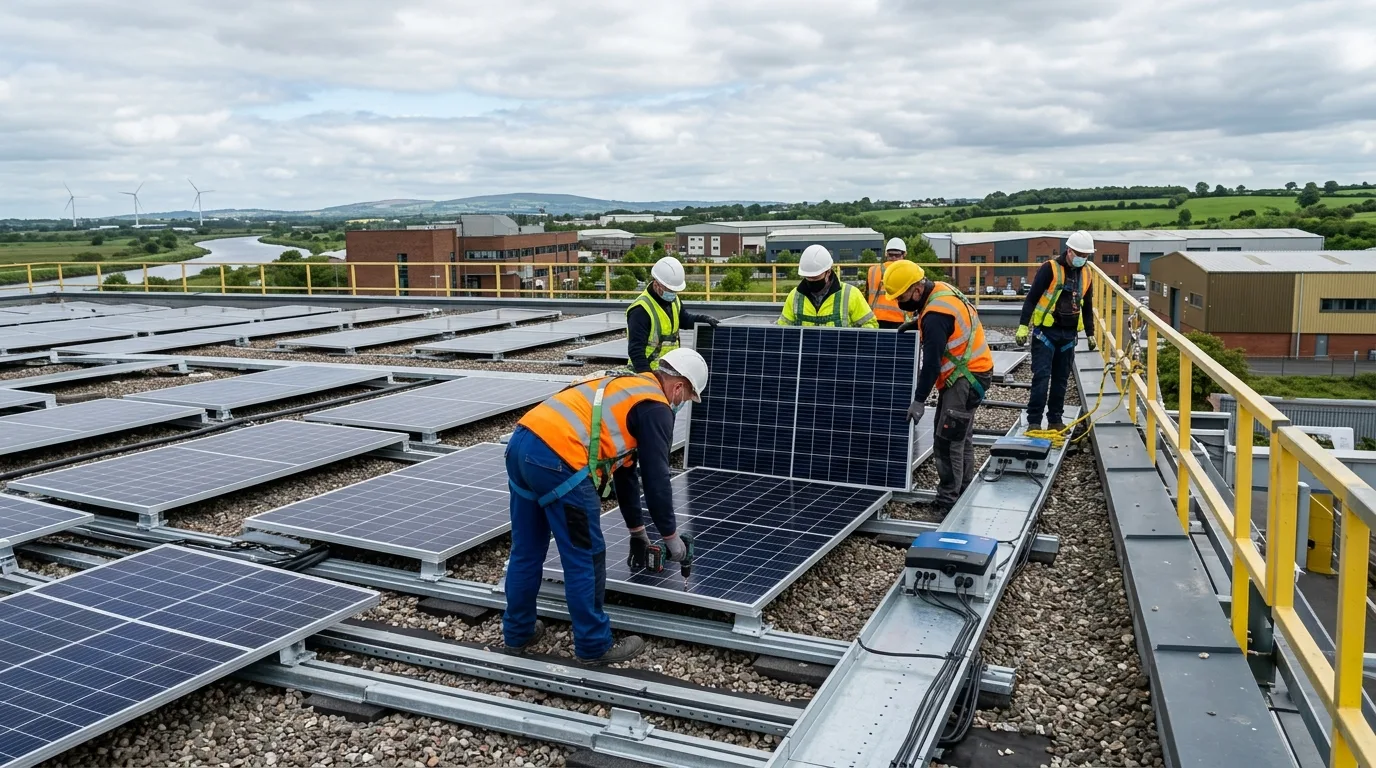
The Non-Domestic Microgen Grant (NDMG) is SEAI's grant for solar PV on business premises, farms, schools, community centres and non-profits. Since it launched in 2022 it has supported 3,160 installations worth over €33 million. On 29 September 2026 the Government approved a temporary increase, and from 6 October 2026 to 6 July 2027 the grant is worth an effective 45% of eligible costs, up to €325,200 per site — double the previous maximum of €162,600.
For the full picture — rates, calculator, deadlines and heat pump and solar thermal grants — see our SEAI business grants hub.
What the grant covers
The NDMG part-funds the design, purchase and installation of a solar PV system — modules, inverters, mounting, cabling, metering and commissioning — for systems up to 1,000 kWp. It does not fund batteries or other supplementary elements outside the standard solar PV system; keep those on a separate invoice.
How much you can claim (enhanced rates)
| Solar PV system | Grant value |
|---|---|
| 1 kWp | €1,800 |
| 2 kWp | €3,600 |
| 3 kWp | €4,200 |
| 4–6 kWp | €4,800 |
| 7–20 kWp | €600 per kWp |
| 21–200 kWp | €400 per kWp |
| 201–1,000 kWp | €300 per kWp |
The bands are cumulative. Examples from SEAI's Application Guide: 30 kWp = €17,200, 100 kWp = €45,200, 200 kWp = €85,200, 500 kWp = €175,200 and 1,000 kWp = €325,200 (the maximum). Systems over 1,000 kWp receive the maximum for the first 1,000 kWp.
On completion SEAI pays the lower of the band value and 45% of your invoiced eligible cost — the state-aid ceiling. Competitively priced systems receive exactly 45%; more expensive ones receive the band value. See will your business actually get 45%?
Eligibility in brief
- Businesses, the agricultural sector, public sector bodies, schools, community centres and non-profit societies
- Premises in the Republic of Ireland, built and occupied on or before 31 December 2024 under SEAI's current terms
- No BER is required — SEAI's Application Guide says applicants do not need an existing BER or a new one after the works
- One system per MPRN; a domestic MPRN can qualify if it supplies a registered business
- The system must be sized for self-consumption, not export only
- No other State grant on the same installation, and no previous SEAI solar support for it
- An SEAI-registered Non-Domestic Microgen company and installer, with Safe Electric certification
The full list is in our eligibility checklist.
How to apply
- Get quotes from SEAI-registered Non-Domestic Microgen (Solar PV) companies and agree a formal contract with one.
- Apply online yourself — the business owner or authorised signatory applies; the company cannot apply on your behalf.
- Wait for your letter of offer. Do not buy materials or start work before it arrives — costs incurred before approval are ineligible.
- Your installer applies to ESB Networks — at least four weeks (20 working days), before installation.
- Install, then pay the company in full.
- Your company uploads the completion documents — Declaration of Works, commissioning certificate, Safe Electric Certificate 3, ESB Networks paperwork, invoice and photos.
- SEAI pays by electronic transfer, typically four to six weeks after all documents are received.
Offers are valid for eight months. If you will receive more than €10,000 in public grants in a calendar year you need a Tax Clearance Certificate. Our step-by-step guide covers each stage.
Existing applications
SEAI states that existing applications will not be increased to the enhanced rate, because grandfathering is not permitted under state-aid rules, and that applicants who have started works cannot seek a higher amount.
NDMG vs EXEED
The NDMG and EXEED cannot both fund the same installation — SEAI lists EXEED among the schemes whose prior solar support makes an installation ineligible for the NDMG. For a standalone solar project the NDMG is usually simpler. EXEED is designed for larger capital projects built around a certified energy-efficient design process, so it can suit very large PV systems that form part of a wider energy upgrade; compare both with your installer.
Bottom line
During the nine-month enhanced window the Non-Domestic Microgen Grant is the most generous it has ever been. It needs no BER and pays a simple, predictable per-kWp amount — but only for new applications, and only if nothing is bought or installed before your offer arrives.
Get 3 free commercial solar quotes — free and no obligation.
Frequently asked questions
How much is the Non-Domestic Microgen Grant in 2026?
From 6 October 2026 to 6 July 2027, up to €325,200 per site: €4,800 for 4–6 kWp, then €600/kWp to 20 kWp, €400/kWp to 200 kWp and €300/kWp to 1,000 kWp, capped at 45% of the invoiced eligible cost.
Does my building need a BER to qualify?
No. SEAI's Application Guide states that applicants are not required to have an existing BER certificate or to complete one after the supported works.
Can my installer apply for the grant on my behalf?
No. The applicant — the business owner or authorised signatory — applies online. SEAI's terms say neither the company nor an assessor may apply on your behalf, though your company uploads the completion documents.
Can I stack the Non-Domestic Microgen Grant with EXEED or TAMS?
Not on the same installation. The NDMG cannot be cumulated with any other Irish Government or State agency grant, and installations previously supported under another SEAI solar scheme such as EXEED are ineligible.
How long does the process take?
Once you have an offer you have eight months to complete the works. The ESB Networks application takes at least four weeks, and SEAI typically pays four to six weeks after all completion documents are uploaded.