Cost of Commercial Solar in Ireland: 2026 Price Benchmarks
What does a 200 kWp system actually cost in Ireland in 2026? Full price benchmarks by size, with grant impact and the line items that drive variance.
By Smart Solar Editorial · Updated 4 November 2026 · 11 min read
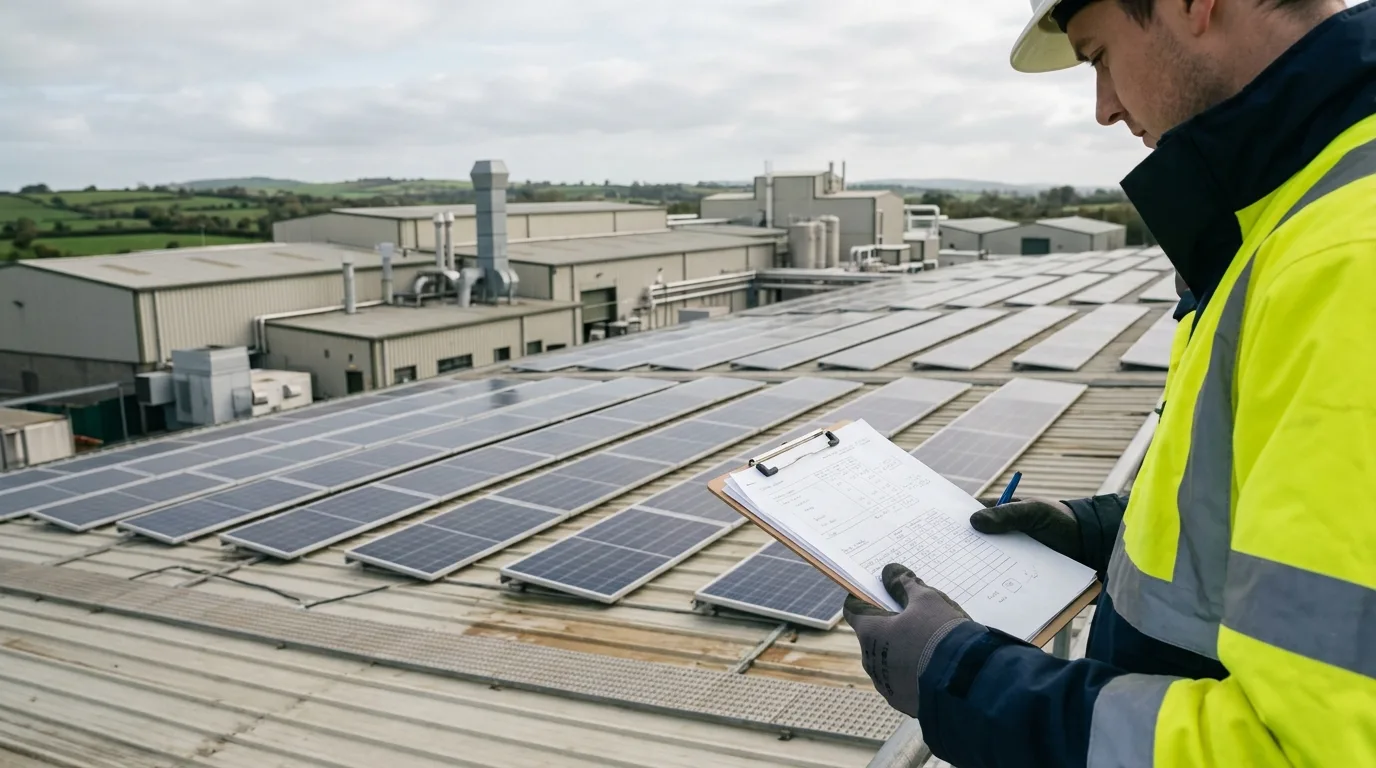
Commercial solar pricing in Ireland has stabilised in 2026 after a turbulent 2022-2024. Module costs have bottomed out, structural steel has softened, and labour has settled into a manageable inflation curve. This article gives the up-to-date €/kWp ranges by system size, breaks down where the money actually goes, and explains why two quotes for the same kWp can differ by 30%.
Headline 2026 prices
These ranges assume turnkey EPC delivery, including design, structural sign-off, modules, inverters, AC and DC works, basic commissioning, NC7 application support, and a 25-year module warranty. They are ex VAT. A commercial building is not zero-rated: Revenue's Tax and Duty Manual on solar panels (last reviewed May 2025) allows the reduced rate (13.5%) on a supply-and-install contract if the goods are no more than two-thirds of its value, and the standard rate (23%) otherwise. A VAT-registered business can normally reclaim the VAT it is charged.
- 50 kWp rooftop: €60,000 - €85,000 (€1,200 - €1,700/kWp)
- 100 kWp rooftop: €110,000 - €145,000 (€1,100 - €1,450/kWp)
- 200 kWp rooftop: €180,000 - €260,000 (€900 - €1,300/kWp)
- 500 kWp rooftop or ground-mount: €420,000 - €580,000 (€840 - €1,160/kWp)
- 1 MWp ground-mount: €750,000 - €1,100,000 (€750 - €1,100/kWp)
The downward trend with size reflects fixed cost amortisation - design, mobilisation, scaffold and connection costs do not scale linearly with kWp.
Where the money goes: a 200 kWp breakdown
For a 200 kWp rooftop on a standing-seam metal roof in 2026, the rough cost split looks like:
| Line item | % of total | €/kWp |
|---|---|---|
| Modules | 14-18% | €170-€220 |
| Inverters | 7-10% | €85-€120 |
| Mounting and clamps | 6-8% | €75-€100 |
| DC cabling and combiners | 4-6% | €50-€75 |
| AC cabling, isolators, RCBOs | 6-8% | €75-€100 |
| Switchgear and protection | 4-6% | €50-€75 |
| Civils, access, scaffold | 5-8% | €60-€100 |
| Labour (install) | 15-20% | €180-€260 |
| Design and structural sign-off | 4-6% | €50-€75 |
| Project management and HSE | 6-9% | €75-€110 |
| NC7 and DSO charges | 3-5% | €40-€65 |
| Commissioning, monitoring | 2-3% | €25-€40 |
| EPC margin and contingency | 8-12% | €100-€150 |
The single line item that varies most between quotes is the labour figure, driven by roof type (trapezoidal vs standing-seam vs ballasted), site access, working-at-height rescue plans and how much sub-contracting the EPC does.
How the Non-Domestic Microgen Grant changes the picture
The SEAI Non-Domestic Microgen Grant (NDMG) pays per kWp on a cumulative sliding scale. For applications made from 6 October 2026 to 6 July 2027 the enhanced bands are:
- First 6 kWp: €4,800 in total
- 7-20 kWp: €600/kWp
- 21-200 kWp: €400/kWp
- 201-1,000 kWp: €300/kWp
The maximum is €325,200 at 1,000 kWp, and SEAI pays the lower of the band value and 45% of eligible cost. Applied to the price benchmarks above, this typically reduces the net capex by roughly 30-45%. Try your numbers in the SEAI business grant calculator.
What makes a 200 kWp quote €180k vs €260k?
The same nominal system can come in at very different prices depending on:
- Roof type and condition. Standing-seam (cheapest), trapezoidal with hooks (mid), asbestos requiring removal (expensive), slate (most expensive).
- Module selection. Mid-market Jinko or JA Solar TOPCon at €0.11/Wp versus premium REC Alpha Pure-R at €0.18/Wp.
- Inverter strategy. A single Huawei SUN2000-100KTL versus two SolarEdge SE100K with optimisers.
- DC architecture. String inverter (cheap) versus optimised (premium) versus microinverter (premium plus).
- Cable routing. A 40 m run from PV to switchroom versus a 300 m run with civils.
- NC7 complexity. A simple existing supply versus needing a transformer upgrade or a new MV cubicle.
- EPC overhead. Top-tier names like Activ8 Solar Energies, Enerpower, Mercury Engineering or ESB Smart Energy Services carry higher overheads but greater bonding and reference depth.
Reading a quote like a CFO
Insist that every quote presents:
- €/kWp ex VAT and inc VAT.
- Line-item breakdown (at least to the level above).
- PVGIS yield estimate with assumed performance ratio.
- NC7 cost estimate (separate or included).
- O&M cost for years 1-5 and 6-25.
- Warranty matrix: module, inverter, structural, workmanship.
- Indicative grant amount (if SEAI-registered).
If a quote arrives as a single number with no breakdown, send it back.
Common cost surprises
- Scaffold. A 200 kWp roof can need €15k-€30k of scaffold or MEWP hire. Not always quoted upfront.
- Roof reinforcement. A 10-year-old metal roof might need new fixings or sub-purlin reinforcement at €10-€30/m².
- Asbestos removal. €40-€90/m² with licensed contractor. Mandatory if existing roof contains asbestos.
- Transformer upgrade. €30k-€150k if MIC needs to be increased to accept export.
- Monitoring contract. Free for year 1, then €500-€1,500/year ongoing for many platforms.
- Insurance. Many insurers re-rate buildings with PV installed; budget €1,000-€2,500/year extra.
What about asset finance and PPAs?
Many Irish commercial solar projects in 2026 use blended financing:
- 25-40% balance-sheet capex
- 40-60% asset finance from AIB, Bank of Ireland, Finance Ireland or BNP Paribas Leasing
- 0-30% supplier credit or grant
A 60-month asset finance deal at 6.5-8% APR typically adds 8-12% to total project cost over the term but preserves working capital.
For larger sites with strong covenants, on-site PPA structures eliminate capex entirely in exchange for a 15-25 year offtake commitment at 11-16 c/kWh.
Common pitfalls in commercial solar pricing
Watch for these recurring traps in 2026 quotes:
- "Grant already deducted" headline pricing. Some EPCs quote the net-of-grant figure as the headline number. The SEAI grant is paid to you after commissioning, not netted from the contractor's invoice — meaning you front 100% of capex and reclaim later. Cashflow timing impacts roughly 4–8 weeks of working capital on a €200k project.
- Provisional NC7 cost left blank. A line that says "ESB Networks charges at cost" can swing €5k–€80k. Always insist the EPC obtains a formal ESB Networks NC7 offer letter before contract sign — typical lead time 10–14 weeks for sub-200 kVA, longer for MV.
- Optimistic performance ratio. Pricing built on a PR of 0.88+ produces lower €/kWh business case numbers but rarely materialises in Irish conditions. Recalculate IRR using PR 0.82 — if the project still works, it is robust; if it collapses, the headline number was finance-engineering.
- Excluding decommissioning. A 25-year asset will eventually be removed. Budget €40–€70/kWp at end-of-life. Best-in-class lenders now require this in financial models for sites going through CSRD reporting.
Bottom line
A well-procured 200 kWp Irish commercial rooftop in 2026 costs €200k-€235k turnkey. After the Non-Domestic Microgen Grant and ACA tax relief, net cash outlay typically lands around €115k-€140k for a system that saves €40k-€55k per year. That is why the queue at SEAI is what it is.
Get 3 free commercial solar quotes — free and no obligation.
Frequently asked questions
How much does a 100 kWp commercial solar system cost in Ireland?
Expect €110,000-€145,000 ex VAT turnkey before grant in 2026. After the Non-Domestic Microgen Grant and ACA tax relief, net cash outlay typically falls to €55,000-€90,000.
Why do commercial solar quotes vary so much for the same kWp?
The main drivers are roof type and condition, module and inverter selection, cable run length, NC7 complexity and EPC overhead. Always insist on a line-item breakdown to compare like-for-like.
What is included in a turnkey commercial solar price?
Design, modules, inverters, mounting, DC and AC cabling, switchgear, structural sign-off, NC7 application, commissioning and basic monitoring. Scaffold, roof reinforcement and transformer upgrades are sometimes separate.
Are commercial solar prices still falling in 2026?
Module prices have largely bottomed. Inverter and structural steel pricing has stabilised. Labour and project management are slowly inflating. Net effect is broadly flat 2026 pricing with modest 2-4% annual movement either way.