Non-Domestic Microgen Grant Rates 2026: Every Band, Worked Examples & Calculator
Exactly how SEAI calculates the enhanced business solar grant — the band table, how the bands stack, worked examples from 7 kWp to 1 MWp, and a calculator that applies the 45% cost cap.
By Smart Solar Editorial · Updated 4 November 2026 · 7 min read
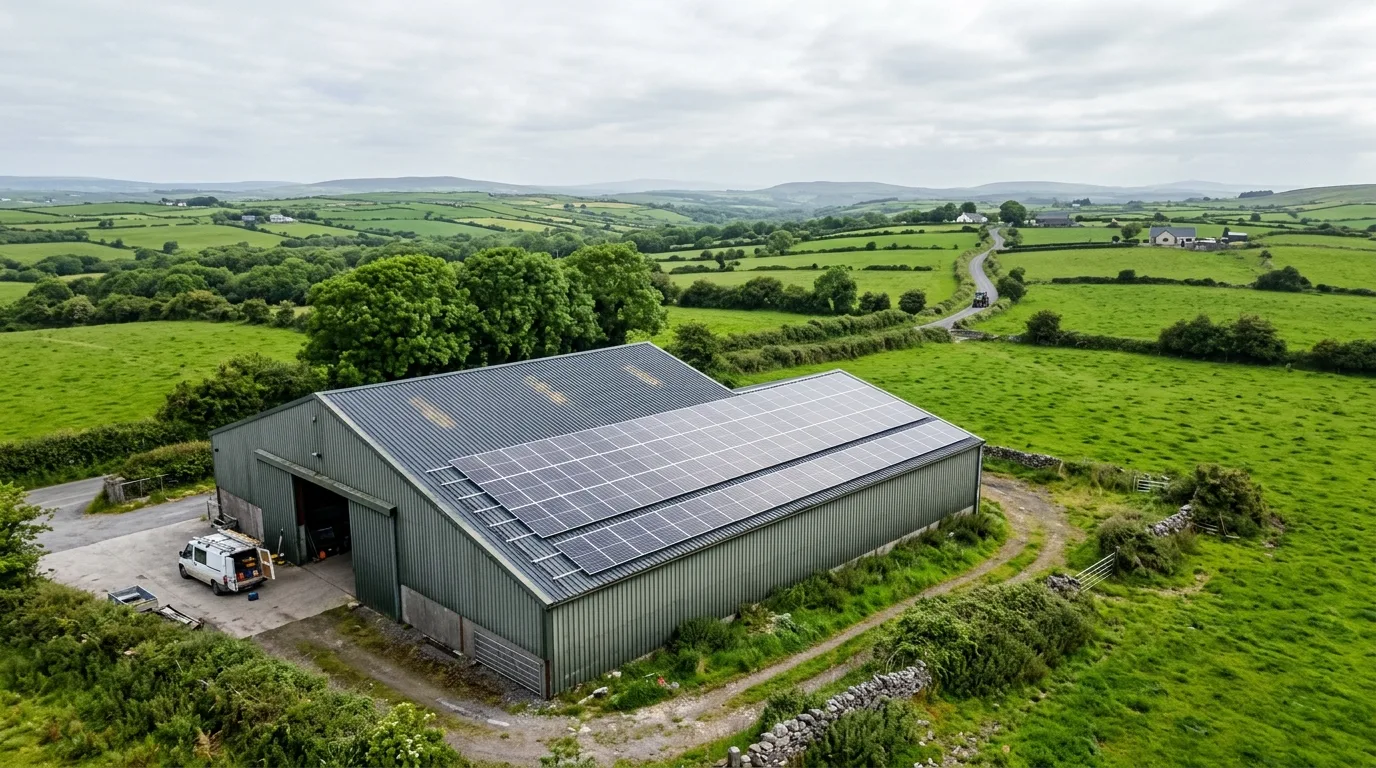
The SEAI Non-Domestic Microgen Grant (NDMG) is a "commoditised" grant: you get a fixed amount per kWp of solar PV installed, not a percentage of whatever you spend. From 6 October 2026 every one of those per-kWp values has doubled for a nine-month window. This page shows the full table, how it adds up, and the one extra rule — the 45% cost cap — that decides what you are actually paid.
The enhanced rate table
These are the values SEAI publishes for applications made in the enhanced window (6 October 2026 – 6 July 2027):
| Solar PV system size | Grant value |
|---|---|
| 1 kWp | €1,800 |
| 2 kWp | €3,600 |
| 3 kWp | €4,200 |
| 4 kWp | €4,800 |
| 5 kWp | €4,800 |
| 6 kWp | €4,800 |
| 7 – 20 kWp | €600 per kWp |
| 21 – 200 kWp | €400 per kWp |
| 201 – 1,000 kWp (1 MWp) | €300 per kWp |
| Above 1,000 kWp | No additional support — maximum €325,200 |
kWp (kilowatt peak) is the standard test output of the panels. SEAI's own rule of thumb: a typical 30 kWp system is about 75 panels covering roughly 125 m².
How the bands stack
The bands are cumulative, like income tax bands. Each kWp is paid at the rate of the band it falls into:
- The first 6 kWp earn €4,800 in total.
- Each kWp from 7 to 20 adds €600 — so 20 kWp = €4,800 + (14 × €600) = €13,200.
- Each kWp from 21 to 200 adds €400 — so 200 kWp = €13,200 + (180 × €400) = €85,200.
- Each kWp from 201 to 1,000 adds €300 — so 1,000 kWp = €85,200 + (800 × €300) = €325,200.
Worked examples (SEAI's own figures)
| System size | Enhanced grant | Previous grant |
|---|---|---|
| 7 kWp | €5,400 | €2,700 |
| 15 kWp | €10,200 | €5,100 |
| 20 kWp | €13,200 | €6,600 |
| 30 kWp | €17,200 | €8,600 |
| 50 kWp | €25,200 | €12,600 |
| 100 kWp | €45,200 | €22,600 |
| 200 kWp | €85,200 | €42,600 |
| 300 kWp | €115,200 | €57,600 |
| 400 kWp | €145,200 | €72,600 |
| 500 kWp | €175,200 | €87,600 |
| 1,000 kWp | €325,200 | €162,600 |
The 45% rule that decides your payment
When the work is finished you submit an invoice, and SEAI pays the lower of:
- the value on your application summary (the band value above), or
- 45% of the invoiced eligible cost.
That second limit is the maximum aid intensity allowed under EU state-aid rules (GBER Article 41). It means a very cheap system can't collect a band value larger than 45% of what it cost — and an expensive system can't collect more than its band value, however much it cost. Plug in your size and quote:
As a rule of thumb, you receive exactly 45% when your price per kWp is at or below these break-even points, and the band value (a lower percentage) above them:
| System size | Band value | Price at which you get exactly 45% |
|---|---|---|
| 10 kWp | €7,200 | €1,600/kWp or less |
| 30 kWp | €17,200 | €1,274/kWp or less |
| 50 kWp | €25,200 | €1,120/kWp or less |
| 100 kWp | €45,200 | €1,004/kWp or less |
| 200 kWp | €85,200 | €947/kWp or less |
| 500 kWp | €175,200 | €779/kWp or less |
| 1,000 kWp | €325,200 | €723/kWp or less |
We go deeper on this in Will your business actually get 45%?
What counts as an eligible cost
Eligible costs are the total investment costs of the solar PV installation — materials and labour for the modules, inverters, mounting, cabling, metering and commissioning. Two important exclusions:
- Batteries and other supplementary elements outside the standard solar PV system are not eligible. Keep them on a separate invoice.
- Self-installs by installers. If a registered company or installer is fitting the system on its own premises, only materials count — not labour.
Sizing tips that protect your grant
- Size to your daytime demand, not your roof. The scheme is for self-consumption. A system that mostly exports earns less per kWh and invites questions.
- Systems over 1 MWp can still apply, but receive the €325,200 maximum for the first 1,000 kWp only.
- The €300/kWp band is still meaningful. Going from 200 kWp to 300 kWp adds €30,000 of grant — worth it if the extra generation is consumed on site.
- Get the kWp right on the application. SEAI pays the lower of your application value and 45% of the invoice, so under-declaring the size on the application caps your grant even if you install more.
Who pays you, and when
SEAI pays by electronic transfer once your installer has uploaded all the completion documents — typically four to six weeks after the last document arrives, longer if your site is selected for inspection. If you receive more than €10,000 in public grants in a calendar year you will need a valid Tax Clearance Certificate.
Get 3 free quotes from SEAI-registered installers — free and no obligation.
Frequently asked questions
How much is the Non-Domestic Microgen Grant per kWp?
From 6 October 2026: a flat €4,800 for 4–6 kWp, then €600 per kWp from 7 to 20 kWp, €400 per kWp from 21 to 200 kWp and €300 per kWp from 201 to 1,000 kWp. The bands are cumulative.
How much grant will a 50 kWp business solar system get?
€25,200 under the enhanced rates, provided that is not more than 45% of the invoiced eligible cost. Before the enhanced window it was €12,600.
Is the grant paid on the kWp I apply for or the kWp I install?
SEAI pays the lower of the value on your application summary and 45% of the invoiced cost, so the application value acts as a ceiling. Make sure the kWp on the application matches the system you contract for.
Is there a minimum system size?
SEAI's rate table starts at 1 kWp, so there is no meaningful minimum. Most business systems are 10 kWp or larger.
Can a 2 MWp system get more than €325,200?
No. Systems above 1,000 kWp are eligible to apply but receive the maximum grant of €325,200 for the first 1,000 kWp.