Commercial Solar PV in Ireland: The 2026 Buyer's Guide
Everything Irish businesses need to know in 2026: grants, prices, ESB connections, export tariffs and how a 200 kWp rooftop typically pays back in 4-6 years.
By Smart Solar Editorial · Updated 4 November 2026 · 11 min read
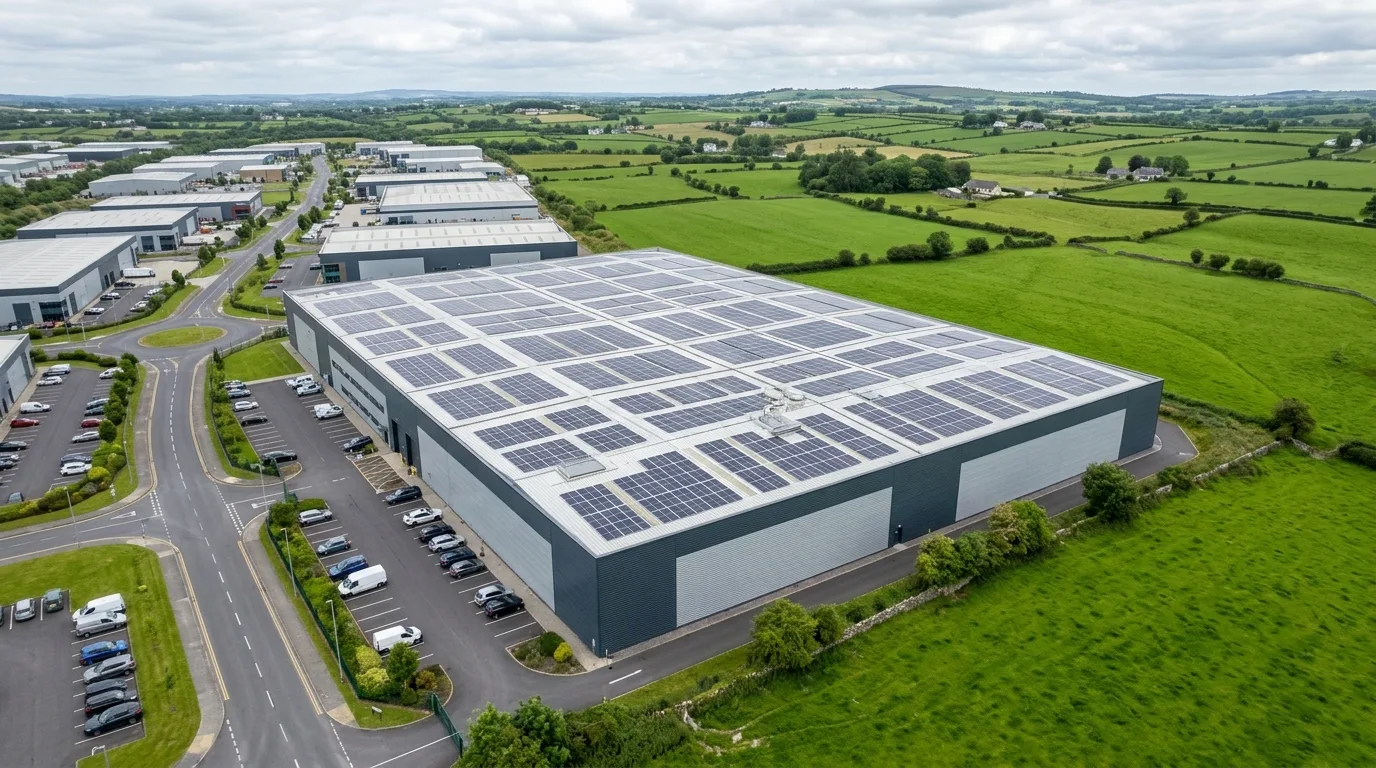
Commercial solar PV in Ireland has moved from a niche sustainability project to a mainstream financial decision. With electricity prices for non-domestic users still hovering around 25-32 c/kWh in 2026, a well-designed rooftop or ground-mount system can cut a site's grid import by 40-70% and pay itself back inside six years. This 2026 buyer's guide explains how Irish commercial solar actually works: what it costs, which grants apply, how to size a system to your load, and what to expect from ESB Networks.
Why 2026 is a strong year to invest
Three things have aligned. First, panel prices have stabilised after the 2024-2025 reset, with tier-1 modules from Jinko Tiger Neo, Trina Vertex, JA Solar and Longi Hi-MO landing in Ireland at €0.10-€0.14/Wp wholesale. Second, the SEAI Non-Domestic Microgen Grant has been doubled to an effective 45% — up to €325,200 — for applications made between 6 October 2026 and 6 July 2027, and a VAT-registered business can normally reclaim the VAT charged on the project. Third, the Microgeneration Support Scheme (MSS) Clean Export Guarantee tariff for non-domestic exporters is paying roughly 13-15 c/kWh in 2026, which makes any over-generation a useful revenue stream rather than a wasted electron.
How big a system do you actually need?
The fastest way to estimate is to take your annual electricity consumption from your supplier bill, divide by 950 (the typical Irish commercial PVGIS yield in kWh/kWp), and then multiply by your expected self-consumption ratio.
- A bakery using 250,000 kWh/year with 80% daytime load could justify around 210 kWp.
- A cold store running 24/7 at 600,000 kWh/year could comfortably take 500-600 kWp.
- A 9-5 office at 80,000 kWh/year is usually capped at 50-70 kWp.
Going larger than your daytime load only makes sense if you can either store energy in batteries, sign a private wire arrangement with a neighbour, or accept the lower MSS export rate.
Realistic 2026 prices
Irish commercial solar prices have settled into reasonably predictable bands once you include design, structural surveys, DC and AC works, NC7 application support, commissioning and a 25-year module warranty.
- 50 kWp rooftop: €60,000 - €85,000 ex VAT
- 200 kWp rooftop: €180,000 - €260,000 ex VAT
- 500 kWp rooftop or ground-mount: €420,000 - €580,000 ex VAT
- 1 MWp ground-mount: €750,000 - €1,100,000 ex VAT
The wide range reflects roof type (standing-seam vs trapezoidal vs concrete vs slate), ballast requirements, distance to the main switchboard, and whether the project needs a new ESB Networks transformer.
Grants and tax reliefs
There are three financial levers that change a commercial solar business case in Ireland.
- SEAI Non-Domestic Microgen Grant (NDMG). For applications made from 6 October 2026 to 6 July 2027, pays an effective 45% of eligible cost — up to €325,200 — for PV up to 1,000 kWp. No BER is required, and the works must use an SEAI-registered company. See our SEAI business grants hub.
- EXEED Certified Grant. For larger or more strategic energy projects, SEAI's EXEED scheme can pay up to 30% of project costs, capped at €3 million, when the works are part of a structured ISO 50001-style energy programme.
- Accelerated Capital Allowance (ACA). Revenue allows 100% write-off in year one of qualifying energy-efficient equipment including solar PV. For a profitable Irish company on 12.5% trading rate, this trims roughly €12,500 off every €100,000 invested.
You can stack NDMG with ACA. You cannot usually stack NDMG with EXEED on the same kWp.
ESB Networks NC7 and grid connection
Anything above 11 kW three-phase requires a formal NC7 application with ESB Networks. For systems up to 200 kVA the process is relatively standardised and typically takes 8-14 weeks. Larger systems may need a transformer upgrade, additional protection (G99 settings, vector-shift relays) and a longer offer process. Mini-Generator (MEC) connections above 200 kVA shift to the SCOG/DSO commercial connection track and often require a network study.
Two practical tips:
- Apply for NC7 before you sign the EPC contract. The grid offer is what really sizes your project.
- If your MIC (Maximum Import Capacity) is small, ask ESB Networks whether you can export up to your MIC without an upgrade. This is the cheapest path to a workable system.
Choosing inverters and modules
In 2026, three inverter families dominate Irish commercial sites:
- SolarEdge SE17K to SE100K with power optimisers when the roof is shaded or has multiple orientations.
- Huawei SUN2000-100KTL and the larger 215KTL platform for clean, large rectangular roofs with strong remote monitoring.
- SMA Sunny Highpower and Sungrow SG110CX for utility-scale ground mounts and where European-built kit is preferred.
For modules, REC, Trina Vertex, JA Solar, Longi Hi-MO and Jinko Tiger Neo are the workhorses. N-type TOPCon panels at 440-460 Wp are now standard on commercial roofs.
Who installs it?
The Irish commercial PV ecosystem is mature. Established EPCs and contractors include Activ8 Solar Energies, Enerpower, Powerlink, Solar Electric Ireland, Mercury Engineering, John Sisk and ESB Smart Energy Services, with companies like Verde LED also active on integrated lighting-plus-PV retrofits. Ask for three references on similar-sized projects, a sample SCADA login, and proof of Safe-T and Safe Pass cards on site.
A worked example: 200 kWp on a midlands food producer
- Annual consumption: 1.2 GWh.
- System size: 200 kWp (limited by roof area and daytime load).
- Capex: €235,000 ex VAT.
- NDMG grant: €98,000.
- Net capex after grant: €137,000.
- Year 1 generation: ~190,000 kWh.
- Self-consumption: 85% at 28 c/kWh = €45,220 saved.
- Export: 15% (~28,500 kWh) at 14 c/kWh = €3,990.
- ACA year-1 tax shield: ~€17,000.
- Simple payback: just under 3 years post-grant.
These numbers vary, but the pattern is consistent: a properly sized commercial PV system in Ireland in 2026 will typically pay back in three to six years and deliver an IRR north of 15%.
Next steps
Start with a half-hour bill review and a satellite roof check. If the daytime load is high and the roof is sound, commission a structural survey and an NC7 enquiry in parallel. The cheapest mistake is to skip these two steps and end up redesigning later.
Get 3 free commercial solar quotes — free and no obligation.
Frequently asked questions
How much does a 100 kWp commercial solar system cost in Ireland in 2026?
Expect €110,000 to €145,000 ex VAT for a turnkey 100 kWp rooftop install, before applying the Non-Domestic Microgen Grant which can take up to roughly €50,000 off that figure depending on size and structure.
Do commercial solar PV systems qualify for 0% VAT in Ireland?
No. Revenue's Tax and Duty Manual on solar panels (last reviewed May 2025) applies the zero rate only to private dwellings and recognised schools. On a commercial building, a supply-and-install contract can take the reduced rate (13.5%) if the goods are no more than two-thirds of the contract value; otherwise the standard rate (23%) applies. A VAT-registered business can normally reclaim the VAT it is charged, so ask your installer how the contract is set up and confirm the rate with your accountant.
What is the typical yield for commercial solar in Ireland?
PVGIS data for commercial sites in Ireland generally returns 900-950 kWh/kWp/year for south-facing roofs at a 10-15 degree tilt, with east-west splits losing about 8-12% but improving self-consumption.
Do I need planning permission for commercial solar in Ireland?
Most rooftop systems on commercial buildings are exempt under updated 2023 planning regulations, but ground-mount systems above 50 kW and any installation visible from a protected structure usually require planning permission.
How long does ESB Networks take to approve a commercial solar connection?
NC7 applications up to 200 kVA typically take 8-14 weeks. Larger MEC connections needing a transformer upgrade can take 6-12 months from application to energisation.
Sources & further reading
- Non-Domestic Microgeneration Grant — SEAI
- Supply and installation of solar panels (Tax and Duty Manual, last reviewed May 2025) — Revenue
- ESB Networks: Connecting Generators — ESB Networks
- Microgeneration Support Scheme — Department of the Environment, Climate and Communications
- CRU Clean Export Guarantee decision — Commission for Regulation of Utilities