ESB Networks NC7 Application Guide 2026: Commercial Solar Grid Connection
Every commercial solar project above 11 kW three-phase in Ireland needs an ESB Networks NC7 connection agreement. Here is the 2026 process, timelines, costs and how to avoid the most common rejections.
By Smart Solar Editorial · Updated 15 May 2026 · 10 min read
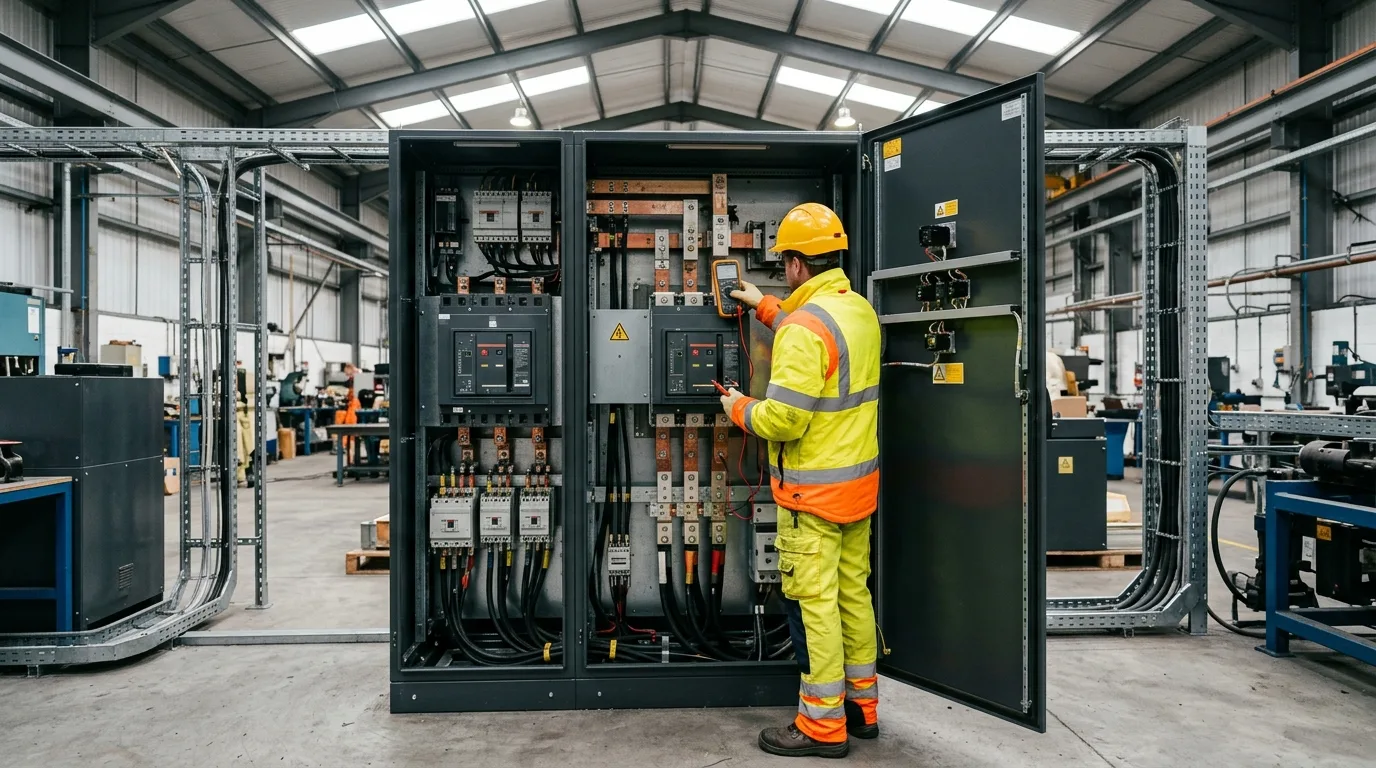
Every commercial solar PV project in Ireland above 11 kW on three-phase supply must be approved by ESB Networks before it can export to the grid. The NC7 application is the formal process. It is also one of the most common reasons commercial solar projects slip - lead times can run from 12 weeks to 9 months depending on grid constraints, and getting the documentation wrong can add months. This guide explains the 2026 NC7 process, timelines, costs, and how to avoid the most common pitfalls.
NC6 vs NC7 vs NC8
ESB Networks uses connection categories to streamline application processing:
- NC6: generation up to 50 kW on LV connections (typically used for small commercial solar 11-50 kW)
- NC7: generation 50 kW to 5 MW on LV or MV connections - the standard category for commercial PV
- NC8: generation above 5 MW, typically utility-scale - sits under EirGrid System Operator processes
In practice, most Irish commercial solar projects (50 kWp to 1 MWp) fall under NC7. Below 50 kW, NC6 applies and the process is lighter. Above 5 MW, the project enters the System Operator queue rather than ESB Networks distribution.
When you need NC7 (and when you do not)
NC7 is required if you are:
- Installing more than 50 kW of generation capacity
- Exporting to the grid (even at low export levels)
- Modifying an existing generator connection
- Adding generation to an existing site with prior generation
NC7 is technically not required if you are:
- Installing a system below 50 kW on three-phase (NC6 applies)
- Installing a system below 11 kW on single phase (NC11 applies)
- Operating fully off-grid with no electrical connection
- Operating fully behind-the-meter with hardwired zero-export
Even in the "non-required" cases, you must notify ESB Networks of any generation connected to their network. Skipping notification is a breach of the Distribution Code and can void your supply contract.
The 2026 NC7 process
The standard pathway:
-
Pre-application enquiry (optional). For projects above 200 kWp, an informal enquiry to ESB Networks can confirm whether grid capacity exists at your substation. Typical response: 2-4 weeks.
-
NC7 application lodged. Either by you, your EPC or a consultant. Submitted online through the ESB Networks portal with full documentation pack.
-
Application acknowledged. Within 5 working days.
-
Technical assessment. ESB Networks runs load-flow studies, harmonic analysis and protection coordination. Typical duration: 8-20 weeks depending on project size and grid complexity.
-
Connection offer issued. Includes connection works required, costs, conditions, and validity period (typically 12 months).
-
Offer accepted and paid. Customer pays connection charge and accepts conditions in writing.
-
Detailed design and construction. Site EPC installs the PV system; ESB Networks executes any grid works in parallel.
-
Pre-energisation testing. EPC submits G99 commissioning test results.
-
Connection energised. ESB Networks installs/programs the export meter and authorises commercial operation.
Total elapsed time from application to first export: typically 4-9 months for a 200 kWp project, longer for sites requiring substation upgrades.
What the documentation pack contains
A complete 2026 NC7 application includes:
- Site location with Eircode and ITM coordinates
- Single-line electrical drawing showing PV array, inverters, protection devices, and existing site infrastructure
- Inverter datasheets with G99/EN 50549-2 compliance certificates
- Protection settings schedule (under/over voltage, under/over frequency, loss-of-mains, anti-islanding)
- Proposed export limit (kW) - critical for sites that must remain non-exporting
- Existing site demand profile (12 months MV90 or supplier data)
- Proposed PV system size in kWp and inverter capacity in kW AC
- Construction timeline
- EPC contact details
Missing documents are the single biggest cause of NC7 delays. Use an EPC with a track record - they keep template packs that ESB Networks accepts without revision rounds.
2026 connection charges
ESB Networks charges are based on the connection works required. Indicative ranges:
- Simple LV connection, no upgrade: €1,500-€4,000
- LV connection with minor reinforcement: €4,000-€20,000
- MV connection (new transformer or HV switchgear): €40,000-€250,000+
- Substation upgrade or new substation: €150,000-€1.5M+
Most Irish commercial rooftop PV under 500 kWp falls in the first two bands. Ground-mount above 1 MWp routinely triggers MV upgrades. Charges are payable on offer acceptance and are not refundable if you cancel.
Export limiting and zero-export
Many commercial sites end up with NC7 conditions that restrict export to a defined kW level or zero. This typically happens when:
- The local network is constrained
- A nearby substation is at capacity
- Voltage rise calculations show that uncapped export would breach EN 50160 limits
If you accept a zero-export connection, you cannot earn the MSS export tariff but you can still self-consume all on-site generation. The economic impact depends on your self-consumption ratio - for sites already exceeding 85% self-consumption, the loss is minimal.
Your inverter must be capable of dynamic export limiting. SolarEdge, Huawei SUN2000, SMA Sunny Tripower CORE and Sungrow SG110CX all support this with the right configuration and current sensor.
Common reasons for rejection or delay
- Voltage rise breach. Long LV cable runs cause >2% voltage rise at peak generation. Mitigation: relocate inverter, increase cable size, or accept export limit.
- Reverse power on existing transformer. Old transformers cannot handle reverse flow. Mitigation: zero-export or transformer upgrade (customer-funded).
- Substation thermal limit. Combined generation in the substation area exceeds rating. Mitigation: queue, accept lower export limit or pay for upgrade.
- Protection coordination issues. Proposed loss-of-mains settings clash with upstream protection. Mitigation: revise inverter settings per ESB Networks engineering advice.
- Incomplete documentation. Missing G99 cert, missing protection schedule, ambiguous SLD. Mitigation: use experienced EPC.
Acceleration tips
- Lodge NC7 the same week you lodge your SEAI Non-Domestic Microgen Grant application
- Pre-enquiry for sites above 200 kWp
- Use an EPC with strong NC7 track record (Activ8, Enerpower, Powerlink, Mercury Engineering all have dedicated grid teams)
- Be flexible on export limit - accepting a 200 kW export cap on a 250 kWp system is often the difference between 4-month approval and 9-month approval
- Respond to ESB Networks queries within 5 working days; delays compound
What changes in 2026
ESB Networks introduced a streamlined commercial small-generator process in late 2024 for systems up to 200 kW with standard configurations. In 2026, this fast-track typically delivers 8-12 week approvals for compliant applications. Projects above 200 kW or in constrained network areas still follow the standard NC7 process.
Bottom line
The ESB Networks NC7 application is the single biggest critical-path item on most Irish commercial solar projects. Apply early, use an experienced EPC, expect 4-9 months for a 200 kWp project, and budget €1,500-€20,000 for connection charges on most rooftop installs. Get this right and the rest of the project flows; get it wrong and you can lose a season of generation.
Get 3 free commercial solar quotes — free and no obligation.
Frequently asked questions
When does a commercial solar project need NC7 approval?
NC7 is required for any generation between 50 kW and 5 MW that connects to or exports to the ESB Networks grid. Below 50 kW NC6 applies; above 5 MW the EirGrid System Operator process applies.
How long does an NC7 application take in 2026?
Typically 4-9 months from application to first export for a 200 kWp project. Fast-track standard applications up to 200 kW can land in 8-12 weeks. Projects in constrained areas or requiring substation upgrades take 9-18 months.
How much does an NC7 connection cost?
From €1,500-€4,000 for simple LV connections with no reinforcement, €4,000-€20,000 for LV connections with minor works, and €40,000-€250,000+ where new MV switchgear or transformer upgrades are required.
What if I cannot get a full export allowance?
Many commercial sites end up with export limits below full inverter capacity. Self-consumption is unaffected. Modern inverters from SolarEdge, Huawei, SMA and Sungrow can dynamically limit export to any defined kW level or zero.
Can I lodge the NC7 myself or do I need an EPC?
Technically you can lodge it yourself, but in practice an experienced EPC delivers a much higher first-time approval rate. Missing documentation is the single biggest cause of NC7 delays.
Sources & further reading
- ESB Networks Generator Connections — ESB Networks
- Distribution Code — ESB Networks
- Conditions Governing the Connection and Operation of Microgeneration — ESB Networks