Grid Code Compliance for Solar in Ireland 2026: Commercial Project Guide
Every commercial solar inverter in Ireland must comply with the relevant grid code. Here is how G99, EN 50549-2 and the Irish Grid Code interact in 2026 and what to insist on in your EPC specification.
By Smart Solar Editorial · Updated 15 May 2026 · 9 min read
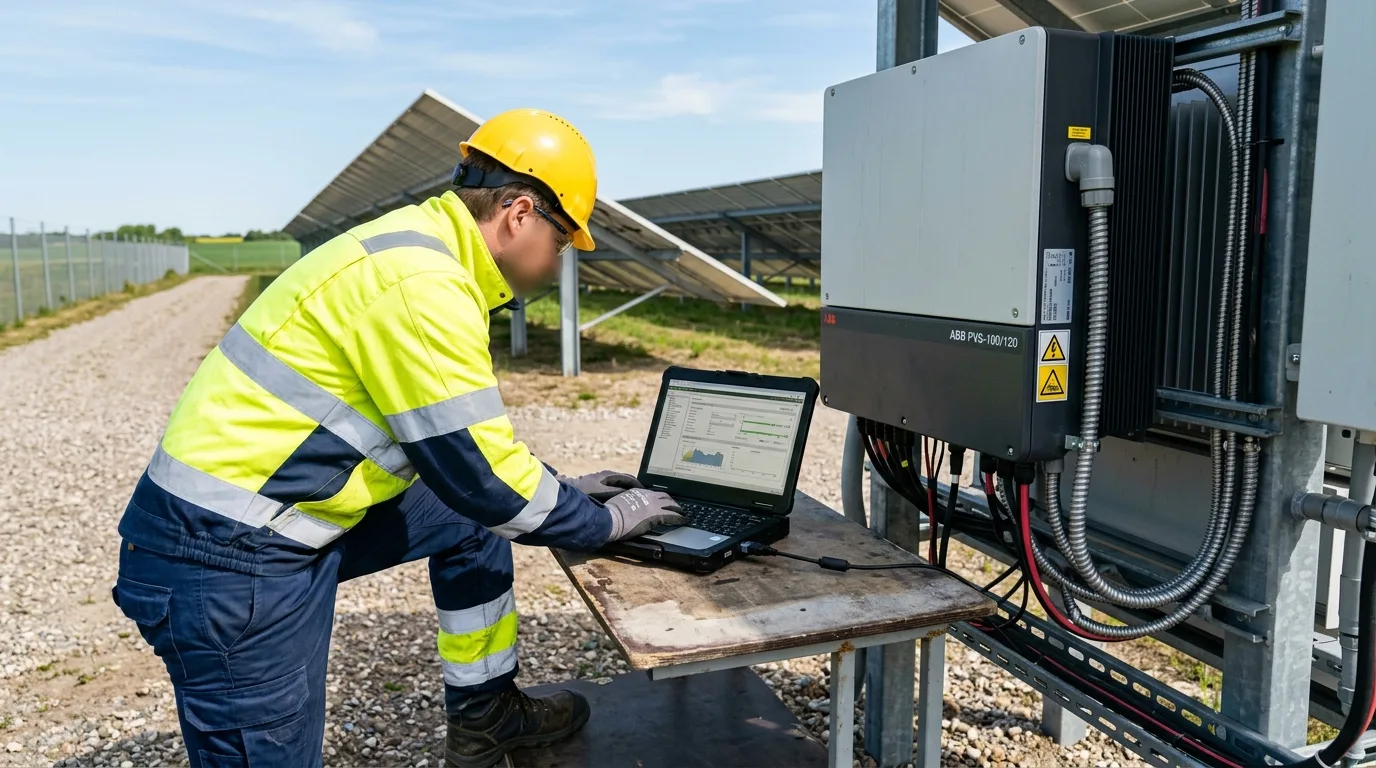
Grid-code compliance is the technical foundation of every commercial solar connection in Ireland. Get it right and your NC7 application sails through; get it wrong and you have an expensive paperweight on your roof. This guide explains how G99, EN 50549-2 and the EirGrid Grid Code interact in 2026, what to specify in your EPC contract, and how to verify compliance at commissioning.
The Irish grid-code landscape
Solar PV connections in Ireland are governed by a stack of overlapping standards and codes:
- EN 50549-2 - the European harmonised standard for generators connecting to the MV network up to 1 MW
- EirGrid Grid Code - the rules for connections to the transmission network (typically above 5 MW or at 110 kV+)
- ESB Networks Distribution Code - the rules for connections to the distribution network (LV and MV up to 110 kV)
- G99 (originally UK ENA Engineering Recommendation G99) - widely referenced in Irish commercial inverter datasheets and accepted by ESB Networks as evidence of equivalent EN 50549-2 compliance
- CRU regulations - the Commission for Regulation of Utilities sets the rules that ESB Networks and suppliers must follow
For a typical Irish commercial solar project (50 kWp to 1 MWp connecting to the distribution network), EN 50549-2 is the primary technical standard, with the ESB Networks Distribution Code defining the connection-specific conditions.
What the inverter must do
Every commercial solar inverter on the Irish grid in 2026 must demonstrate:
- Voltage ride-through. Continue operating through specified voltage dips and rises rather than tripping immediately.
- Frequency response. Adjust active power output in response to grid frequency deviations.
- Reactive power control. Provide reactive power within defined limits to help support local voltage.
- Active power control. Limit or modulate output on command from the network operator.
- Anti-islanding. Detect when the upstream grid is lost and stop exporting within defined timeframes.
- Loss-of-mains protection. Coordinated with upstream protection to avoid nuisance tripping.
- Voltage and frequency protection. Trip if grid parameters move outside safe ranges.
- Quality of supply. Limit harmonic distortion, DC injection, voltage flicker.
For systems above ~250 kW, additional requirements typically apply around fault ride-through, grid-services participation and remote control. For systems above 1 MW connecting at MV, the EirGrid Grid Code's "Type B" or "Type C" Power Generating Module rules kick in.
G99 vs EN 50549-2 in Irish practice
Almost every commercial inverter sold in Europe in 2026 is certified to both G99 (the UK standard) and EN 50549-2 (the European standard). For ESB Networks NC7 applications:
- G99 certification is accepted as evidence of equivalent EN 50549-2 compliance for most parameter sets
- Some Irish-specific parameter overrides apply, particularly on loss-of-mains and frequency response thresholds
- Your EPC must configure the inverter to the ESB Networks Distribution Code parameter set, not the default G99 UK settings
This last point catches many EPCs out. An inverter shipped with default UK G99 settings will pass laboratory certification but may not meet the Irish protection coordination requirements. Always confirm the commissioning engineer has applied the correct Irish parameter set.
ESB Networks Distribution Code parameters
Key Irish-specific parameter settings as of 2026 (always verify against the current ESB Networks publication):
- Over-voltage trip (Stage 1): 230V +10% (253V), trip in 1.5 seconds
- Over-voltage trip (Stage 2): 230V +14% (262.2V), trip in 0.5 seconds
- Under-voltage trip: 230V -15% (195.5V), trip in 2.5 seconds
- Over-frequency trip: 51.5 Hz, instantaneous
- Under-frequency trip: 47.5 Hz, instantaneous
- Loss-of-mains: ROCOF threshold per ESB Networks
- Anti-islanding: detection within 1 second per EN 50549-2
These settings are documented in the ESB Networks "Conditions Governing the Operation of Microgenerators" and similar generator connection documents.
Type A, Type B and Type C generators
Under EN 50549-2 and the EirGrid Grid Code, generators are classified by size:
- Type A: below 1 MW connecting at LV. Most Irish commercial rooftop solar.
- Type B: 1 MW to 50 MW. Larger ground-mount and industrial-scale.
- Type C: 50 MW to 75 MW. Utility-scale (rare for solar at present).
- Type D: above 75 MW. Connected directly to transmission.
Type A inverters must demonstrate basic grid-code compliance through type-testing. Type B and above must additionally demonstrate site-specific compliance through commissioning tests witnessed by ESB Networks or EirGrid. For commercial solar in the 50 kWp-1 MWp range, Type A applies and standard inverter certification suffices.
What to specify in the EPC contract
Insist that the EPC contract requires:
- Inverter type-test certificates for EN 50549-2 and/or G99 (provide copies in O&M manual)
- Inverter on the ESB Networks Approved Equipment List at the time of connection
- Parameter setting per ESB Networks Distribution Code at commissioning
- G99 commissioning test results submitted to ESB Networks
- Loss-of-mains and anti-islanding tests documented at commissioning
- Export limit configuration verified live with current sensors
- Reactive power capability demonstrated and documented
- Power quality measurements (THD, DC injection, flicker) within EN 50160 limits
The EPC should provide a complete commissioning pack at handover. Without it, the NC7 final sign-off cannot be issued and your export meter does not get programmed.
Approved Equipment List
ESB Networks maintains an Approved Equipment List for generators connecting to the distribution network. Inverters on the list are pre-cleared for use in Irish commercial connections. In 2026 the list includes models from SolarEdge, Huawei, SMA, Sungrow, Fronius, Fimer and others. If your specified inverter is not on the list, the NC7 process requires additional witness testing and adds 8-16 weeks to the timeline. Always specify a listed model.
Commissioning tests
At commissioning the EPC must execute and document:
- Visual inspection of all DC and AC equipment
- DC insulation resistance test (megger) per IEC 62446
- String I-V curve test per string
- Earth continuity and bonding tests
- Protection trip tests at each setting threshold
- Anti-islanding test by isolating the inverter and confirming export ceases within specified time
- Loss-of-mains test by opening upstream breaker
- Export limit test by manually loading the site and confirming inverter clamps to limit
- Performance ratio test over 24+ hours
The results go into the commissioning pack required for NC7 final sign-off.
Grid services and ancillary revenue
For larger Irish commercial solar projects (typically 1 MW+), participation in EirGrid's DS3 ancillary services market can generate additional revenue from grid-services contributions (frequency response, reactive power, etc.). This requires Type B compliance, additional protection equipment and a separate grid-services agreement with EirGrid. Most sub-1 MW commercial PV does not participate.
Bottom line
Grid-code compliance is non-negotiable for commercial solar in Ireland in 2026. Specify an inverter on the ESB Networks Approved Equipment List, insist on Irish-specific parameter configuration, witness the commissioning tests, and keep the complete certification pack in the O&M manual. The compliance regime is mature and well-trodden - the cost of getting it wrong is months of delay and zero export revenue while the issue is resolved.
Get 3 free commercial solar quotes — free and no obligation.
Frequently asked questions
Is G99 the same as EN 50549-2 for Irish commercial solar?
Functionally equivalent for most parameters. G99 certification is accepted by ESB Networks as evidence of EN 50549-2 compliance, but the inverter must be configured with Irish-specific parameter settings at commissioning rather than UK default G99 values.
What is the ESB Networks Approved Equipment List?
A list of inverters pre-cleared for use on the Irish distribution network. Specifying a listed model avoids the 8-16 weeks of additional witness testing required for unlisted equipment. In 2026 the list includes SolarEdge, Huawei, SMA, Sungrow, Fronius and Fimer commercial inverters.
Do I need to participate in DS3 grid services?
No, and most commercial solar does not. DS3 ancillary services participation typically requires 1 MW+ and Type B compliance with EirGrid Grid Code. For sub-1 MW rooftop and ground-mount, the standard NC7 connection is sufficient.
Who configures the grid-code parameters on the inverter?
The commissioning engineer from your EPC. Inverters ship with default settings (often UK G99) that must be reconfigured to ESB Networks Distribution Code values before energisation. Always verify this is done before commissioning sign-off.
What happens if my inverter trips frequently after commissioning?
Most nuisance tripping is caused by incorrect parameter settings, weak grid conditions, or upstream protection coordination issues. ESB Networks can advise on parameter adjustments; the EPC must implement them and submit revised commissioning paperwork.
Sources & further reading
- EN 50549-2 Generator Connection Requirements — CENELEC
- ESB Networks Distribution Code — ESB Networks
- EirGrid Grid Code — EirGrid