SolarEdge Commercial Inverter Review 2026: SE17K-SE100K for Irish Businesses
SolarEdge SE17K to SE100K inverters dominate complex Irish commercial rooftops thanks to module-level optimisers. Here is where they shine, where to avoid them, and what to budget in 2026.
By Smart Solar Editorial · Updated 15 May 2026 · 10 min read
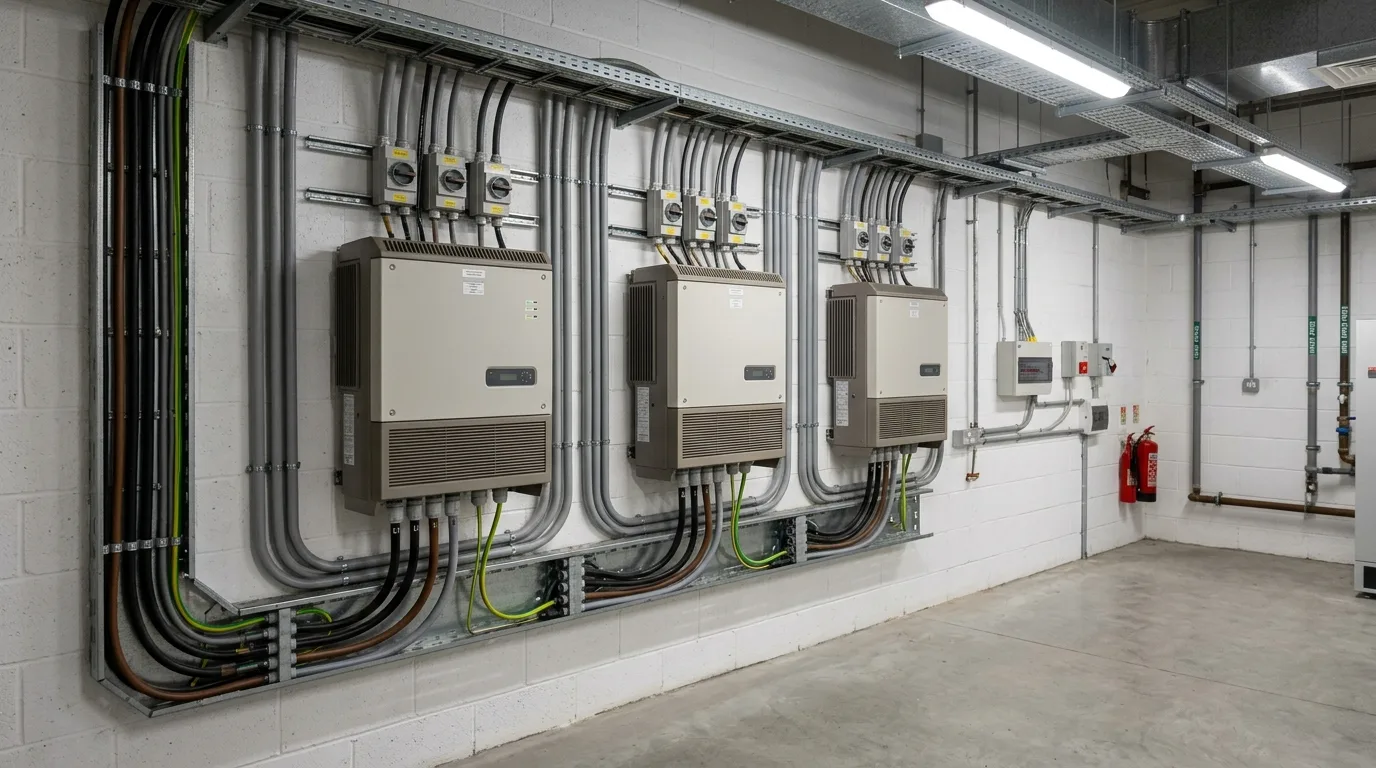
SolarEdge has been a fixture on Irish commercial rooftops for the better part of a decade. Their three-phase Synergy platform - covering SE17K up to SE100K - is specified more often than any other inverter brand on complex, shaded or multi-pitch sites in Ireland in 2026. This review covers what they do well, where they fall short, real-world pricing, and how to decide whether SolarEdge is the right specification for your project.
How SolarEdge actually works
Unlike string inverters from SMA, Huawei or Sungrow that operate at the string level, SolarEdge pairs each module (or pair of modules) with a Power Optimiser - a small DC-DC converter that performs maximum power point tracking per module. The inverter itself then runs at a fixed DC voltage and only does DC-AC conversion.
The practical consequences are significant:
- A single shaded or soiled module drops only its own output, not the entire string.
- You can mix module orientations, pitches and even module models on the same string.
- Monitoring resolves to individual module performance.
- The system has more components - but each is simpler and lower-stress.
The Synergy range
For Irish commercial work in 2026, the relevant models are:
- SE17K-SE33.3K - small commercial, 17-33 kW three-phase, single-unit
- SE40K-SE100K Synergy - modular blocks of "Synergy Units" that combine into a single 40-100 kW inverter
- SE120K and above - large commercial, used in 200 kWp+ ground-mount and rooftop arrays via parallel units
The Synergy architecture is the differentiator. A 100 kW inverter is built from three Synergy Units that can be replaced individually. If one fails, you swap the unit on-site in 30 minutes rather than craning out a full inverter. For Irish industrial sites where downtime is expensive, this matters.
Where SolarEdge wins on Irish commercial sites
- Multi-pitch and complex roofs. Older Irish industrial buildings often have north-south oriented monopitch roofs, dormers, plant rooms, skylights or rooftop AHUs. SolarEdge handles these without splitting into multiple string inverters.
- Partial shading. Chimney stacks, neighbouring buildings, telecoms masts, and wind-stunted trees affect more sites than people expect. Module-level MPPT recovers shaded losses far better than string-level MPPT.
- Monitoring depth. The SolarEdge ONE platform provides module-level performance data, fault detection, and string-level alerts. For O&M contractors this drastically cuts mean-time-to-diagnose.
- SafeDC. When the inverter is off, optimisers reduce string voltage to 1V per module. This is a legitimate safety advantage for firefighters and during roof maintenance - several Irish insurers now reference this in commercial PV underwriting.
- Module flexibility. You can mix module types on a string, which makes phased rollouts and module replacements easier 10-15 years out.
Where SolarEdge struggles
- Cost. Optimisers add roughly €15-€30 per module to the BoM. On a 200 kWp system with 450W modules (444 modules) that is €7,000-€13,000 extra. The premium is rarely justified on a clean, unshaded south-facing single-pitch roof.
- Component count. More devices means more potential failure points. Optimiser failure rates have improved in recent years but are not zero.
- DC voltage limits. Fixed DC bus voltage means careful string sizing - this is a designer issue but worth confirming with your EPC.
- Field experience. Some Irish EPCs have moved away from optimiser platforms after a wave of optimiser warranty claims in 2019-2021. Ask your EPC for their current view.
2026 pricing
Indicative Irish commercial prices in 2026 (supply-only, EPC margin extra):
- SE33.3K three-phase: ~€2,200-€2,600
- SE50K Synergy: ~€3,500-€4,200
- SE100K Synergy: ~€6,500-€7,800
- P850/P950 optimiser (pairs two modules): ~€55-€75 each
For a 200 kWp Irish commercial install, the SolarEdge inverter+optimiser package typically lands at €28,000-€38,000 supply-only. The same kWp with SMA Sunny Highpower or Huawei SUN2000-100KTL string inverters lands at €18,000-€26,000.
Warranty in 2026
- Inverter: 12 years standard, extendable to 20 years
- Optimisers: 25 years standard
- Monitoring: covered for inverter warranty period
The 25-year optimiser warranty is genuinely best-in-class. SolarEdge handles claims directly from Ireland through their EMEA logistics centre, with typical turnaround of 5-10 working days for in-warranty replacements.
Monitoring and integration
SolarEdge ONE consolidates monitoring across PV, storage, EV charging and load metering. For Irish commercial sites the practical features that matter:
- Module-level production alarms
- String-level fault detection (e.g. RCD trips, optimiser comms loss)
- Smart Energy Manager for export limiting (NC7 compliance)
- Modbus TCP for integration with BMS systems
- API access for ESG and ISO 50001 reporting
The platform has improved markedly since the rebrand from Monitoring Portal. It is now genuinely usable by facilities teams without solar training.
When to specify SolarEdge
Default to SolarEdge when your site has any of:
- Multi-pitch or complex roof geometry
- Significant shading or partial shading risk
- Heritage or insurance constraints requiring SafeDC
- Phased rollout planned (different modules over time)
- A facilities team that wants module-level visibility
Default away from SolarEdge when:
- Single unshaded south-facing roof
- Tight capex budget where every euro counts
- Very large ground-mount where central or string inverters scale better
- Site team has low appetite for component complexity
Ecosystem and Irish supply
SolarEdge has strong distribution in Ireland through Activ8 Solar Energies, Enerpower, Powerlink and other major EPCs. Lead times in 2026 are typically 4-8 weeks for standard Synergy units, longer for the SE120K+ range. Most EPCs hold buffer stock for SE33.3K and SE50K.
Field-tested commissioning checklist for SolarEdge commercial sites
Before sign-off on a Synergy install, walk this checklist with the commissioning engineer:
- P-coupling verification. Every optimiser pairs with one or two modules and must be physically labelled with its serial number against the string map. Audit a 10% random sample on the roof against the commissioning PDF — mismatches cause baffling fault alerts six months later.
- Pre-pairing voltage check. Before turning on the inverter, measure DC string voltage at the inverter terminals. Should read ~1 V per optimiser (SafeDC). A higher reading indicates an optimiser failed to enter SafeDC mode and must be replaced before energisation.
- Smart Energy Manager export limit witnessed. ESB Networks may require evidence of dynamic export limiting. Run a test that drops a 100 kVA load and confirms the inverter throttles within 2 seconds. Document with a screenshot from SolarEdge ONE.
- Firmware on current SPL. Older Synergy units sometimes ship on firmware that lacks the 2026 NC7 grid-code refinements. Confirm the unit is on at least CPU 4.18.0 and SMI 5.2.0 before warranty start-date is registered.
- Optimiser comms density check. SolarEdge ONE should show 100% optimiser comms within 48 hours. Persistent "missing optimiser" alerts (>3% of fleet) suggest poor RF environment from metal-clad roof — may require LAN extension or comms gateway repositioning.
Bottom line
SolarEdge SE17K-SE100K is the right inverter for the Irish commercial sites where it is the right inverter - complex, shaded, multi-pitch or where monitoring depth matters. It is overspec for clean south-facing rooftops and rarely the right choice for large ground-mount. Get an EPC who has installed at least 30 SolarEdge commercial systems, insist on the 20-year extended inverter warranty, and you will get 25+ years of low-friction operation.
Get 3 free commercial solar quotes — free and no obligation.
Frequently asked questions
Is SolarEdge worth the premium on Irish commercial sites?
Yes on shaded, multi-pitch or complex roofs where module-level MPPT recovers losses. No on clean south-facing single-pitch rooftops where a string inverter delivers similar yield for 25-35% less capex.
What is the SolarEdge optimiser warranty in 2026?
25 years, with replacement handled through SolarEdge EMEA. Inverters carry a 12-year standard warranty, extendable to 20 years for a modest premium.
Can SolarEdge meet ESB Networks NC7 export-limit requirements?
Yes. The Smart Energy Manager and Export Limit configuration are widely accepted on Irish NC7 applications and can dynamically curtail export to a defined kW limit.
What is SafeDC and why does it matter in Ireland?
SafeDC reduces string voltage to 1V per module when the inverter is off, eliminating high-voltage DC on the roof during maintenance or fire. Several Irish insurers reference this in commercial PV cover.
Which Irish EPCs specify SolarEdge for commercial projects?
Activ8 Solar Energies, Enerpower, Powerlink and many specialist EPCs install SolarEdge regularly. Always ask for at least three commercial references at your kWp range.
Sources & further reading
- SolarEdge Commercial Inverters — SolarEdge Technologies
- Synergy Technology — SolarEdge Technologies
- ESB Networks Connection Requirements — ESB Networks