Rooftop vs Ground-Mount Solar for Irish Commercial Sites
Rooftop is cheaper and grant-eligible. Ground-mount scales bigger and yields more. Here is the honest comparison for Irish commercial sites in 2026.
By Smart Solar Editorial · Updated 15 May 2026 · 10 min read
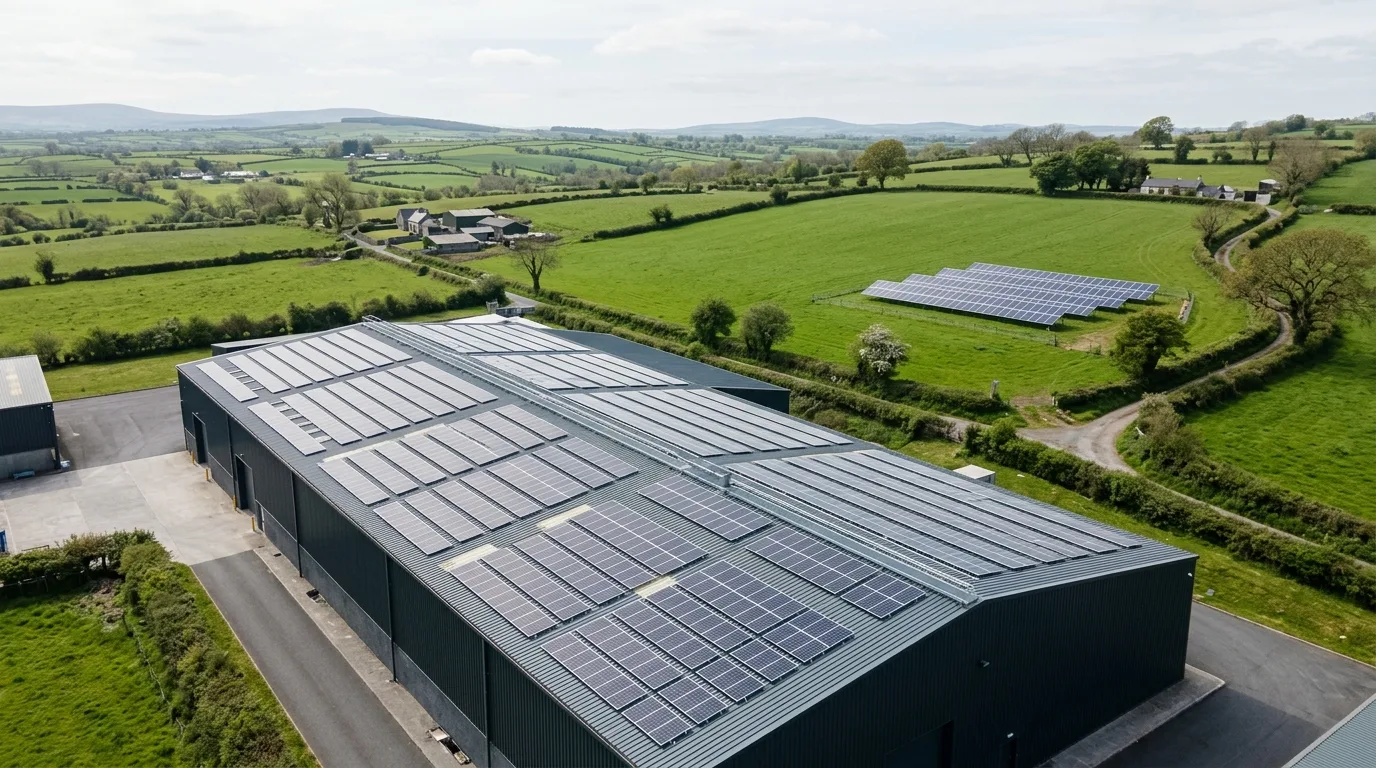
Most Irish commercial PV decisions come down to one question: do we put the panels on the roof or on the ground? Both work. They just optimise different things. This guide compares rooftop and ground-mount across the eight factors that actually move the business case.
The fast answer
- Choose rooftop if you have a sound, large, accessible roof and your daytime load can absorb the generation.
- Choose ground-mount if you need more capacity than the roof allows, want maximum yield, or own land that is otherwise unproductive.
- Combine both if you are pushing for a 1 MWp+ build with constrained roof area.
1. Capex per kWp
In 2026, Irish commercial solar capex looks broadly like this:
- Rooftop standing-seam: €1,050-€1,250/kWp
- Rooftop trapezoidal with hooks: €1,150-€1,350/kWp
- Rooftop ballasted flat roof: €1,100-€1,300/kWp
- Ground-mount fixed tilt: €850-€1,100/kWp
- Ground-mount single-axis tracker: €1,000-€1,250/kWp
Ground-mount usually wins on raw €/kWp because it avoids working at height, removes roof penetration risk and uses simpler racking. The savings narrow once you add fencing, civils, security and a 200-500 m HV cable run.
2. Yield
Ground-mount almost always outperforms rooftop because:
- You can pick the perfect tilt (32-35 degrees in Ireland) instead of accepting the roof pitch.
- You can avoid every shadow.
- Bifacial gain on grass or gravel adds 4-9%.
- Cleaning is straightforward, so soiling losses are lower.
Expect 950-1,050 kWh/kWp on a fixed-tilt ground-mount in Ireland versus 880-960 kWh/kWp on a typical commercial roof.
3. Planning permission
This is where rooftop wins decisively. Under updated 2023 regulations, most rooftop commercial solar is exempt from planning. Ground-mount above 50 kW almost always requires planning permission, an environmental impact screening, a glint-and-glare assessment if near roads or aerodromes, and sometimes an Appropriate Assessment if near a Natura 2000 site. Expect 4-9 months from preplanning meeting to grant of permission for a 500 kWp ground-mount.
4. Grant eligibility
The Non-Domestic Microgen Grant explicitly targets generators connected to demand. Rooftop systems on the same building as the consuming load are textbook eligible. Ground-mount systems on the same site folio can qualify if private-wired to the meter. Pure export farms or remote ground-mounts that need a new grid connection generally do not qualify for NDMG and shift towards merchant or PPA economics.
5. ESB Networks connection
A rooftop system reuses the existing MIC. A ground-mount might need a dedicated connection if it is far from the building. The NC7 cost difference can be €30,000-€150,000 once you factor in a new transformer, switchgear and the metered service.
6. Roof condition and structural risk
A roof that has 5 years of life left is a poor solar host. Adding 12-18 kg/m² of dead load means you need a chartered structural engineer's sign-off. If the roof needs replacing within 10 years, the panels will have to come down and go back up - typically €60-€90/m² of avoidable cost. Ground-mount sidesteps this entirely.
7. Land use and farm context
Many Irish commercial projects sit on farms or in industrial estates with adjacent paddocks. The new "agrivoltaics" approach lets you graze sheep under panels or grow shade-tolerant crops between rows, recovering some agricultural value. Solar arrays at 2.5 m clearance and 3-4 m row spacing are increasingly common.
8. O&M
Rooftop O&M is harder. Every cleaning visit means scaffold or MEWP access, height permits and rescue plans. Ground-mount O&M is just a person with a brush trolley and a clipboard. Over a 25-year life this matters more than most CFOs realise - typically €4-€8/kWp/year for rooftop versus €2-€4/kWp/year for ground-mount.
A worked comparison: 500 kWp food producer
The same producer in Tipperary could either install 500 kWp on a refurbished roof or 500 kWp on a back field.
| Item | Rooftop | Ground-mount |
|---|---|---|
| Capex | €580k | €510k |
| NDMG grant | €162.6k | €0 (no demand-link) |
| Net capex | €417k | €510k |
| Year-1 generation | 460,000 kWh | 510,000 kWh |
| Planning | Exempt | 6-9 months |
| O&M annual | €3,000 | €1,500 |
In this scenario the rooftop wins on cash terms because the grant outweighs the yield gap. If the same producer needed 1.5 MWp and the roof only fit 500 kWp, ground-mount becomes the only way to hit the target.
A hybrid worth considering: solar carports
If your site has a large staff car park, a solar carport (covered in detail in our dedicated article) gives you ground-mount-like yields with rooftop-like grant eligibility because the canopy structure is a "building" for grant purposes and is on-site.
How to decide
- Map total daytime electrical load.
- Measure available unshaded roof area in m².
- Multiply by 0.18 to get realistic kWp.
- If that is at least 80% of your sizing target, lead with rooftop.
- If you need more, add a ground-mount or carport for the balance.
- Speak to ESB Networks early - the grid offer often decides the final split.
Common pitfalls in the rooftop vs ground-mount decision
Three errors consistently push Irish projects into the wrong choice:
- Skipping the structural survey. A pre-2005 trapezoidal roof in Munster often has hidden purlin corrosion that only shows up under destructive testing. Discovering it after rails are ordered adds €15k–€40k and 6–10 weeks. Budget €1,500–€3,000 upfront for a proper structural and roof condition report.
- Underestimating ground-mount civils. "We have a field" sounds simple until you cost the 250 m HV trench (€80–€140/m), three-phase ring-main unit (€18k–€35k), 2 m security fencing (€45–€70/m) and the access track to ESB standards (€30–€60/m). On a 500 kWp project these can add €120k–€200k beyond the panel and inverter quote.
- Missing the agricultural relief angle. Ground-mount on farm land can affect Basic Income Support for Sustainability (BISS) payment eligibility. Up to 30% panel coverage of a parcel typically retains BISS if combined with grazing; above that, your agricultural consultant should re-model the entitlement impact before lodging planning.
Most Irish commercial sites end up rooftop-first, ground-mount-second. But for farms, light-industrial parks with idle paddocks, and any site over 1 MWp, the calculus increasingly tilts towards ground-mount.
Get 3 free commercial solar quotes — free and no obligation.
Frequently asked questions
Is ground-mount solar cheaper than rooftop in Ireland?
Yes, per installed kWp the capex is typically €100-€200/kWp cheaper for ground-mount, but the loss of the Non-Domestic Microgen Grant often closes the gap on smaller systems.
Do ground-mount solar projects need planning permission?
Yes, ground-mount installations above 50 kW require planning permission in Ireland, and typically also a glint-and-glare assessment plus environmental screening.
Can I install ground-mount solar on agricultural land?
Yes, but the project shifts into agrivoltaics or solar-farm territory. Grant rules, land-use planning and entitlement to single-farm payment all need to be checked with your agricultural consultant.
How much land do I need for a 500 kWp ground-mount?
Roughly 1.0-1.2 hectares (2.5-3 acres) for a fixed-tilt ground-mount at typical Irish spacing, including fence line, internal access and a small substation compound.
Sources & further reading
- Solar PV Planning Exemptions — Department of Housing
- Non-Domestic Microgeneration Grant — SEAI
- ESB Networks Generator Connections — ESB Networks