Agrivoltaics in Ireland: Combining Solar PV with Active Farming
Agrivoltaics lets Irish farms generate electricity and food on the same hectare. The maths, the planning, and the new grant landscape for 2026.
By Smart Solar Editorial · Updated 15 May 2026 · 11 min read
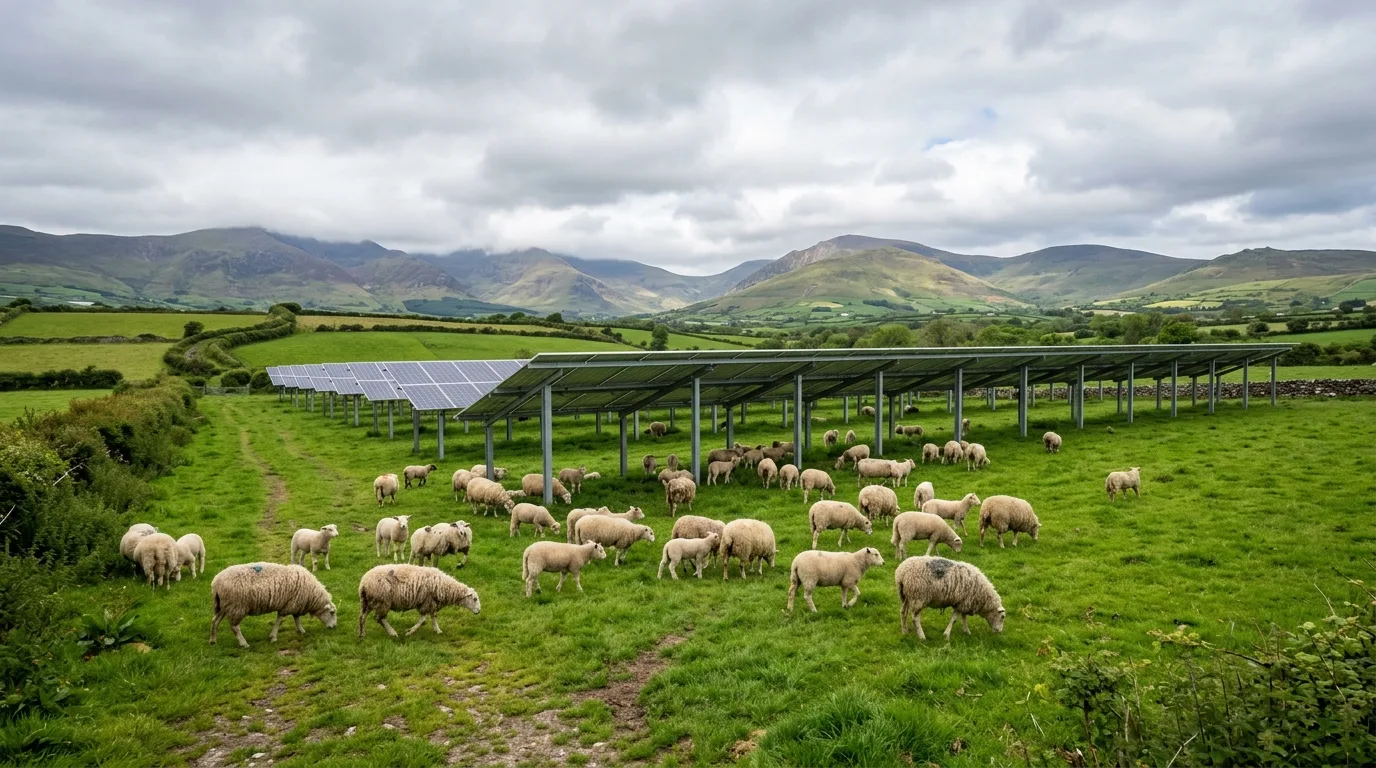
Agrivoltaics - the deliberate combination of solar PV and agricultural production on the same land - has gone from research project to commercial reality in Ireland over the past three years. With Department of Agriculture clarifications on single-farm payment compatibility, falling structural costs and rising electricity prices, 2026 is the year many Irish farmers start treating their land as a dual-yield asset.
What counts as agrivoltaics
Three configurations dominate Irish projects:
- Solar grazing. Standard fixed-tilt arrays at 2.5-3 m clearance allow sheep (and increasingly chickens) to graze under and between rows. The simplest and most common Irish format.
- Elevated agrivoltaics. Panels mounted at 4-5 m clearance with 8-12 m row spacing, enabling tractor passage and arable crops below.
- Vertical bifacial. East-west facing vertical bifacial modules arranged in rows 12-15 m apart, allowing normal farming between hedges of glass.
Each format trades land productivity, capex and electricity yield in different proportions.
The Irish policy backdrop
The Department of Agriculture, Food and the Marine confirmed that solar arrays designed to permit continued grazing or cropping can retain eligibility for Basic Income Support for Sustainability (BISS) on the share of land still in active use, subject to inspection. The 2024-2026 CAP guidance refined the qualifying conditions: minimum livestock density, percentage of land under panels, accessible margins and species-appropriate pasture. Get the latest letter of clarification before signing any EPC contract.
The Non-Domestic Microgen Grant remains the simplest funding route for systems up to about 1 MWp where the generation is consumed on the farm. Above that, schemes shift to merchant power purchase agreements with developers like SSE, Statkraft, ESB and Lightsource bp, or to community-shared projects.
Yield trade-offs
Compared to a conventional fixed-tilt ground-mount, agrivoltaic layouts typically yield:
- Solar grazing (standard pitch): 95-100% of baseline kWh/kWp.
- Elevated agrivoltaics for arable: 88-95%, due to wider row spacing reducing density.
- Vertical bifacial: 75-85% on annual energy but with a flatter daily profile.
You install fewer kWp per hectare with elevated and vertical formats, but the agricultural land you retain offsets the difference.
Capex bands in 2026
- Solar grazing fixed-tilt: €850-€1,050/kWp (very close to conventional)
- Elevated agrivoltaics: €1,150-€1,400/kWp (taller steel, longer cable runs)
- Vertical bifacial: €1,250-€1,500/kWp (specialist racking, higher module count)
Funding above and beyond NDMG often comes through EXEED for integrated farm energy projects, or via SEAI's smart grid demonstration calls when paired with battery and demand response.
Worked example: 250 kWp solar grazing on a Wexford sheep farm
- 250 kWp fixed-tilt, 1.4 hectares, 100 ewes grazing under and between rows.
- Capex: €240,000 ex VAT.
- NDMG grant (parlour and farmhouse demand link): €98,000.
- Net capex: €142,000.
- Year-1 generation: 240,000 kWh.
- On-farm consumption: 40,000 kWh at 27 c/kWh = €10,800.
- Export: 200,000 kWh at 14 c/kWh = €28,000.
- BISS retained on ~85% of original land basis.
- Total Year-1 yield: ~€38,800 + retained agricultural income.
- Simple payback: ~3.7 years.
This is a typical sweet spot: small enough to be NDMG-eligible, large enough to be a meaningful income stream.
Choosing modules and inverters
For Irish agrivoltaic projects, the equipment shortlist is consistent:
- Modules: Bifacial N-type TOPCon from Jinko Tiger Neo, Trina Vertex, JA Solar, Longi Hi-MO or REC at 540-580 Wp.
- Inverters: SMA Sunny Highpower, Sungrow SG110CX, Huawei SUN2000-215KTL, depending on scale.
- Trackers: Generally avoided in Ireland below 5 MWp because the kWh uplift rarely justifies the maintenance cost; single-axis trackers can make sense above 5 MWp on south-facing sites.
Animal welfare and practical management
Solar grazing works best with sheep because they are short enough to walk under standard arrays without damaging cabling. Common practical points:
- Use crimped cabling and conduit at sheep-snout height to avoid damage.
- Drinkers and shade are provided naturally by the panels; rotate flocks weekly to prevent grass burn-off under drip lines.
- Avoid copper grounding rods accessible to livestock.
- A 25-year array means 25 years of fencing maintenance - budget for it.
For cattle, you need elevated agrivoltaics with at least 4.5 m clearance and reinforced bracing against rubbing.
Planning and Appropriate Assessment
Agrivoltaic projects above 50 kW need planning permission and almost always an Appropriate Assessment screening because Irish farmland often sits near Natura 2000 sites or river basins. Local authorities increasingly expect:
- Landscape and visual impact assessment with photomontages
- Glint-and-glare analysis if near roads or aerodromes
- Biodiversity enhancement plan (hedgerow planting, wildflower strips)
- Decommissioning bond
Lead time from preplanning to commencement is typically 9-15 months.
Insurance and revenue protection
Agricultural-grade public liability for solar grazing operations is now a standard product from IFAC-recommended underwriters. Equipment insurance should explicitly cover livestock damage. For larger sites consider parametric weather insurance to smooth low-irradiance years.
Who is building these projects?
In addition to the established Irish commercial EPCs (Activ8 Solar Energies, Enerpower, Powerlink, Solar Electric Ireland, Mercury Engineering and ESB Smart Energy Services), specialist agri-solar developers are emerging that handle the agricultural side of the contract from grazing leases to BISS paperwork. Insist on at least one Irish reference where grazing has been in continuous operation for 2+ years.
Common pitfalls in Irish agrivoltaic projects
Three errors recur on agrivoltaic builds that turn 4-year paybacks into 7-year ones:
- Ground compaction under installation. A 250 kWp build needs 60–90 lorry movements of steel and panels. Without proper trackway plates and dry-weather scheduling, ground compaction reduces grass yield by 15–25% for two seasons afterwards. Budget €4k–€8k for temporary trackway and schedule installs for May–September.
- MIC bottleneck on the parlour supply. A typical 100-cow dairy parlour runs on 70–100 kVA MIC. Adding 250 kWp generation requires either a new dedicated MIC for the solar (€8k–€25k plus 16–24 weeks for ESB Networks NC7) or an MIC upgrade. Many farms discover this only after the panels are on the field.
- BISS verification without photos. Department of Agriculture inspectors verify continued grazing through unannounced visits. Keep dated photos of livestock under panels at quarterly intervals from year one — without evidence of active grazing, the BISS entitlement on that parcel can be retrospectively withdrawn.
Bottom line
Agrivoltaics is not a way to put solar on land you cannot otherwise use - it is a way to keep land productive while adding a second revenue stream. For Irish farmers with a sound MIC, a southern-tilted field and a willingness to engage with planning, 2026 is the right time to commit.
Get 3 free commercial solar quotes — free and no obligation.
Frequently asked questions
Can sheep really graze under solar panels in Ireland?
Yes. Solar grazing with sheep is now a mainstream commercial practice in Ireland, with several large operators offering managed flocks under PV arrays. Standard arrays at 2.5-3 m clearance work well for ewes and lambs.
Will an agrivoltaic project affect my Basic Income Support payment?
Provided land remains in qualifying agricultural use under updated Department of Agriculture guidance, much of the original BISS basis can be retained, but the share of land directly under panel footings is generally excluded. Get a written letter of clarification before signing.
What is the typical capex for agrivoltaics in Ireland?
Solar grazing systems land at €850-€1,050/kWp, very close to conventional ground-mount. Elevated and vertical configurations run 30-50% higher per kWp because of taller steel and lower module density.
Do I need planning permission for an agrivoltaic project?
Yes, any ground-mount or agrivoltaic project above 50 kW requires planning permission in Ireland, plus typically a glint-and-glare assessment and Appropriate Assessment screening.
Sources & further reading
- Solar PV on Farms - DAFM guidance — Department of Agriculture
- Microgeneration Support Scheme — Department of the Environment, Climate and Communications
- Non-Domestic Microgeneration Grant — SEAI