Solar PV for Irish Dairy Farms 2026: Cutting the Milking Parlour Bill
Irish dairy farms are among the highest daytime electricity users in agriculture. Here is how to size, fund and install commercial solar PV for the milking parlour, bulk tank and water heating in 2026.
By Smart Solar Editorial · Updated 4 November 2026 · 10 min read
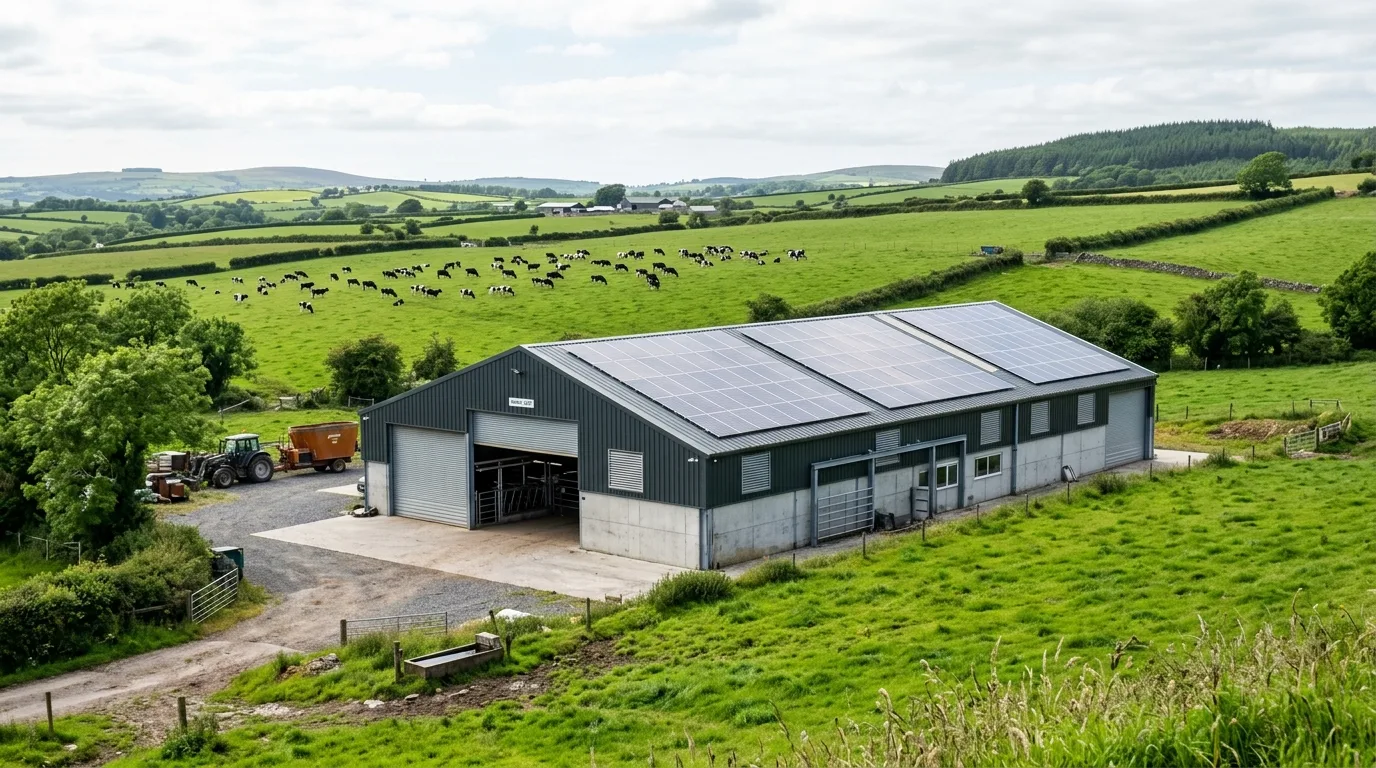
Irish dairy farms are one of the strongest commercial solar PV use cases in 2026. The combination of high daytime electricity demand (milking, refrigeration, vacuum pumps, water heating), large suitable roof areas on sheds and parlours, and generous grants (the enhanced 45% Non-Domestic Microgen Grant or TAMS 3) makes the economics genuinely compelling. This guide covers sizing, funding, real-world economics and the practical install considerations for solar PV on Irish dairy farms.
Why dairy farms are a perfect fit for solar
Dairy farms have a unique daytime load profile that maps exceptionally well to solar generation:
- Morning milking (6am-9am): vacuum pumps, milk pump, plate cooler
- Bulk tank refrigeration (continuous): compressors run hardest during and after milking
- Water heating (continuous): for hot wash of plant
- Evening milking (4pm-7pm): repeat of morning loads
- Auxiliary loads (continuous): yard lighting, automatic scrapers, calving cameras
A typical 100-cow Irish dairy farm uses 35,000-50,000 kWh per year. A 200-cow farm uses 65,000-100,000 kWh. Most of this is during daytime hours when PV generates. Self-consumption rates on dairy installs routinely reach 80-90% with no battery storage required.
Sizing for a typical Irish dairy
Rule of thumb sizing:
- 100-cow herd: 25-40 kWp PV system, generating 22,500-36,000 kWh/year
- 200-cow herd: 50-75 kWp, generating 45,000-67,500 kWh/year
- 400-cow herd: 100-150 kWp, generating 90,000-135,000 kWh/year
- 600-cow herd: 150-200 kWp, generating 135,000-180,000 kWh/year
These figures size to roughly match the day-time portion of total annual consumption. Going significantly larger usually pushes self-consumption below 80% and reduces the economic return per kWp installed.
For an exact sizing, run a 12-month MV90 import profile (your electricity supplier can provide this) and overlay a PVGIS yield curve for your location. Most Irish dairy farms benefit from south or south-west orientation at 25-35 degree tilt; if shed roofs are aligned differently, accept the modest yield loss rather than ground-mounting.
Roof options on a typical Irish dairy farm
- Cubicle shed roofs. Usually the largest available area. Often south-pitched. Standard agricultural cladding (Kingspan KS1000 RW or similar) takes solar mounting easily.
- Milking parlour roof. Smaller but ideally located near loads. Good for 10-20 kWp.
- Bulk tank house roof. Often south-facing and right beside the largest load.
- Calving shed roofs. Underused space, easy to retrofit.
- Slurry tank covers. Increasingly used for ground-mount-style solar over a slurry store (with appropriate gas-handling and ventilation design).
- Ground-mount in paddock. Less common but viable if shed roofs are unsuitable.
Structural assessment is essential. Older agricultural sheds (pre-2000) often have purlin spacing or roof condition issues that make solar mounting unwise without reinforcement.
Choosing a grant: Non-Domestic Microgen vs TAMS 3
Dairy farms have two grant routes for solar PV, and they cannot be stacked: SEAI's terms prohibit cumulating Non-Domestic Microgen Grant (NDMG) aid with any other Irish Government or State agency grant on the installation.
- Non-Domestic Microgen Grant (SEAI): for applications made from 6 October 2026 to 6 July 2027, pays the lower of SEAI's per-kWp band value and 45% of eligible cost, up to €325,200. A 50 kWp system earns up to €25,200. Batteries are not eligible.
- TAMS 3 Solar Capital Investment Scheme (DAFM): 60% grant on a ring-fenced investment ceiling of €90,000, with system-size limits set by the TAMS terms for your enterprise.
For a typical 50 kWp dairy install costing around €60,000:
- NDMG: €25,200 (the band value is below 45% of cost)
- TAMS 3: 60% of eligible spend — around €36,000 if the system fits within TAMS limits
- TAMS usually pays more for smaller systems that fit its rules; the NDMG is simpler, not tranche-based and scales to 1,000 kWp
We compare the two in detail in Farm solar grants 2026: SEAI 45% vs TAMS 60%.
Indicative 2026 economics
A worked example for a 200-cow Irish dairy farm with 70 kWp PV:
- System capex: €85,000 ex-VAT
- Non-Domestic Microgen Grant (enhanced rate): €33,200
- Net capex: €51,800
- Annual generation: ~63,000 kWh at 900 kWh/kWp
- Self-consumption: 85% = 53,550 kWh at 30c/kWh = €16,065
- Export: 15% = 9,450 kWh at 14c/kWh = €1,323
- Total annual saving: ~€17,388
- Simple payback: ~3.0 years on net capex
- 25-year cumulative saving (net of net capex, before degradation): €350,000+
These returns are exceptional. They are driven by Ireland's high industrial electricity prices, the daytime-heavy load profile of dairy farming, and the NDMG grant.
Battery storage on Irish dairy farms
Battery storage is usually NOT the right add-on for a dairy farm. With self-consumption already at 80-90%, the marginal kWh that gets exported is small. A 20-30 kWh battery would only shift 5-10% of annual generation into storage at a capex of €15,000-€25,000 - poor return.
The exception is farms with significant electricity demand outside daylight hours (large calving herds with calving boxes running heat lamps overnight, robotic milking systems running 24/7, or substantial grain dryer loads). For these farms a modest battery (10-30 kWh) can lift self-consumption to 95%+ and justify the capex.
ACA tax treatment for dairy farms
Solar PV qualifies for Accelerated Capital Allowance (ACA) under the Energy-Efficient Equipment scheme. For an Irish dairy farm structured as a sole trader or partnership, the full capex (net of grant) can typically be written off against farm income in year one - effectively saving 20-40% of the net capex in income tax depending on marginal rate.
For a 70 kWp install with €30,000 net capex, the year-one tax saving for a higher-rate-tax farmer can be €12,000-€15,000, taking the effective net capex to €15,000-€18,000. Always confirm with your accountant.
Practical installation considerations
- Avoid milking hours. Schedule installation outside morning and evening milking - the parlour cannot be shut down twice a day during install.
- Slurry handling. Some installations require crane access; coordinate with slurry-tanker movements.
- Cattle and electrical safety. Brief installers on cattle handling and farm biosecurity (foot-dips, no contamination between farms).
- Single-phase vs three-phase. Many older Irish dairy farms still run single-phase. Upgrading to three-phase is often required for PV above 11 kW and adds €5,000-€15,000 to capex (sometimes grant-supported under TAMS).
- NC7 application. Mandatory above 11 kW three-phase. Allow 4-6 months.
- BER on dairy buildings. Required for NDMG. Most agricultural buildings have lower BERs than commercial; the solar PV often itself uplifts the rating to B.
Real Irish dairy farm experience
Across hundreds of Irish dairy farm solar installs since 2020, the consistent feedback:
- Payback is typically faster than projected (driven by rising electricity prices)
- Maintenance is minimal - 1-2 inverter inspections per year
- Roof cleaning is rarely needed in the Irish climate
- The biggest single risk is dust or splatter from yard activity on near-ground panels - keep panels high
- Monitoring catches issues quickly - install a system with proper alarming
Bottom line
Solar PV on Irish dairy farms in 2026 is one of the strongest commercial solar use cases in the country. Payback of around three years is realistic for properly sized systems with the enhanced NDMG grant, and a load profile that delivers 80-90% self-consumption. Size to the day-time load, prioritise NC7 application early, pick the right grant (NDMG or TAMS, not both), and the system will pay for itself many times over across its 25-year life.
Get 3 free commercial solar quotes — free and no obligation.
Frequently asked questions
How big a solar PV system does a 200-cow Irish dairy farm need?
Typically 50-75 kWp, generating 45,000-67,500 kWh per year. This matches the daytime portion of total consumption and delivers self-consumption rates of 80-90% without battery storage.
Can I stack the Non-Domestic Microgen Grant with TAMS 3 for dairy farm solar?
No. SEAI's terms prohibit cumulating Non-Domestic Microgen Grant aid with any other Irish Government or State agency grant on the installation, so you choose one. TAMS 3 (60%) often pays more for smaller systems within its limits; the enhanced NDMG (up to 45%) suits larger systems and doesn't depend on TAMS tranches.
Do I need a battery for solar on my dairy farm?
Usually no. Dairy farm daytime load profiles already deliver 80-90% self-consumption without storage. Batteries make sense only if you have significant overnight loads from robotic milking, grain drying or calving facilities.
What is the typical payback on dairy farm solar in 2026?
1.5-2.5 years on net capex (after grant) for properly sized systems. ACA tax relief in year one can further reduce effective payback to 12-18 months for higher-rate tax farmers.
Do I need to upgrade to three-phase for dairy farm solar?
Above 11 kW PV capacity, yes. Many older Irish dairy farms are still single-phase and need a three-phase upgrade (€5,000-€15,000) before installing solar above microgen threshold. TAMS 3 can sometimes co-fund the upgrade.
Sources & further reading
- Non-Domestic Microgeneration Grant — SEAI
- TAMS 3 Solar PV Investment Scheme — Department of Agriculture, Food and the Marine
- Energy Use on Irish Dairy Farms — Teagasc