Maximising Self-Consumption from Commercial Solar in Ireland
With the Irish MSS export tariff for non-domestic at just 13-15 c/kWh, every kilowatt-hour you self-consume is worth more than double an exported one. Here is how to engineer high self-consumption.
By Smart Solar Editorial · Updated 15 May 2026 · 11 min read
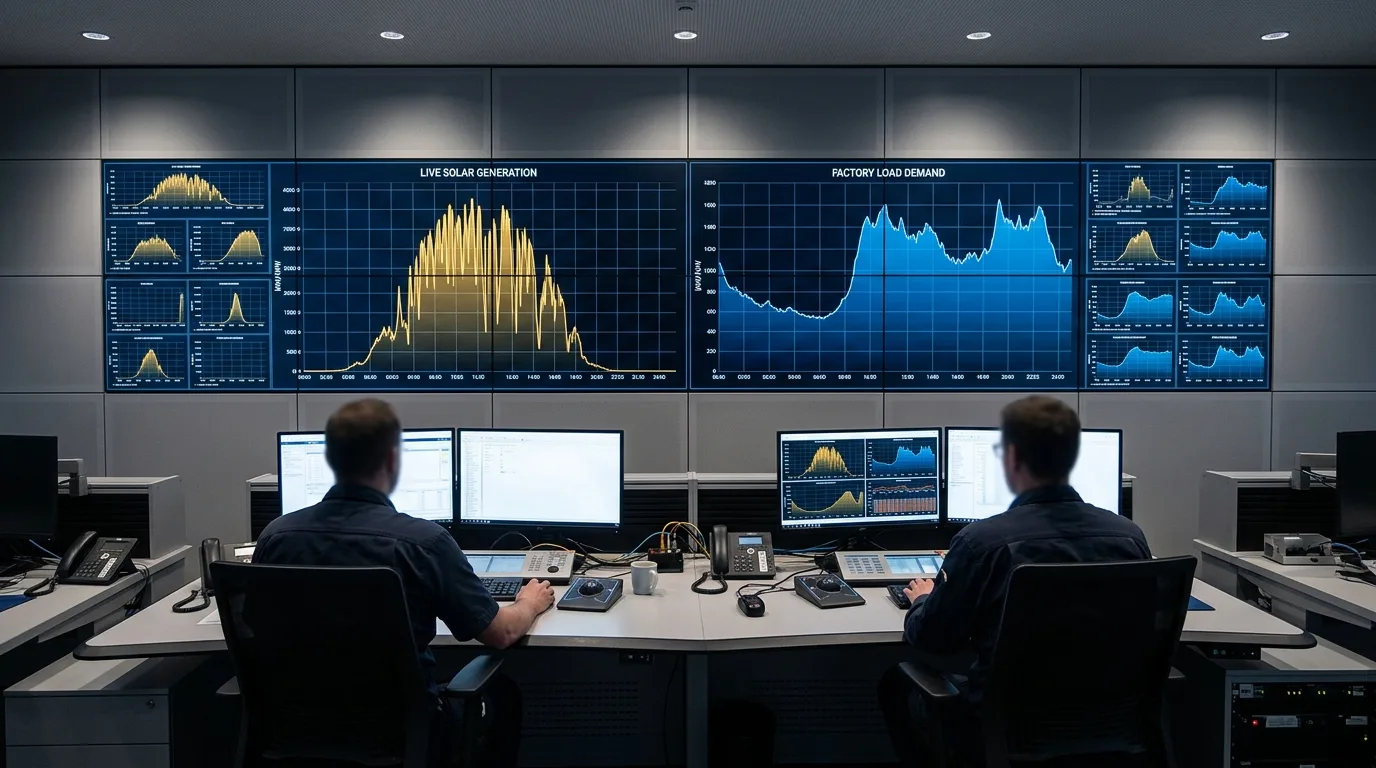
Self-consumption is the single biggest lever in Irish commercial solar economics. With the MSS Clean Export Guarantee non-domestic tariff sitting at roughly 13-15 c/kWh in 2026 and retail import prices running 25-32 c/kWh, every kilowatt-hour you consume on-site is worth nearly twice as much as one exported. A 200 kWp project at 85% self-consumption pays back nearly two years faster than the same project at 65%. This guide explains how to engineer that uplift.
Why self-consumption matters more than ever
Pre-2024, Irish domestic exporters benefited from a relatively generous Clean Export Guarantee that made over-sized systems easy to justify. The non-domestic tariff was always lower, but the gap widened in 2025-2026 as suppliers re-priced their commercial offerings. Today:
- Retail import: 25-32 c/kWh (with DUoS, PSO and tax)
- Non-domestic export: 13-15 c/kWh
- Differential value of a self-consumed kWh: ~15 c/kWh
For a 200 kWp system generating 190,000 kWh/year, lifting self-consumption from 70% to 85% adds 28,500 kWh of high-value consumption, worth roughly €4,300/year and 25% of a typical project's annual cash savings.
Step 1: Right-size the system
The single most common mistake is over-sizing. A 9-5 office with 80,000 kWh/year baseline consumption fitted with 150 kWp will export 60%+ of generation. The grant gets used up on kWh worth 13 cents each.
Use this rule of thumb:
- Estimate average weekday daytime kWh from your half-hourly data.
- Multiply by 365.
- Divide by 950 kWh/kWp.
- That is roughly your maximum self-consumed-optimised kWp.
A site at 50,000 daytime kWh/year should size at ~50 kWp, not 100. If you have grant headroom and want to oversize, do it deliberately, with eyes open.
Step 2: Orientation strategy
A south-facing roof produces a tall, narrow daily curve peaking 12-14:00. An east-west split produces a flatter, wider curve from 09:00-17:00 that better matches a working day. For Irish commercial sites:
- South orientation: 100% energy, 70-75% self-consumption.
- East-west 10 degrees: 88-92% energy, 85-92% self-consumption.
For most factories and offices the east-west split is now the default precisely because it lifts self-consumption.
Step 3: Load shifting
Many industrial processes are surprisingly flexible. Cheap and effective load-shifting opportunities in Irish industry:
- Hot water tanks and CIP systems running at 09:00 instead of 06:00 absorb morning PV.
- Compressed air topped up midday rather than overnight.
- Cold-storage defrost cycles scheduled into solar windows.
- HVAC pre-cooling or pre-heating during the solar peak.
- Lab autoclaves and ovens queued for midday slots.
A formal solar-aware scheduling exercise typically uncovers 10-15% additional self-consumption with zero capex.
Step 4: EV charging
EV charging is the fastest-growing commercial daytime load and the perfect complement to solar. A 50-vehicle fleet on AC chargers (7-22 kW) can absorb 30-150 kWh per vehicle per workday - well over 100 MWh/year of additional daytime demand. Smart chargers from companies like SolarEdge, Wallbox, Easee, Garo, Schneider and Alfen integrate with PV control systems via OCPP or proprietary APIs to follow generation.
Step 5: Battery storage
When load-shifting and EV are exhausted, battery storage is the final lever. Commercial batteries from suppliers like BYD B-Box Premium, Tesla Megapack (utility scale), Sungrow SBR/SBH commercial range, Huawei LUNA2000-200KTL and SolarEdge Energy Bank push self-consumption from 75-85% to 90-97%.
Approximate 2026 Irish prices for installed commercial battery storage:
- 50 kWh / 25 kW: €30,000-€42,000
- 100 kWh / 50 kW: €58,000-€78,000
- 250 kWh / 100 kW: €130,000-€170,000
Batteries do not yet attract NDMG but are eligible under EXEED-funded projects and can be valuable for peak-shaving DUoS charges in addition to self-consumption uplift.
Step 6: Time-of-use tariffs
Some Irish industrial suppliers now offer time-of-use tariffs with a clear midday valley and evening peak. If your battery can soak up midday PV and discharge into the evening peak, the effective value of stored solar can climb to 35-45 c/kWh - well above the 13-15 c export rate. Speak to suppliers like Energia, SSE Airtricity, Bord Gais, Electric Ireland, Pinergy and Flogas about commercial ToU pricing.
Step 7: Monitoring discipline
You cannot manage what you do not measure. A self-consumption KPI dashboard tracking:
- Daily generation (kWh)
- On-site consumption of generation (kWh and %)
- Export to grid (kWh)
- Avoided import value (€)
...allows operations teams to spot lost opportunities (a CIP cycle moved to midnight instead of midday) and to course-correct quickly. SolarEdge Monitoring, Huawei FusionSolar, SMA Sunny Portal and dedicated platforms like SolarEdge Designer + monitoring all support this.
Worked example: 200 kWp food producer
Without intervention:
- Generation: 190,000 kWh
- Self-consumption: 70% (133,000 kWh) at 28 c = €37,240
- Export: 30% (57,000 kWh) at 14 c = €7,980
- Total: €45,220/year
With load shifting, EV and a 100 kWh battery:
- Generation: 190,000 kWh
- Self-consumption: 92% (174,800 kWh) at 28 c = €48,944
- Export: 8% (15,200 kWh) at 14 c = €2,128
- Total: €51,072/year
- Incremental value: €5,852/year for ~€70,000 of incremental investment, plus DUoS savings.
Common pitfalls in chasing self-consumption
A handful of mistakes regularly leave 10–20 percentage points of self-consumption on the table:
- Sizing battery to nameplate kWh instead of usable kWh. A 100 kWh nameplate LFP battery typically delivers 85–92 kWh usable at end-of-life depth-of-discharge ratings. Round-trip efficiency of 88–92% removes another 8–12 kWh per cycle. Spec your battery on usable, cycled energy — not on the badge number.
- Ignoring weekend export. Most Irish factories are dark Saturday–Sunday. A 200 kWp system sat idle for 96 weekend hours exports roughly 1,800–2,400 kWh per weekend at 13–15 c/kWh while the same generation on Monday–Friday at 28 c/kWh would be worth nearly double. Either schedule recurring weekend processes (CIP cycles, refrigeration setpoint shifts) or accept the export reality and price accordingly.
- DUoS off-peak misalignment. ESB Networks Distribution Use of System charges on Maximum Demand contracts spike between 17:00–19:00 winter weekdays. A 50–100 kWh battery discharging into that window saves €1,800–€4,500/year in DUoS alone on a 200 kVA MIC site — often missed in self-consumption-only modelling.
Bottom line
Irish commercial solar economics are now self-consumption economics. Get the sizing right, pick the right orientation, exploit cheap load-shifting first, then EV, then battery. Hitting 85%+ self-consumption is the difference between a good investment and a great one.
Get 3 free commercial solar quotes — free and no obligation.
Frequently asked questions
What is a typical self-consumption rate for Irish commercial solar?
Without optimisation, 60-75% is typical. With east-west orientation, load shifting and modest battery storage, 85-95% is regularly achieved on Irish industrial sites in 2026.
Does battery storage qualify for the Non-Domestic Microgen Grant?
No, batteries are not eligible under NDMG in 2026, but they can be included as part of an EXEED-funded project or in private commercial financing structures.
How big a battery do I need for a 200 kWp commercial solar system?
A 50-150 kWh commercial battery is typical. The exact size depends on overnight base load, peak-shaving requirements and time-of-use tariff opportunities.
Is east-west solar always better than south-facing for commercial sites?
For sites with a daytime working pattern, usually yes. The 8-12% energy loss is more than compensated by the higher self-consumption rate, which lifts financial value per generated kWh.
Sources & further reading
- Clean Export Guarantee Tariffs — Commission for Regulation of Utilities
- Microgeneration Support Scheme — Department of the Environment, Climate and Communications
- SEAI Energy Audits Guidance — SEAI