Solar Carports for Irish Businesses: Costs, Yield and EV Charging
A staff car park is dead space. A solar carport turns it into 200-400 kWp of clean generation plus weather-protected EV charging. Here is how the maths works.
By Smart Solar Editorial · Updated 6 October 2026 · 10 min read
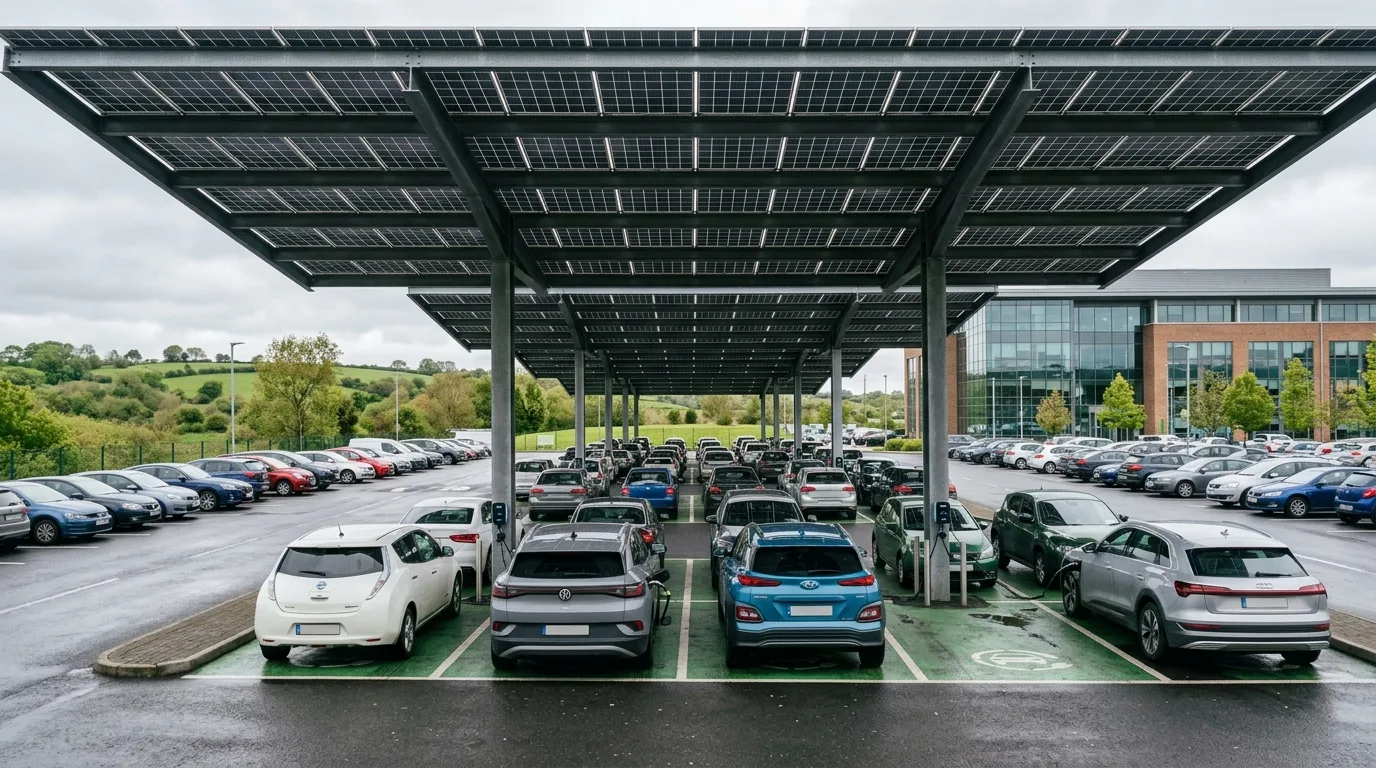
Solar carports have moved from a US-coastal curiosity to a mainstream Irish commercial product. With falling steel costs, mature canopy designs from suppliers like Solar Carport, GreenAsphalt, Schletter, K2 and Solarwatt, and the EV charging ramp-up driving daytime demand on every business park, a 100-bay solar carport is now a credible alternative to a rooftop or ground-mount build.
Why carports work in Ireland
Three forces converge:
- Most Irish business parks have 0.3-0.5 hectares of underused tarmac that is already serviced by drainage and an existing MIC.
- EV penetration in company fleets is climbing rapidly, and the daytime charging load matches solar generation almost perfectly.
- Carports are classed as structures with a defined use (vehicle protection), which generally avoids the planning headaches of ground-mount solar in greenfield.
The result is a project that pays for itself with electricity savings and adds employee benefit, fleet decarbonisation and CSRD-relevant Scope 2 reductions on top.
Capacity per bay
A standard Irish carport bay is 2.5 m x 5 m. With a typical canopy covering 2.5 bays per module-row width, you get roughly:
- 2.8-3.2 kWp per bay at standard module pitch
- 270-320 kWh per bay per year at Irish yield assumptions
A 100-bay carport therefore delivers around 280-320 kWp and 280-320 MWh annually - more than enough to fully charge 60-80 EVs daily.
Cost in 2026
Carports are more expensive per kWp than rooftop or ground-mount because of the steel. Typical Irish 2026 prices:
- Single-bay row, no EV: €1,650-€1,950/kWp
- Double-row central walkway: €1,750-€2,100/kWp
- With integrated EV chargers (7-22 kW per bay, 50% coverage): add €1,500-€3,500 per charger position
So a 300 kWp carport with 30 EV chargers might land at €600,000-€720,000 ex VAT. The Non-Domestic Microgen Grant still applies for the PV element — for a 300 kWp array, €115,200 at the enhanced rate available to 6 July 2027. EV chargers are not eligible costs.
EV integration
The single biggest design choice is the AC/DC architecture for the chargers. Two common approaches:
- Behind-the-meter AC chargers linked to the PV via the building distribution board. Simpler, cheaper, but you lose the ability to ringfence solar kWh for EV billing.
- DC-coupled hub where PV, battery and EV chargers share a DC bus through a multi-port inverter (e.g. SolarEdge EV Charger range, Huawei FusionCharge, or Sungrow + chargers via OCPP). More expensive, far better measurement and billing flexibility.
For employee benefit setups where free or subsidised charging is offered, AC is usually sufficient. For fleet operators billing usage back to drivers, DC-coupled architectures become attractive.
Structural design
Carports must withstand Irish wind loads (zone 3-5, up to 27 m/s basic wind speed in the west) and occasional snow loads. Typical specs:
- Galvanised steel columns at 5-6 m spacing
- Beam clear height: 2.4-2.7 m
- Module tilt: 5-10 degrees with rear water-channel drainage
- Foundation: 600 mm concrete pad with M24 anchor bolts or driven pile
Insist on a chartered structural engineer's sign-off against I.S. EN 1991-1-4 and an inspection plan for galvanising integrity at 5, 15 and 25 years.
Planning permission
Carports are not automatically exempt. Most local authorities treat large canopies as new structures requiring planning, particularly if they exceed 4 m in height or are visible from a public road. Allow 4-6 months for grant of permission and budget €2,500-€6,000 for preplanning, drawings and the application itself. A planning consultant familiar with PV is well worth the fee.
Worked example: 100-bay tech-sector carport in Cork
- Site: 100-bay staff car park, MIC 400 kVA, existing rooftop solar of 90 kWp.
- Carport size: 310 kWp covering 100 bays, integrated with 30 x 22 kW AC chargers.
- Capex: €685,000 ex VAT.
- NDMG grant: €118,200 (enhanced band value for 310 kWp).
- EXEED top-up considered: not stacked here.
- ACA year-1 tax relief: ~€65,000.
- Net post-grant capex: €566,800.
- Annual generation: 295,000 kWh.
- Self-consumption: 92% (heavy daytime EV load) at 28 c/kWh = €76,000.
- Export: 8% (23,600 kWh) at 14 c/kWh = €3,300.
- Annual EV revenue (employee subsidy model, neutral).
- Simple payback: ~7.1 years.
The payback is longer than a typical rooftop because of the steel premium, but the carport delivers strategic value rooftops cannot: weather-protected EV charging, employee benefit and a visible decarbonisation statement to customers.
Common pitfalls to avoid
- Underestimating site civils. Drainage, lighting reinstatement and line-marking can add €40k-€80k.
- Forgetting accessibility. Carports must respect Part M and provide accessible bays with appropriate column setbacks.
- Skipping fire and EV chargepoint zoning. New chargepoint installations need to comply with current ETCI and CRU EV guidance, including emergency stops and signage.
- Cheap steel. A 25-year solar life requires a 25-year steel life. Avoid pre-galvanised box section that cannot be re-coated.
Who designs and builds them?
Several Irish EPCs now run dedicated carport teams - Activ8 Solar Energies, Enerpower, Powerlink and ESB Smart Energy Services among them - typically partnered with European steel fabricators. Verde LED has an integrated LED-plus-carport package for retrofit lighting upgrades. Get at least two designs from different steel suppliers; column spacing and tilt strategy vary widely.
Field-tested checklist before commencing on site
Before mobilisation, walk through this checklist with your EPC and structural engineer:
- Ground condition survey. A car park surface that has carried light traffic for 15 years is not automatically suitable for foundation loading. Insist on at least three trial pits to 2.5 m depth and a CBR test; weak subgrade requires piled foundations adding €40k–€90k on a 100-bay project.
- Drainage redirection plan. A 310 kWp canopy concentrates approximately 1,800–2,200 m² of rainwater into channels. Existing surface drains rarely handle this — typically requires 150–200 mm uPVC sub-surface drainage at €60–€110/m.
- MIC headroom confirmation. A 30-charger array drawing 660 kW concurrent peak can breach a 400 kVA MIC even before adding solar generation. Confirm ESB Networks MIC capacity in writing and budget for an upgrade if peak diversity factor falls below 0.65.
- Public liability and vehicle damage rider. Specify cover for vehicles parked under the canopy during commissioning and inverter replacement events. Default commercial PV policies routinely exclude this.
- Phased commissioning to allow continued staff parking. A 100-bay rebuild typically takes 14–20 weeks. Phasing into thirds keeps 60–70% of bays in use throughout; bidding the works without a phasing plan attracts a 15–25% disruption premium.
If you have 50+ staff bays and your fleet is electrifying, a solar carport is the most strategic PV investment your site can make. It is more expensive per kWp than rooftop, but it solves three problems at once: clean energy, EV infrastructure and employee experience. For most large Irish business parks, 2026-2028 is the right window to commit.
Get 3 free commercial solar quotes — free and no obligation.
Frequently asked questions
How much does a solar carport cost per parking bay in Ireland?
Without EV chargers, expect €4,500-€6,000 per bay including civils. With a 22 kW AC charger on every second bay, expect €7,500-€9,500 per bay before the Non-Domestic Microgen Grant.
Do solar carports need planning permission in Ireland?
Almost always yes. Most local authorities treat carports as new structures, particularly if over 4 m high or visible from public roads. Allow 4-6 months from preplanning to grant of permission.
Can I get the Non-Domestic Microgen Grant for a solar carport?
Yes, the PV element of a carport on a qualifying commercial site is grant-eligible — up to €325,200 at the enhanced 45% rate for applications made by 6 July 2027. The steel structure itself is not separately funded but counts as part of the eligible install cost.
What is the best EV charger configuration for a solar carport?
For employee benefit programmes, AC chargers at 7-22 kW behind the building meter are simplest. For fleet billing or pay-per-use, a DC-coupled architecture with OCPP-capable chargers offers cleaner solar-to-EV accounting.
Sources & further reading
- Non-Domestic Microgeneration Grant — SEAI
- Solar PV Planning Exemptions — Department of Housing
- EV Charge Point Infrastructure Strategy — Department of Transport