kWh per kWp: What Yield Should Irish Commercial Solar Deliver?
Most Irish commercial sites generate 900-950 kWh per installed kWp per year. Here is exactly how that number is built up and how to stress-test a contractor's yield estimate.
By Smart Solar Editorial · Updated 15 May 2026 · 10 min read
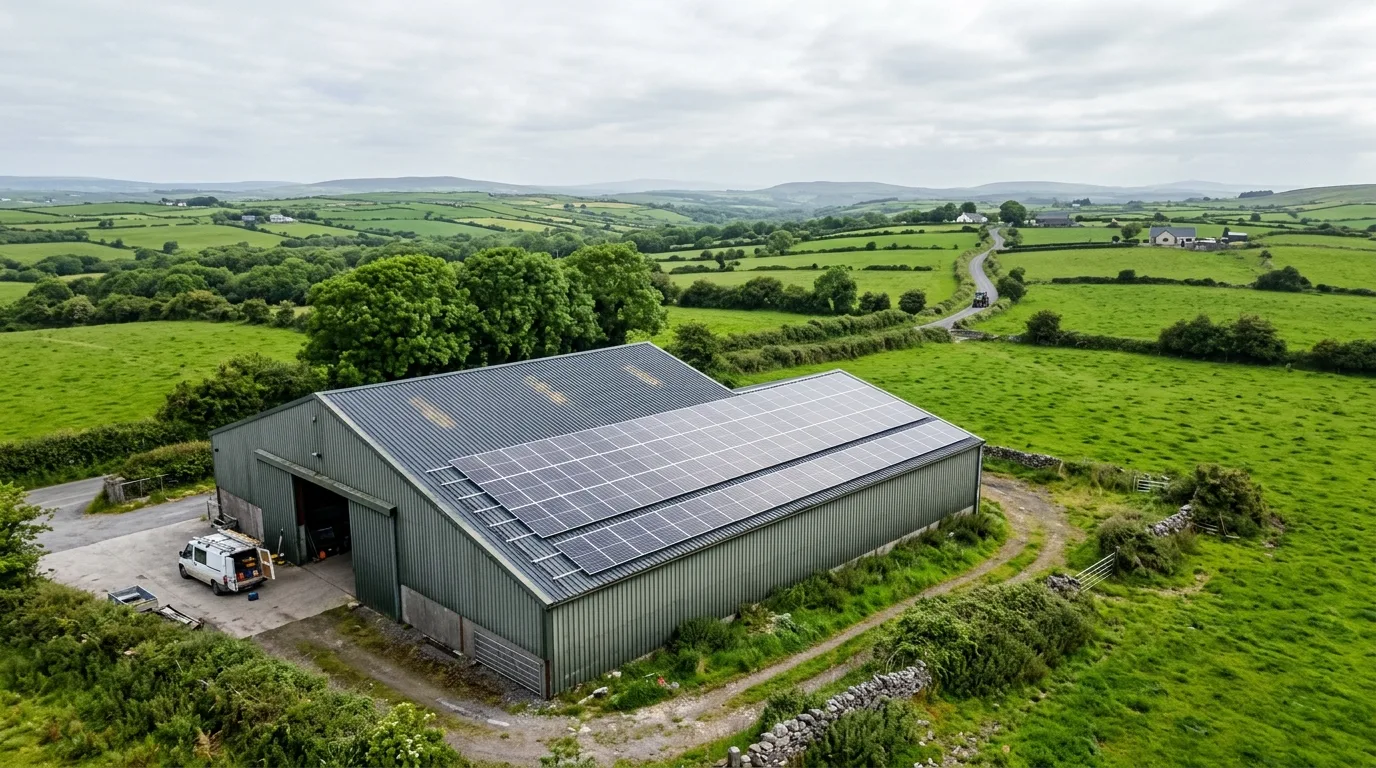
Specific yield, expressed as kWh per installed kWp per year, is the single most important number on any commercial solar proposal. It tells you how much electricity each euro of capex will actually produce. In Ireland in 2026, a well-designed commercial PV system should deliver between 900 and 950 kWh/kWp/year. Anything lower needs explaining, anything higher needs questioning. This guide walks through where the number comes from and how to check yours.
Why kWh/kWp matters more than panel count
Two installers can quote the same 200 kWp system and produce wildly different annual outputs. Module wattage, inverter clipping, string design, soiling assumptions, shading and degradation curves all feed into the final yield. By focusing on kWh/kWp rather than total kWh, you can compare proposals on a like-for-like basis even when the headline system sizes differ slightly.
The Irish baseline: PVGIS values by region
PVGIS (the European Commission's free photovoltaic database) is the industry standard for Irish yield estimates. Typical annual global horizontal irradiation in Ireland sits between 950 and 1,100 kWh/m². Once that is converted to system output through a south-facing array tilted at 10-15 degrees, you typically get:
- Cork and the south coast: 950-985 kWh/kWp
- Dublin and Leinster: 920-955 kWh/kWp
- Galway and Mayo: 905-935 kWh/kWp
- Donegal and the north-west: 880-915 kWh/kWp
Most commercial proposals should land within these bands. If a contractor quotes 1,050 kWh/kWp for a Tullamore warehouse, ask to see the PVGIS export.
Seasonal profile in Ireland
Irish commercial solar is highly seasonal. A typical 200 kWp system will generate roughly:
- 4-6% of annual yield in December and January each
- 11-13% in May, June and July each
- 8-10% in March, April, August and September each
This matters for self-consumption modelling. A bakery that runs ovens all year sees consistent savings; a seasonal hospitality business in West Cork captures most of its value in the May-September peak.
What erodes the yield?
A 200 kWp module nameplate does not produce 200 kWp at the inverter terminals. The following losses are typical:
- Module temperature: -3% to -5% per year (cooler in Ireland than southern Europe).
- Inverter efficiency: -1.5% to -2.5%.
- DC cabling: -1% to -2%.
- AC cabling and transformer: -0.5% to -1%.
- Soiling: -1% to -3% (higher near coastal salt or agricultural dust).
- Shading and string mismatch: -0% to -8% depending on roof.
- Snow and downtime: -0.5% to -1% in Ireland.
- Module degradation: -0.45% per year for N-type TOPCon.
Stack these and you arrive at the 900-950 kWh/kWp Irish baseline. A south-facing, unshaded, well-ventilated rooftop with Tier-1 modules (Jinko Tiger Neo, Trina Vertex, JA Solar) and a SolarEdge SE100K or Huawei SUN2000-100KTL inverter is the textbook 950 kWh/kWp build.
Orientation and tilt
Irish commercial roofs are rarely textbook. Here is how common configurations compare relative to a south-facing baseline of 100%:
- South 10-15 degrees: 100%
- South-east or south-west 10-15 degrees: 96-98%
- East-west split 10 degrees: 88-92%
- Flat ballasted at 5 degrees: 94-96%
- Pure east or west 10 degrees: 78-82%
East-west splits are now extremely common on Irish factory roofs because they spread generation across the working day, lifting self-consumption from typically 75% (south) to 90%+ (east-west). The 10% yield loss is usually more than offset by the higher value of each generated kWh.
DC-to-AC ratio and clipping
Modern commercial designs run a DC-to-AC ratio of 1.15 to 1.30. This means a 100 kW inverter often sees 120 kWp of modules. Some clipping in peak summer is now considered good design, not bad, because it lowers €/kWh capex without losing significant annual energy. Expect 0-1.5% clipping losses across the year in Ireland; anything more should be flagged.
Bifacial gain
Bifacial modules on white TPO roofs or ground-mount with light gravel can add 4-9% to the rear-side generation, lifting Irish commercial yields towards 1,000 kWh/kWp. For dark trapezoidal roofs, bifacial gain is closer to 1-2% and rarely worth the premium.
How to read a contractor's yield estimate
Ask for three documents:
- The full PVGIS or PV*SOL output including monthly tables.
- The shading analysis screenshot (preferably from Helioscope or PV*SOL).
- The performance ratio (PR) the contractor has assumed. A PR of 0.80-0.85 is realistic for Ireland. PR of 0.90 is optimistic.
If any of these are missing, the kWh/kWp number is not yet trustworthy.
Monitoring and validating year one
Once installed, your monitoring platform (SolarEdge Monitoring, Huawei FusionSolar, SMA Sunny Portal) will give you the actual kWh/kWp every month. Compare to the proposal in the second summer after installation, not the first - commissioning year almost always under-delivers due to ramp-up and snagging. Most Irish commercial systems hit their design yield by year two and then drift down at around 0.45-0.5% per year.
Field-tested yield validation checklist
Before signing off on year-one performance, walk through this five-point validation against the contract yield estimate:
- Inverter-side metering vs revenue meter. Ensure the inverter's lifetime kWh counter agrees with the ESB Networks bidirectional meter to within 2%. Discrepancies typically trace to CT-clamp orientation errors or an export meter installed downstream of an unmonitored circuit.
- String-level performance ratio. Pull individual string PR from monitoring (SolarEdge, FusionSolar). The lowest-performing string should be within 5% of the average. A laggard 8–10% below indicates shading, soiling on a localised area, or a failing MC4 connector.
- Soiling baseline. In agricultural Munster or coastal Galway, schedule a wash after the first 12 months and compare 7-day output before and after. A 2.5–4% jump is normal; less means you can stretch wash intervals to 24 months.
- Inverter clipping audit. Cross-check Q2 generation against PVGIS predictions. Sustained clipping above 1.5% across May–July indicates DC oversizing beyond design (often a bonus, but worth quantifying for the asset register).
- Temperature coefficient check. Compare a 25 °C ambient summer day to a 5 °C winter day at equal irradiance. Output should rise by approximately 8–10% in winter conditions (cooler modules), confirming healthy thermal behaviour.
Bottom line
A 200 kWp Irish commercial rooftop should produce 180,000 to 190,000 kWh in a typical year. If your proposal says 220,000 kWh, ask for the PVGIS export. If it says 150,000 kWh, ask what is wrong with your roof. Either way, the kWh/kWp number gives you the leverage to compare quotes properly.
Get 3 free commercial solar quotes — free and no obligation.
Frequently asked questions
What is a realistic specific yield for commercial solar in Ireland?
For a well-oriented commercial rooftop or ground-mount, expect 900-950 kWh/kWp/year. The north-west of Ireland trends towards the lower end, the south coast towards the upper end.
Does an east-west roof reduce my solar generation?
Yes, by roughly 8-12% compared to a south-facing baseline, but it spreads generation across the working day which usually lifts self-consumption and the financial value of each kWh.
How much does shading reduce commercial PV yield?
Light intermittent shading from chimneys or HVAC can cost 1-3%. Tree shading or adjacent buildings can take 8-15% off annual yield, which is why SolarEdge optimisers or microinverters are often specified.
How accurate is PVGIS for Irish commercial sites?
PVGIS-SARAH3 typically lands within 5% of measured output once a representative performance ratio is applied. It tends to slightly under-estimate yield in Atlantic-coast counties and slightly over-estimate in low-elevation midland sites.
Sources & further reading
- PVGIS - European Commission — Joint Research Centre
- Solar PV best practice for Irish commercial sites — SEAI
- ESB Networks: Solar PV Connection Guidance — ESB Networks