Bifacial Solar Modules for Commercial Projects in Ireland 2026
Bifacial solar modules can lift annual yield by 5-15% on the right Irish commercial site. Here is where they pay back, where they do not, and what to specify in 2026.
By Smart Solar Editorial · Updated 15 May 2026 · 9 min read
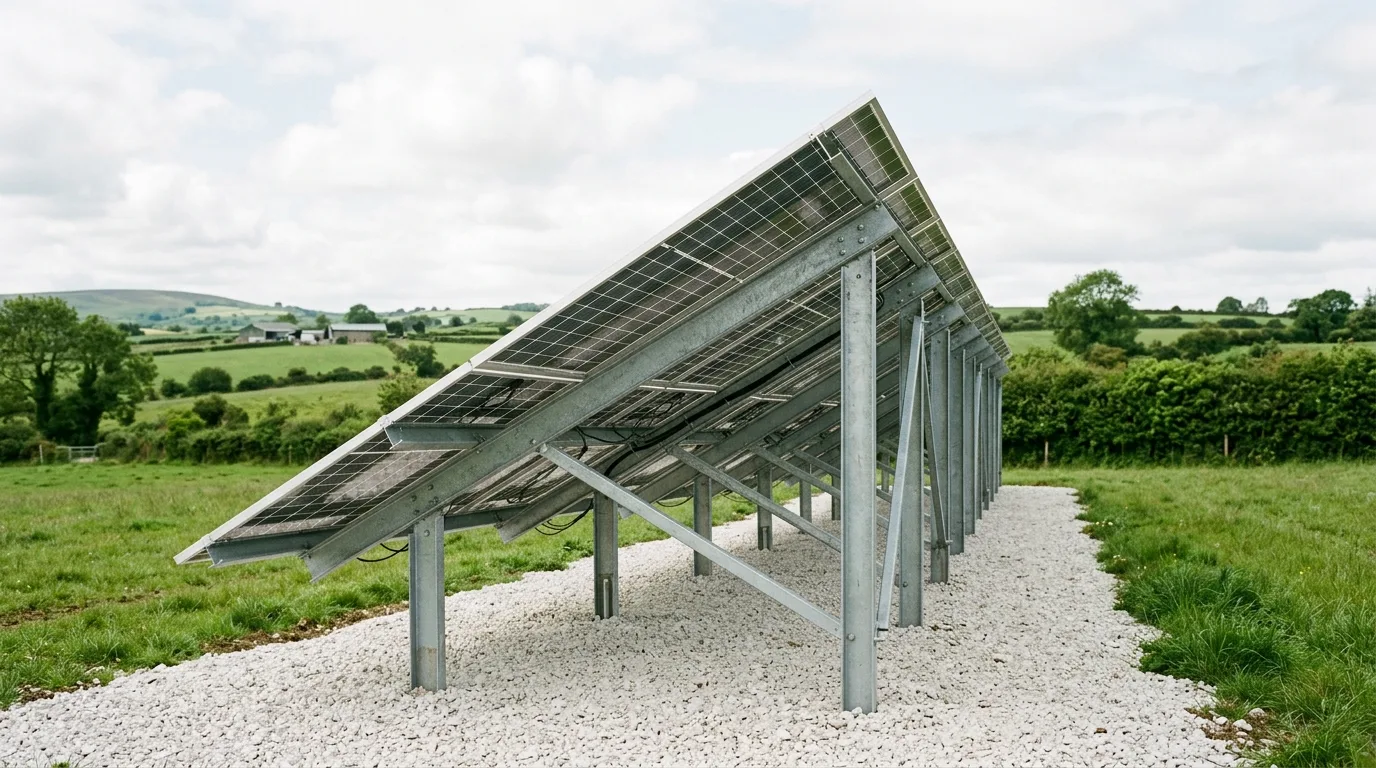
Bifacial solar modules generate electricity from both the front and rear faces of the cell. On the right Irish commercial site they deliver 5-15% more annual energy than equivalent monofacial modules, with a capex premium of just 3-8% in 2026. This guide covers where bifacial pays back in Ireland, where it does not, and how to specify it on a commercial PV project.
How bifacial actually works
Standard monofacial modules have an opaque back-sheet. Bifacial modules use either a glass back-sheet or a transparent polymer back-sheet, allowing the rear face of the cells to absorb light reflected from the ground or surrounding surfaces. The actual rear-side generation depends on:
- Albedo - the reflectivity of the ground beneath the array
- Module height above the ground (higher = more rear-side light)
- Row spacing (wider = more rear-side light)
- Tilt angle and orientation
- Cell technology - modern TOPCon and HJT cells have higher bifaciality factors (75-90%) than older PERC cells
The headline "bifaciality factor" published on datasheets (often 70-90%) is the ratio of rear-side to front-side efficiency in lab conditions. In the field, actual gain is much lower because the rear side only sees diffuse and reflected light.
Realistic bifacial gain in Ireland
PVGIS modelling and Irish field data from 2023-2025 commercial installations show:
- Ground-mount on white gravel/concrete: 10-15% bifacial gain
- Ground-mount on standard grass: 6-10% gain
- Carport over light-coloured concrete: 8-12% gain
- Carport over dark tarmac: 3-6% gain
- Flat rooftop with white membrane: 5-9% gain
- Flat rooftop with dark/grey membrane: 2-5% gain
- Pitched roof with close-coupled mounting: 0-2% gain (rear side is dark)
The headline 15% gain is achievable but requires a deliberate site design - high-tilt ground-mount with white ground covering. The 2-5% rooftop gain is more typical for retrofit commercial projects.
When bifacial is worth specifying
The capex premium for bifacial glass-glass modules in 2026 is approximately 3-8% over equivalent monofacial. For a 200 kWp Irish project that is €2,000-€5,000 extra. The decision rule:
- Ground-mount or carport: specify bifacial by default. The yield uplift consistently pays back the premium within 3-5 years.
- Flat commercial rooftop with white/light membrane: bifacial worth specifying.
- Flat rooftop with dark membrane: marginal; specify only if EPC stocks bifacial anyway.
- Pitched close-coupled rooftop: do not specify - no rear-side light.
For agrivoltaics (panels over grazing or crops) bifacial is particularly valuable as the grass and crops provide moderate albedo and the elevated mounting captures rear-side light effectively.
Glass-glass vs glass-backsheet
Bifacial modules come in two construction types:
- Glass-glass: 2-3 mm tempered glass on both sides. Heavier (~25 kg for a 450W module), more durable, longer warranties.
- Transparent backsheet: lighter (~22 kg), cheaper, slightly lower rear-side efficiency.
For Irish commercial work in 2026, glass-glass is the default specification. The extra weight is manageable on most commercial roofs (additional ~2-3 kg/m² over monofacial), and the durability benefit translates into 30-year linear performance warranties on premium brands.
Recommended bifacial modules in 2026
Brands widely available in Ireland for commercial bifacial:
- REC Alpha Pure-R Bifacial - 450W, HJT cells, 30-year product and performance warranty
- Longi Hi-MO 6 Bifacial - 580W, TOPCon cells, strong supply chain
- Trina Vertex S+ Bifacial - 440-450W, balance of cost and quality
- Jinko Tiger Neo Bifacial - 470-580W, very cost-competitive
- Canadian Solar HiKu7 Bifacial - 550W+, common on ground-mount
Lead times in 2026 are typically 6-10 weeks through Irish distribution. EPCs like Activ8, Enerpower and Powerlink stock bifacial routinely for ground-mount and carport projects.
Design considerations specific to Ireland
- Tilt angle. Bifacial gain increases with tilt up to ~30 degrees. Irish ground-mount typically runs at 25-35 degrees - already in the bifacial sweet spot.
- Row spacing. Wider rows expose more rear surface to reflected light. Standard 1.5x module height spacing captures most of the gain; wider gives diminishing returns.
- Mounting structure. Use mounting brackets that minimise rear-side shading. Mid-clamps and bracket designs that shade <5% of the rear cells are now standard.
- Ground preparation. For ground-mount, light gravel (50-80% reflectivity) outperforms grass (15-25%) by 3-5 percentage points on rear-side generation. Worth the modest groundwork cost.
- Inverter sizing. Bifacial gain shifts the DC/AC ratio. Most EPCs size inverters at 1.1-1.2 DC/AC; for high-bifacial-gain sites, 1.15-1.2 is appropriate to avoid clipping summer peaks.
Monitoring and validation
The challenge with bifacial is that yield is hard to validate. You cannot easily turn off the rear side and compare. Best practice:
- Compare actual generation to PVGIS-modelled bifacial output (most modern modelling tools include bifacial gain)
- Benchmark against a nearby monofacial reference if one exists
- Track albedo seasonally - snow boosts albedo dramatically; wet grass reduces it
- Use string-level monitoring (Huawei or SMA Data Manager) to confirm uniform gain across the array
Tax and grant treatment
Bifacial modules are treated identically to monofacial for the Non-Domestic Microgen Grant - the grant is paid per installed kWp regardless of module technology. Same for ACA: the full module cost qualifies for accelerated capital allowance in year one.
Common pitfalls when specifying bifacial in Ireland
Three traps regularly turn theoretical 12% bifacial gain into actual 4% gain:
- Mounting clamps that shade the rear face. Standard mid-clamps shade 8–12% of rear cells; specialist bifacial-friendly clamps (Schletter Solo-50, K2 SingleRail bifacial) reduce this to 2–4%. The cost premium is €0.02–€0.04/Wp — a rounding error on the bifacial gain it preserves.
- Cable trays under the array. Galvanised cable tray strapped to the underside of a bifacial array on a south-facing ground-mount can shade 6–10% of rear cells across the row. Run cables in trenches or up the rear-most leg, not across the back of the modules.
- Reflective surface assumptions without maintenance. White roof membrane reflectivity falls from 0.75 at year zero to 0.45 by year five without cleaning. Specify either a white-coated TPO with a published 10-year reflectivity warranty (Sika, Carlisle SynTec) or budget for biennial roof cleaning at €0.40–€0.80/m².
Bottom line
Bifacial solar modules deserve to be the default specification for Irish commercial ground-mount, carports and agrivoltaics in 2026. The 3-8% capex premium is comfortably outweighed by 6-15% yield gain on suitable sites. For flat commercial rooftops with dark membrane or pitched close-coupled roofs, monofacial remains the right choice. Specify glass-glass construction, design for adequate row spacing and ground albedo, and bifacial will deliver tangibly more kWh per kWp over the asset life.
Get 3 free commercial solar quotes — free and no obligation.
Frequently asked questions
How much extra energy does a bifacial module produce in Ireland?
On ground-mount with light-coloured ground covering, expect 10-15% bifacial gain. On standard grass ground-mount, 6-10%. On flat rooftops with white membrane, 5-9%. On dark roofs or close-coupled pitched arrays, 0-5%.
Is bifacial worth the extra cost?
Yes for ground-mount, carports and agrivoltaics in Ireland. The 3-8% capex premium is paid back by yield gain in 3-5 years on suitable sites. Marginal for dark-membrane rooftops, not worthwhile on pitched close-coupled installs.
Which bifacial modules are widely available in Ireland in 2026?
REC Alpha Pure-R Bifacial, Longi Hi-MO 6 Bifacial, Trina Vertex S+ Bifacial, Jinko Tiger Neo Bifacial and Canadian Solar HiKu7 Bifacial are all stocked through Irish commercial distribution channels.
Do bifacial modules qualify for the Non-Domestic Microgen Grant?
Yes. The grant is paid per installed kWp regardless of module technology. Bifacial modules qualify identically to monofacial.
Should I use glass-glass or transparent backsheet bifacial modules?
Glass-glass for Irish commercial work. They are more durable, carry longer warranties (often 30-year linear performance), and the additional weight is comfortably handled by typical commercial roofs.
Sources & further reading
- PVGIS Photovoltaic Geographical Information System — European Commission Joint Research Centre
- IEC 60904-1-2 Bifacial PV Module Testing — International Electrotechnical Commission
- Bifacial Photovoltaic Modules and Systems — US National Renewable Energy Laboratory