Farm Solar Grants 2026: 45% SEAI Grant vs 60% TAMS — Which Should Farmers Use?
With SEAI's business solar grant doubled, farmers have two real options: the 45% Non-Domestic Microgen Grant or the 60% TAMS 3 Solar Capital Investment Scheme. You can't stack them — here is how to choose.
By Smart Solar Editorial · Updated 4 November 2026 · 7 min read
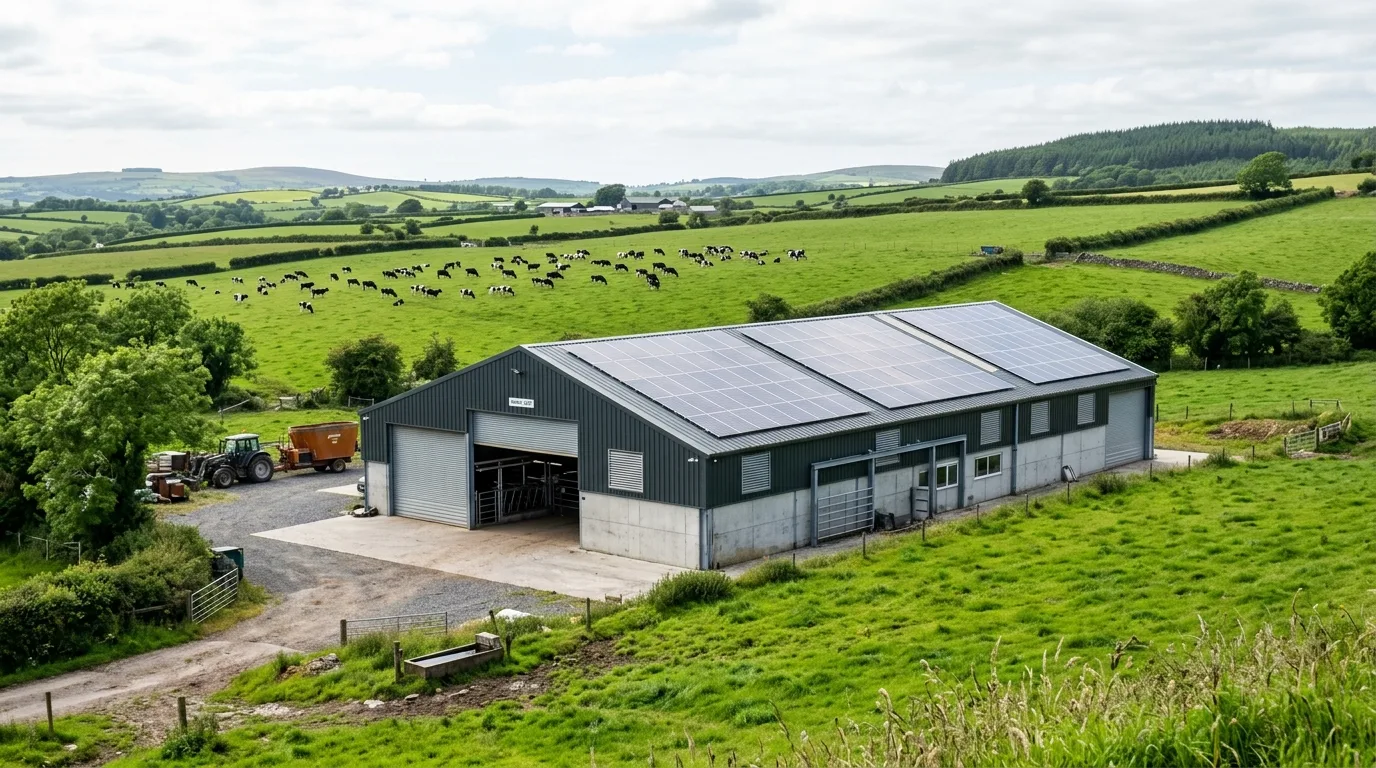
Farms are one of the best fits for solar PV in Ireland: milking, milk cooling, water heating, ventilation and pumping all run during daylight. From 6 October 2026 farmers have two strong grant routes for the same panels — and choosing the wrong one can leave thousands on the table.
The two schemes side by side
| SEAI Non-Domestic Microgen Grant (enhanced) | TAMS 3 Solar Capital Investment Scheme | |
|---|---|---|
| Run by | SEAI | Department of Agriculture, Food and the Marine |
| Grant rate | Lower of SEAI's per-kWp band value and 45% of eligible cost | 60% of eligible investment |
| Maximum | €325,200 (at 1,000 kWp) | Investment ceiling of €90,000 (so up to €54,000 grant) |
| System size | Funded up to 1,000 kWp | Capped by TAMS rules for your farm enterprise |
| Batteries | Not eligible | Check the current TAMS terms |
| How it works | Apply online, offer arrives, 8 months to complete | Apply through agfood.ie in TAMS tranches, scored applications |
| Window | Applications 6 Oct 2026 – 6 Jul 2027 | Open tranches as announced by the Department |
Rule number one: you can't use both
The NDMG terms are explicit: you cannot cumulate aid from the NDMG with any other grant from any Irish Government or State agency source, and the installation must not have been incentivised under any other grant scheme, including schemes run by other departments. So it's one or the other for each installation.
Worked examples
These use illustrative prices. Your quotes decide the real answer.
A 30 kWp system on a dairy farm, costing €40,000
- TAMS at 60%: €24,000 (inside the €90,000 investment ceiling)
- NDMG: band value €17,200, which is below 45% of cost (€18,000) → €17,200
TAMS pays about €6,800 more — if the farm qualifies for TAMS, the system fits within TAMS's size limits, and the timing of the tranche works for you.
A 60 kWp system on a pig or poultry unit, costing €66,000
- TAMS at 60%: €39,600 (inside the ceiling)
- NDMG: band value €29,200, which is below 45% of cost (€29,700) → €29,200
TAMS still pays more, if the system is within the size allowed for the enterprise.
A 150 kWp system on a farm with a large processing or storage load, costing €150,000
- TAMS: the investment ceiling caps the grant at €54,000 at most, and system-size rules may rule it out entirely
- NDMG: band value €65,200, below 45% of cost (€67,500) → €65,200
At this size the NDMG is the stronger option — and it's the only one that scales up to 1,000 kWp.
When the SEAI grant is the better choice
- Larger systems that exceed TAMS's size limits or investment ceiling.
- Speed and certainty. The NDMG is not scored or tranche-based: you apply when ready and receive an offer. TAMS applications are assessed and ranked.
- Your farm isn't eligible for TAMS, or the next TAMS tranche doesn't suit your timing.
- Farm businesses on a domestic meter. SEAI allows an NDMG application on a domestic MPRN where the electrical infrastructure supplies a registered business — common where the farmhouse and yard share a supply. Only one system per MPRN can be funded.
When TAMS is the better choice
- Smaller systems within TAMS size limits, where 60% beats SEAI's band value.
- You want a battery funded. Batteries are not eligible under the NDMG. Check whether the current TAMS terms cover battery storage for your enterprise.
- You're already applying in a TAMS tranche and the timing fits.
What both schemes have in common
- Approval first. Under both schemes, buying equipment or starting work before approval puts the grant at risk.
- Self-consumption. Size the system to what the farm actually uses. Exporting surplus earns far less than avoiding a day-rate unit.
- Registered, qualified installers and proper electrical certification.
Sizing a farm system
A dairy farm's daytime demand is driven by milking, the bulk tank cooler, water heating and pumps. Look at your interval data or at least a year of bills, and size to the daytime base load plus a margin. Over-sizing to fill a big shed roof mostly produces cheap export.
Bottom line
For a typical 20–60 kWp farm system that fits within TAMS's limits, 60% TAMS usually pays more than the enhanced SEAI grant. Above that — or where speed, certainty or a shared domestic meter matter — the 45% NDMG is now a genuinely strong alternative. Get quotes priced both ways before you apply to either.
Get 3 free quotes from SEAI-registered installers — free and no obligation.
Frequently asked questions
Can farmers get the SEAI business solar grant?
Yes. The Non-Domestic Microgen Grant is open to the agricultural sector. From 6 October 2026 it pays the lower of SEAI's per-kWp band value and 45% of eligible cost, up to €325,200.
Can I combine TAMS and the SEAI solar grant?
No, not on the same installation. The NDMG cannot be cumulated with any other grant from an Irish Government department or State agency, and the installation must not have been funded under another grant scheme.
Which pays more for farm solar, TAMS or the SEAI grant?
For smaller systems within TAMS size limits, TAMS at 60% usually pays more. For larger systems, or where TAMS limits or its €90,000 investment ceiling bite, the enhanced SEAI grant can pay more.
Does the SEAI farm solar grant cover batteries?
No. Batteries are not eligible costs under the Non-Domestic Microgen Grant.
Sources & further reading
- Non-Domestic Microgen Scheme — Terms and Conditions — SEAI
- Non-Domestic Microgen Scheme — Application Guide — SEAI
- TAMS 3 Solar Capital Investment Scheme — Department of Agriculture, Food and the Marine
- Non-Domestic Microgen Grant (solar PV for business) — SEAI