Corporate Solar PPAs in Ireland: Structures, Pricing and Pitfalls
Corporate PPAs let Irish businesses lock in solar electricity for 10-15 years without owning the asset. Here are the structures, pricing and contract clauses that matter.
By Smart Solar Editorial · Updated 15 May 2026 · 11 min read
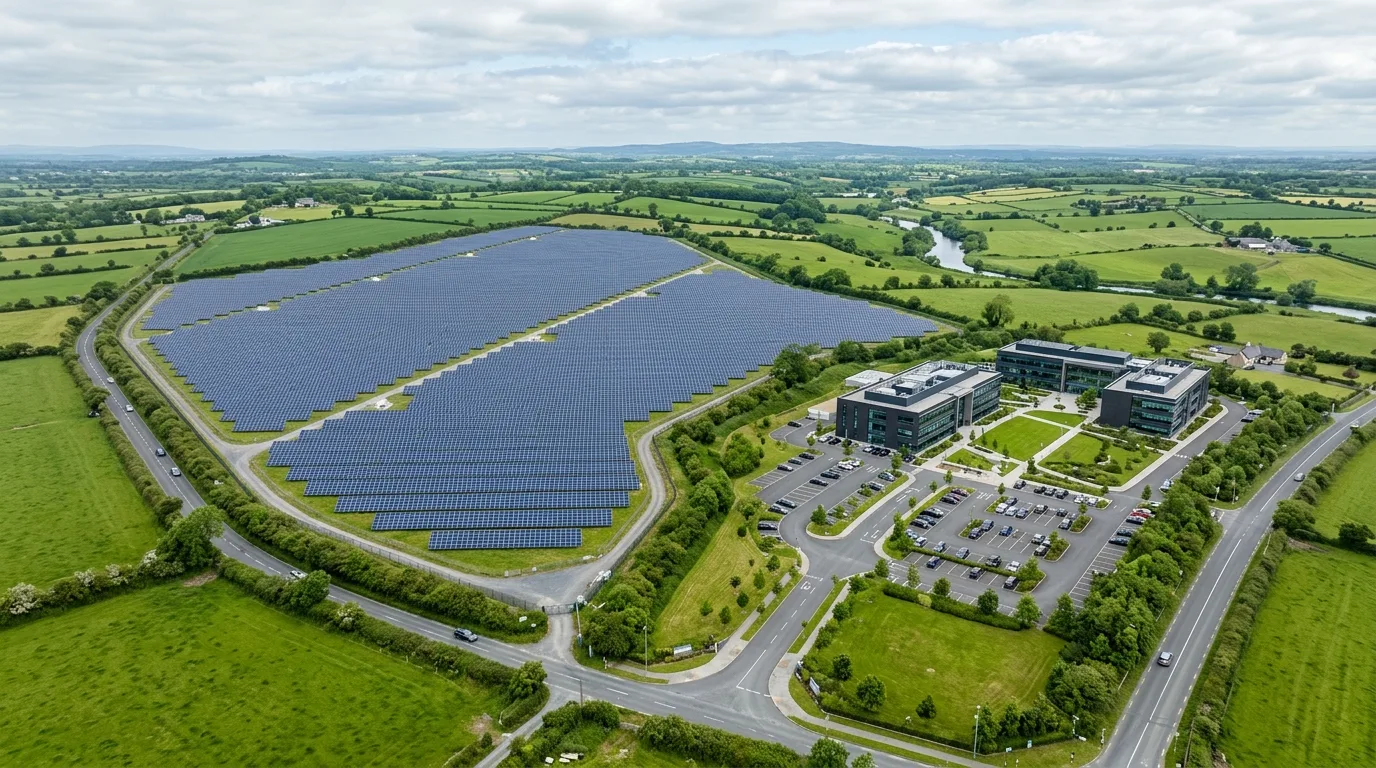
Corporate Power Purchase Agreements (PPAs) have become the default tool for large Irish energy buyers - tech, pharma, food processing, retail and increasingly the public sector - to secure long-dated, fixed-price renewable electricity. By 2026 Ireland has crossed 2 GW of contracted corporate PPA volume, with utility, IPP and aggregator counterparties all active. This guide explains the structures available, where pricing currently sits, and which contractual details actually decide whether the deal works.
The three main PPA structures
1. On-site / behind-the-meter
A developer funds, builds, owns and operates a PV system on your land or roof. You pay a per-kWh tariff for the solar electricity consumed. Surplus is exported. Tenor typically 15-25 years.
- Pro: zero capex, simple savings story, you avoid O&M complexity.
- Con: longer-term obligation, less flexibility if your site relocates or load profile changes.
- Typical PPA price 2026: 12-18 c/kWh ex VAT, indexed to CPI or a blended escalator.
2. Sleeved (physical off-site)
A solar farm somewhere else in Ireland generates electricity. An intermediary supplier (Bord Gais, Electric Ireland, SSE Airtricity, Energia, Flogas, Pinergy) "sleeves" the energy from the project to your meter under your existing supply contract. You receive the electricity plus the renewable origin certificates.
- Pro: works at scale (5-50 MW typical), proper additionality, doesn't depend on your roof or land.
- Con: market-risk exposure during shaping and balancing.
- Typical 2026 sleeved PPA price: 75-95 €/MWh fixed for 10-15 years.
3. Virtual / Synthetic (financial)
You don't take physical delivery. You sign a contract-for-difference style swap with the generator: if the wholesale price is above the strike, the generator pays you; if below, you pay them. Your physical supply continues unchanged.
- Pro: zero operational integration, scales beyond any single site, supports Scope 2 reporting via RGGOs/Guarantees of Origin.
- Con: accounting complexity (often must be marked-to-market under IFRS 9), regulatory clarity still evolving in Ireland.
- Typical 2026 virtual PPA strike: 70-90 €/MWh.
What is driving 2026 pricing
Three forces:
- Wholesale gas-set prices in SEM have stabilised around 90-110 €/MWh. Solar PPAs price relative to forward curves with a 10-25% discount for the contracted lock-in.
- Connection queue length. Projects with grid offers that have already been signed and a clear path to energisation carry a premium of 5-15 €/MWh over speculative projects.
- Tax and tariff policy. The continuing absence of a strong RESS-style support for behind-the-meter solar means corporate offtake remains the primary commercial route for utility-scale Irish PV.
Contract terms that matter most
A PPA negotiation lives or dies on roughly twelve clauses. The ones to read most carefully:
- Price escalator. Fixed, CPI-linked, blended (e.g. 60% fixed + 40% CPI), or wholesale-linked above a floor. A 2.5% fixed escalator over 15 years compounds to a 45% price increase by year 15.
- Volume guarantee. Pay-as-produced is generally cheaper than pay-as-forecast. Make sure your supplier or sleeve agent quotes the shaping cost transparently.
- Curtailment and dispatch-down. Who pays when ESB Networks or EirGrid instruct the project to reduce output? In Ireland's increasingly constrained network, this can be 3-8% of nominal annual output.
- Guarantees of Origin (GOs). Specify quantity, registry (IRENA/AIB), retirement timing and reporting.
- Change of law. Define what counts (e.g. CRU tariff changes, network reinforcement charges) and the price adjustment formula.
- Step-in rights. Lenders to the developer will require step-in if you default; you should require step-in if the developer fails operationally.
- Replacement supply. If the project trips or under-produces, who supplies the shortfall and at what price?
- Exit and assignment. Can you assign the PPA to a successor entity if you sell the business or relocate?
Counterparty landscape in 2026
The active Irish PPA counterparties include:
- Utilities: SSE Airtricity, Bord Gais Energy, Electric Ireland, Energia, ESB Smart Energy Services, Flogas, Pinergy.
- IPPs and developers: Statkraft, Lightsource bp, NTR, Power Capital, Greencoat, Solar 21, Octopus Renewables.
- Aggregators: Various boutique advisory and aggregation firms specialising in cluster PPAs for SMEs.
For deals under 5 MW, aggregation through a supplier is often the only practical route because legal and structuring costs do not scale down well.
Worked example: 10 MWp sleeved PPA for an Irish food group
- Buyer: multi-site food group consuming 40 GWh/year.
- Project: 10 MWp solar farm in Wexford, signed 15-year sleeved PPA.
- Strike: 84 €/MWh, fixed, no escalation.
- Expected delivery: 9.6 GWh/year (24% of total demand).
- Wholesale benchmark forecast: 95-110 €/MWh.
- Annual hedge value: €100k-€250k at expected forwards.
- Scope 2 reduction: ~3,700 tCO2e/year.
The buyer gets a long-dated hedge, an authentic decarbonisation narrative and additionality (the project would not have been built without the PPA).
Common pitfalls
- Treating it like a utility supply contract. A PPA is a 10-15 year capital structure. Get an experienced energy lawyer.
- Underestimating internal accounting effort. Virtual PPAs in particular require finance, treasury and audit alignment.
- Ignoring shape risk. Solar produces summer-daytime; your load might be winter-night. The mismatch is priced and you pay it.
- Single-project concentration. A 100% PPA dependent on one farm has single-point-of-failure risk. Many corporates now sign portfolio PPAs across two or three projects.
How to start
- Pull 3 years of half-hourly consumption.
- Decide your renewable target and timeline.
- Issue a market-sounding RFI to 6-10 counterparties.
- Shortlist 3 for structured RFP.
- Plan 6-9 months from RFP to signed deal.
Field-tested PPA negotiation checklist
Before signing, walk through this checklist with your treasury, sustainability and legal teams:
- Stress-test against three wholesale scenarios. Run the PPA strike against (a) DECC forward curve, (b) DECC curve minus 25%, and (c) DECC curve plus 15%. A PPA that only wins in one scenario is a speculation, not a hedge. Robust deals deliver positive NPV across all three.
- Confirm GO registry and vintage. Irish GOs trade through the IRENA AIB hub. Specify "Irish-issued GOs, same-year vintage, retired by 31 March" in the contract. Cross-border or prior-year GOs degrade your Scope 2 reporting under GHG Protocol Market Based methodology.
- Verify financial close conditions precedent. Many speculative PPAs require ESB Networks grid connection, planning permission and final investment decision before the project breaks ground. Add a long-stop date (typically 24–30 months from PPA signing) beyond which you can walk away without penalty.
- Negotiate force majeure with precision. Standard force majeure clauses now exclude pandemic-style disruption (carved out post-2022). Insist on explicit treatment of grid curtailment, transformer failure (>4-week outage) and extreme weather events.
- Get CSRD/CSDDD alignment in writing. From 2026, larger Irish buyers must report Scope 2 emissions under CSRD. Confirm the developer will provide annual generation, emissions and additionality data in CSRD-compatible format — not all 2022-2024 vintage PPAs include this.
Corporate PPAs are no longer exotic - in 2026 they are the standard tool for any Irish business consuming above 5 GWh/year that wants long-term price certainty and credible Scope 2 reductions.
Get 3 free commercial solar quotes — free and no obligation.
Frequently asked questions
What is a corporate PPA in Ireland?
A long-term contract under which an Irish corporate buys electricity directly from a renewable generator, typically a solar or wind farm, either physically through a sleeved supply or financially through a virtual swap.
How long are typical Irish solar PPAs?
Most Irish corporate solar PPAs run 10-15 years, with on-site projects often extending to 20-25 years. Shorter tenors carry meaningful premiums because they limit the developer's debt capacity.
What does a sleeved PPA cost in Ireland in 2026?
Sleeved solar PPAs typically price between 75 and 95 €/MWh in 2026 depending on volume, tenor, indexation and counterparty credit quality.
Can SMEs sign corporate PPAs?
Yes, but generally through aggregator structures rather than bilateral deals. SMEs consuming below 5 GWh/year usually access PPA-style products via green supply contracts from utilities or pooled aggregator deals.
Sources & further reading
- Renewable Electricity Support Scheme — Department of the Environment
- CRU Wholesale Electricity Market — Commission for Regulation of Utilities
- EirGrid Generation Capacity Statement — EirGrid