Solar PV for Irish Data Centres 2026: On-Site Generation and PPA Strategy
Data centres are Ireland's largest electricity consumers. On-site solar PV is constrained but corporate PPAs are reshaping the sector. Here is how Irish data centre operators should think about solar in 2026.
By Smart Solar Editorial · Updated 6 October 2026 · 10 min read
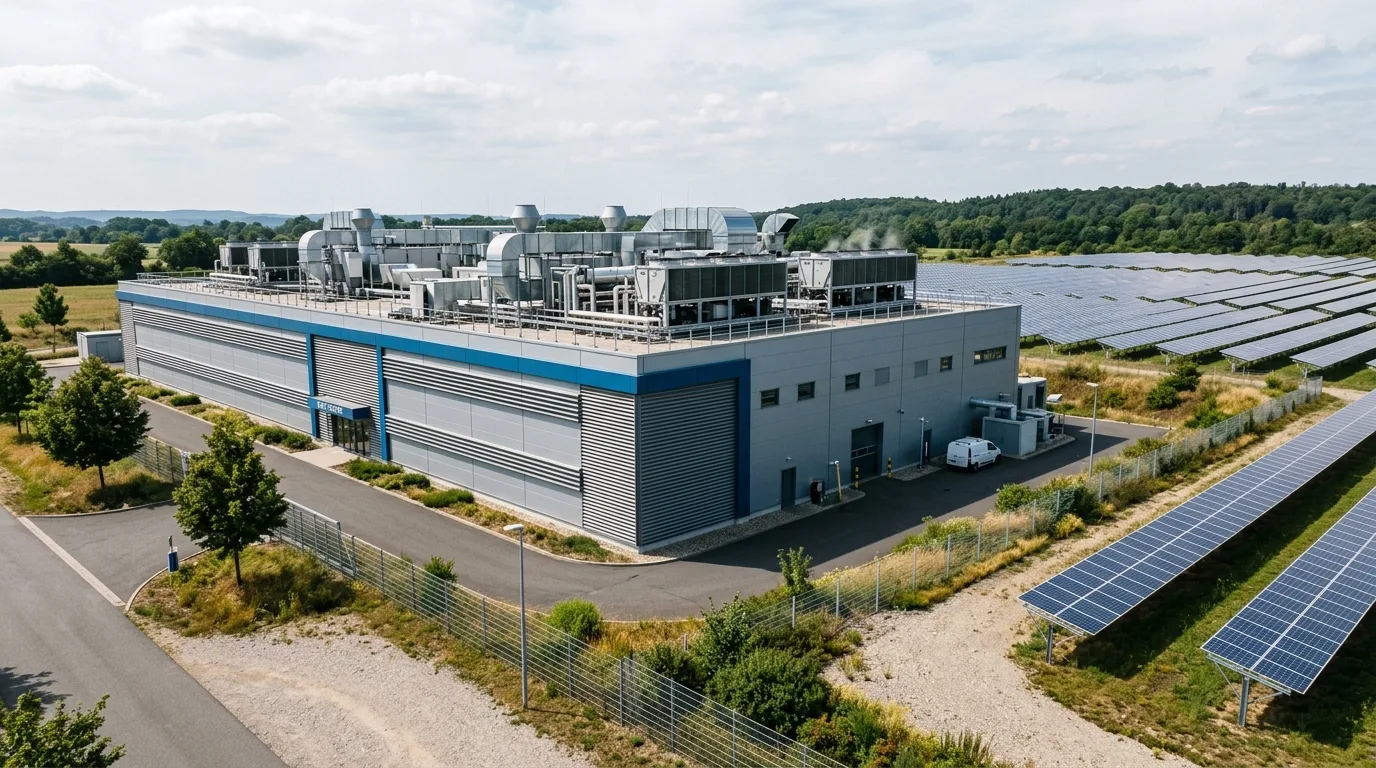
Data centres are Ireland's single largest commercial electricity demand category - approximately 21% of national consumption in 2024 and rising. The constraints on grid connection introduced by EirGrid and CRU since 2021, combined with growing CSRD and hyperscaler ESG commitments, have made solar PV a central part of every credible data centre energy strategy in 2026. This guide covers the realistic on-site solar opportunity, corporate PPAs, and how Irish data centre operators should approach renewable procurement.
The data centre energy challenge
A modern hyperscale data centre in Ireland typically draws 50-200 MW continuously. Total annual consumption is 430 GWh to 1,750 GWh per facility. Even a modest co-location data centre draws 5-30 MW.
By contrast, a maximised on-site rooftop solar installation on the data centre building itself might cover 2-5% of total consumption on a hyperscale facility, and perhaps 5-15% on a smaller co-location site. On-site solar can never offset data centre load on its own - the question is what role it plays alongside corporate PPAs, behind-the-meter generation, and emerging on-site storage.
On-site rooftop solar: the realistic ceiling
A typical hyperscale data centre building of 30,000 m² could host 2-3 MWp of rooftop solar - generating approximately 1.8-2.7 GWh per year. Against 500-1,000 GWh annual consumption, this is 0.2-0.5%. Not insignificant in absolute kWh terms (it is the equivalent of a large commercial rooftop) but a small fraction of total demand.
On-site solar is still worth doing because:
- It directly counts towards Scope 2 reduction and renewable energy share metrics
- It demonstrates physical on-site sustainability action to regulators and communities
- It supports facility EUE (Energy Usage Effectiveness) and renewable EUE metrics
- It provides resilience benefit during grid outages (with appropriate islanding design)
- The economic returns are still strong (sub-3-year payback typical)
- Several hyperscalers have committed to on-site renewable energy as a brand standard
For a 100 MW hyperscale facility a 2-3 MWp rooftop install is essentially a rounding error in operating costs but a meaningful element of the sustainability narrative.
On-site ground-mount and carport
Where data centre campuses include significant landscaped land or surface car parking, the on-site footprint can grow substantially:
- Ground-mount on landscaped perimeter: 1-5 MWp typical
- Carport over employee and visitor parking: 0.5-2 MWp
- Combined campus: 5-15 MWp potentially
For some Irish data centres the total on-site renewable footprint can reach 5-10% of consumption when ground-mount and carports are added. Worth pursuing for the ESG and resilience benefits, even if it does not move the needle on overall consumption.
The corporate PPA reality
For data centre operators, corporate power purchase agreements (CPPAs) with off-site Irish solar and wind projects are the primary route to renewable energy at scale. In 2026, the Irish data centre sector has signed CPPAs for several GW of renewable generation, contracted years ahead of operational delivery.
Typical structures:
- Physical PPA: developer builds and operates a dedicated solar or wind farm; output is delivered to the data centre via the grid (with appropriate settlement)
- Virtual PPA (vPPA): developer sells output to the market; data centre receives a notional financial settlement that hedges its actual power price
- Sleeved PPA: electricity supplier acts as intermediary, simplifying settlement for both parties
For solar specifically, Irish CPPAs in 2026 typically price at €70-€110/MWh for 10-15 year terms, depending on project size, location and grid connection certainty. Wind PPAs are typically lower (€55-€85/MWh) but more variable.
The EirGrid moratorium and capacity constraints
Since the 2021 CRU decision and subsequent EirGrid policy, new data centre connections in the Dublin area face strict capacity constraints. CRU and EirGrid criteria for new data centre connections now typically include:
- Demonstrated renewable energy sourcing aligned with consumption
- On-site generation contribution
- Dispatchable on-site generation (typically gas turbine or fuel cell)
- Demand-response capability
In this context, on-site solar PV is part of the "demonstrating renewable contribution" requirement, even if its absolute contribution is small. A new data centre application without on-site solar is essentially incomplete in 2026.
ESG and CSRD reporting
Data centres are at the leading edge of corporate sustainability reporting. CSRD obligations and hyperscaler net-zero commitments drive requirements for:
- 100% renewable electricity matching (hourly or annual)
- Scope 2 emissions reduction
- Scope 3 emissions including embodied carbon of construction
- Water usage effectiveness (WUE)
- On-site renewable share
Solar PV contributes to several of these directly. The most demanding hyperscalers (Google, Microsoft, Amazon) have committed to 24/7 carbon-free energy matching by 2030 - which solar plus storage plus other renewables must collectively deliver hour-by-hour, not just on annual averages.
Behind-the-meter solar + battery
For some data centre operators, behind-the-meter solar with battery storage is being explored as a path to genuine 24/7 matching. Typical configurations being explored in Ireland in 2026:
- 10-30 MWp on-site solar (including ground-mount and carports)
- 20-100 MWh battery storage
- Integration with on-site dispatchable generation (gas, fuel cell)
- Smart EMS optimising across all generation and load
These are non-trivial engineering and capital projects (€30-€150M+) but several Irish data centre owners are progressing them in tandem with new build programmes.
Indicative on-site rooftop economics
A worked example for a small Irish co-location facility (10 MW connected load):
- 2 MWp rooftop solar installation
- Capex: €1.8M ex-VAT
- Non-Domestic Microgen Grant: €325,200 (enhanced maximum, paid on the first 1,000 kWp)
- ACA tax relief on remaining €1.47M at 12.5% corporation tax: €184,000
- Net capex: ~€1.29M
- Annual generation: ~1.8M kWh at 900 kWh/kWp
- Self-consumption: 100% (data centre demand vastly exceeds PV generation)
- Value at 22c/kWh (large industrial rate): €396,000/year
- Simple payback: ~3.3 years
- 25-year cumulative saving: €8M+
For hyperscalers the headline grant cap means percentage support is small, but absolute returns remain strong because every kWh self-consumed displaces grid imports.
Procurement and EPC selection
Data centre solar EPCs in Ireland in 2026 typically need:
- Track record on critical-infrastructure sites (downtime is unacceptable)
- Cybersecurity capability (NIS2 obligations apply)
- Coordinated working with the data centre operations team
- Ability to execute through change-control without disrupting live load
- Experience with the data centre's existing electrical infrastructure (HV switchgear, UPS, generator interfaces)
Activ8, Enerpower, Mercury Engineering, ESB Smart Energy Services and a small number of specialist contractors have meaningful data centre solar track records.
Cybersecurity and NIS2
Data centres in scope for NIS2 (which is most of them) must apply enhanced cybersecurity controls to all connected operational technology, including solar monitoring. The PV monitoring network must be VLAN-isolated, firewalled, and integrated with the data centre SOC rather than connecting to public internet directly.
Bottom line
On-site solar PV on Irish data centres in 2026 is essential for ESG positioning and regulatory compliance but cannot offset data centre load on its own. The realistic on-site contribution is 1-5% of consumption for hyperscale and 5-15% for smaller co-location. Real renewable energy at scale comes from corporate PPAs with off-site solar and wind, increasingly bundled with on-site storage. The combination is now a baseline expectation for new connections, not an optional extra.
Get 3 free commercial solar quotes — free and no obligation.
Frequently asked questions
Can on-site solar power an Irish data centre?
No. The energy density of data centre operations far exceeds what rooftop solar can deliver. Realistic on-site solar contribution is 1-5% for hyperscale and 5-15% for smaller co-location facilities. Real renewable matching is delivered through corporate PPAs.
Why install on-site solar if it covers so little of demand?
Scope 2 reduction contribution, ESG narrative, support for new connection approvals under EirGrid policy, facility resilience benefits, strong financial returns on the small percentage that is delivered, and explicit hyperscaler commitments to on-site renewable energy.
What does an Irish corporate solar PPA cost in 2026?
Typically €70-€110/MWh for 10-15 year solar PPAs depending on project size, location and grid connection certainty. Wind PPAs are typically lower (€55-€85/MWh) but more variable in output.
Does EirGrid require on-site renewable energy for new data centre connections?
Effectively yes. CRU and EirGrid criteria for new data centre connections now include demonstrated renewable energy sourcing, on-site generation contribution, and dispatchable on-site generation. On-site solar PV is part of meeting these requirements.
How do data centres pursue 24/7 carbon-free energy matching?
Through a combination of corporate PPAs sized to annual consumption, on-site solar PV, battery storage to shift renewable energy into low-renewable hours, and dispatchable low-carbon generation (gas turbines, fuel cells). Hyperscaler commitments target this by 2030.
Sources & further reading
- CRU Direction on Data Centre Grid Connection — Commission for Regulation of Utilities
- EirGrid Generation Capacity Statement — EirGrid
- Data Centres and Climate Action Plan — Department of Environment, Climate and Communications