Solar PV for Irish Manufacturing 2026: Industrial Site Guide
Irish manufacturers are scaling commercial solar fast - driven by electricity costs, ESG pressure and shareholder demands. Here is how to specify and deliver industrial solar PV in 2026.
By Smart Solar Editorial · Updated 6 October 2026 · 10 min read
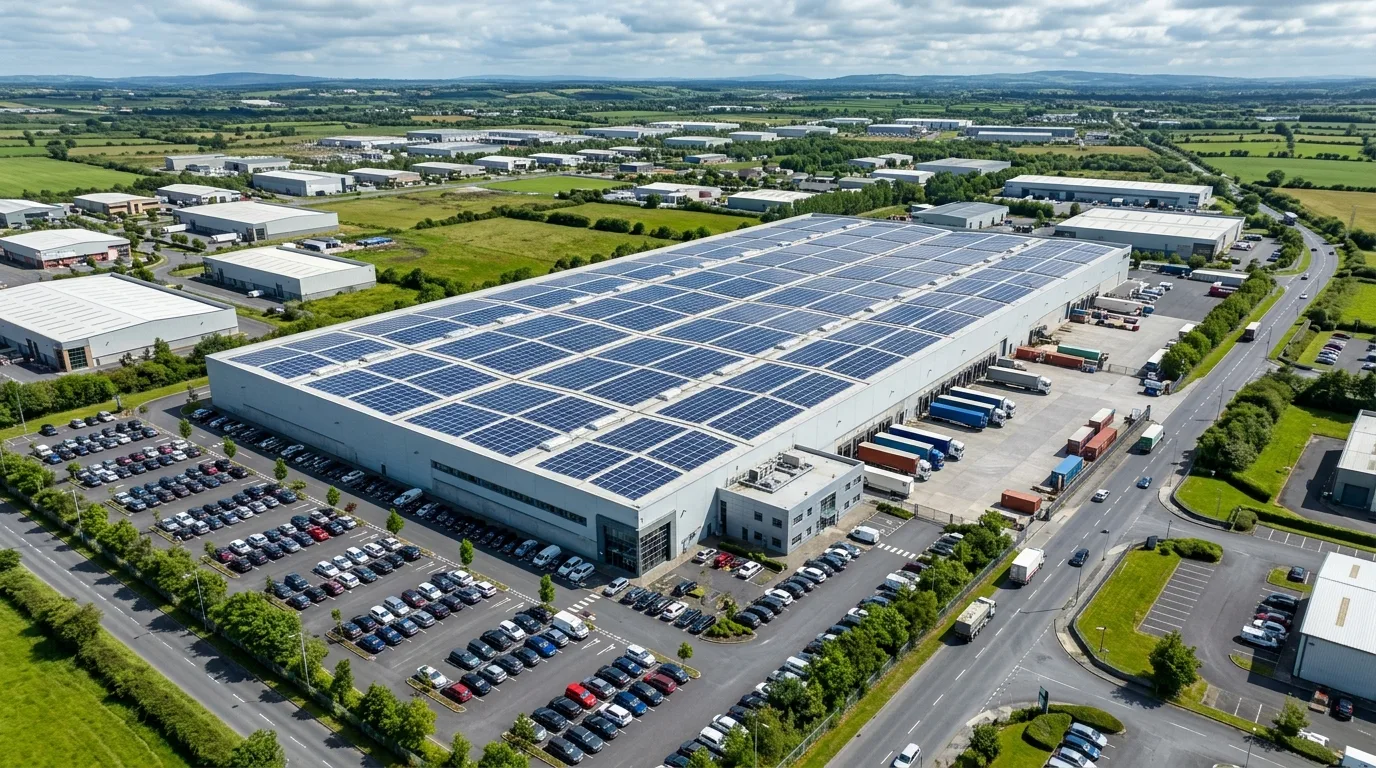
Irish manufacturing is one of the most attractive markets for commercial solar PV in 2026. Large flat roofs, high daytime electricity demand, three-phase supply, multinational ESG pressure and rising industrial electricity prices have combined to make rooftop and ground-mount solar a near-default investment for new and existing manufacturing facilities. This guide covers the sizing approach, grid considerations, ESG drivers and real-world economics for solar on Irish manufacturing sites.
Why manufacturing fits solar so well
Irish manufacturing facilities have an unusually good match between solar generation and electricity load:
- Daytime production hours. Most facilities run 6am-10pm Monday-Friday at minimum; many run 24/5 or 24/7.
- Large flat or low-pitched roofs. Typical manufacturing units have 5,000-50,000 m² of roof area suitable for PV.
- Three-phase MV or LV supply. Most have the electrical infrastructure to accept large PV connections.
- Significant base load. Refrigeration, compressed air, HVAC, lighting all run continuously - delivering very high self-consumption ratios.
- ESG and CSRD pressure. Many Irish manufacturers are subsidiaries of multinationals required to report Scope 2 reductions.
For most Irish manufacturers above 30,000 m² floor area, the question in 2026 is not whether to install solar but how big and how fast.
Typical sizing for Irish manufacturing
Manufacturing loads vary widely by sector. Rough guides:
- Light manufacturing/assembly: 50-150 kWh/m² per year
- Food and beverage: 200-500 kWh/m² per year
- Pharmaceutical: 400-1,200 kWh/m² per year
- Heavy industrial (chemicals, metals): 500-2,500 kWh/m² per year
- Data-driven manufacturing/cleanrooms: 1,000-3,000 kWh/m² per year
Solar sizing rule of thumb in 2026:
- 10,000 m² light manufacturing: 200-300 kWp PV
- 10,000 m² food/beverage: 300-500 kWp PV
- 10,000 m² pharmaceutical: 500-1,000 kWp PV
- 10,000 m² heavy industrial: 700-1,500 kWp PV (constrained by roof area)
The constraint is usually either roof area, grid connection capacity, or capex appetite - rarely electricity consumption. Most Irish manufacturers can comfortably absorb 100% of solar generation as self-consumption.
Rooftop vs ground-mount for manufacturing
Rooftop is preferred when:
- The roof is structurally adequate (typically post-2000 construction with KS1000 or similar cladding)
- The roof area can support enough kWp to meaningfully offset load
- No planned roof refurbishment in the next 5-10 years
- Asset is owned, not leased on a short lease
Ground-mount in adjacent land is appropriate when:
- Roof is structurally compromised or planned for replacement
- Larger system needed than roof can support
- Adjacent land is available (often the underused frontage or rear yard)
- The site has parking that could host carports
Many Irish manufacturers in 2026 are doing both - maximising the roof and adding carports over staff parking to push past 1 MWp.
Grid connection considerations
Most manufacturing sites already have a three-phase supply, but the connection capacity may not accommodate a large PV system without an upgrade:
- Sub-200 kVA supply: PV typically limited to 50-150 kWp without import-MIC upgrade
- 200-500 kVA supply: 200-500 kWp PV typically accommodatable
- 500 kVA-2 MVA supply: 500 kWp-2 MWp PV often viable
- MV-connected sites (above 2 MVA): much larger PV systems possible, but reverse-flow analysis required
The ESB Networks NC7 application drives this. Apply early; manufacturing sites in industrial estates often share substation capacity and may be constrained by neighbouring sites' generation already in the queue.
ESG drivers and CSRD reporting
Since 2024-2025, the Corporate Sustainability Reporting Directive (CSRD) has brought formal sustainability reporting obligations to a widening pool of Irish companies. For Irish manufacturers, particularly those owned by multinationals or supplying multinationals, solar PV directly contributes to:
- Scope 2 emissions reduction (renewable electricity displaces grid imports)
- Renewable energy share (a key CSRD disclosure)
- Energy intensity (kWh per unit of production)
- Climate transition plan credibility
Many Irish manufacturers have reported that the ESG benefit alone now justifies modest solar investments that would not have made a pure financial case 3-5 years ago. With strong financial returns also available in 2026, the dual benefit is making solar approvals fast.
Indicative 2026 economics
Worked example for an Irish food manufacturer with 800,000 kWh/year consumption, 12,000 m² flat roof:
- System sized at 500 kWp
- Capex: ~€500,000 ex-VAT
- Non-Domestic Microgen Grant: €175,200 (enhanced band value for 500 kWp)
- ACA tax relief on remaining €324,800 at 12.5% corporation tax: €40,600
- Net capex after grant + ACA: ~€284,000
- Annual generation: ~450,000 kWh at 900 kWh/kWp
- Self-consumption: 95% = 427,500 kWh at 28c/kWh = €119,700
- Export: 5% = 22,500 kWh at 14c/kWh = €3,150
- Total annual saving: ~€122,850
- Simple payback: ~2.3 years on net capex
- 25-year cumulative saving: €2.5M+
For larger sites (1 MWp+) the headline grant cap means the percentage support drops, but absolute returns remain very strong.
EXEED for larger projects
For manufacturing projects above 300 kWp where the broader energy strategy includes additional measures (lighting upgrades, compressed air optimisation, heat recovery, controls), the SEAI EXEED programme can be more valuable than NDMG. EXEED provides up to 30% capped at €3M and aligns well with ISO 50001 or similar structured energy management.
The decision between NDMG and EXEED for manufacturing typically depends on:
- Total project size and breadth of measures
- Whether you have ISO 50001 in place
- Capex sensitivity vs holistic energy strategy
- Project timeline (NDMG is faster; EXEED is more strategic)
Phasing for fast deployment
For sites with multiple buildings or roof sections, phased deployment can:
- Spread capex over multiple years for budget planning
- Allow learning from Phase 1 to inform Phase 2 design
- Match grant cycles (one NDMG application per phase if structured correctly)
- De-risk grid connection (smaller blocks easier to approve)
Typical phasing: 200-300 kWp in year 1, expanding to 500-800 kWp in year 2-3, with potential carport or ground-mount addition in year 3-4.
Industrial-specific design considerations
- Process equipment on roof. Many manufacturing roofs have AHUs, chillers, extract fans, dust collectors, conveyor housings. Solar layout must work around these without compromising service access.
- Vibration and harmonic environments. Some processes (compressors, grinders) generate vibration or harmonics that affect inverter siting and electrical design.
- Cleanroom requirements. Pharma and medical device facilities have controlled-environment requirements that affect roof penetrations and access.
- 24/7 operations. Installation must be planned around production schedules; some sites require night work.
- Hazardous areas. See the Seveso solar guide for COMAH-regulated facilities.
Recommended EPCs for Irish manufacturing
Active Irish EPCs with strong manufacturing track records in 2026 include Activ8 Solar Energies, Enerpower, Mercury Engineering, Powerlink, John Sisk, ESB Smart Energy Services, and a growing number of specialist contractors for the pharma sector. Ask for at least three references at your size and sector.
Bottom line
Solar PV for Irish manufacturing in 2026 is one of the highest-conviction commercial energy investments available. Sub-3-year paybacks are routine, ESG benefits are tangible, and the technology is mature. Size to roof area and grid connection rather than load (most manufacturers have headroom), apply for NC7 and NDMG in parallel, and use ACA to accelerate tax relief. For larger sites consider EXEED instead. The Irish manufacturing solar opportunity is real - and finite, as grid capacity tightens in many industrial estates.
Get 3 free commercial solar quotes — free and no obligation.
Frequently asked questions
How big a solar PV system fits on a 10,000 m² Irish manufacturing roof?
Typically 300-800 kWp depending on roof structure and orientation. Modern flat-roof manufacturing buildings comfortably accommodate 60-80 W/m² of solar capacity, allowing 600-800 kWp on a 10,000 m² roof with ballasted east-west or tilted south layouts.
What is the typical payback on Irish manufacturing solar in 2026?
2-3.5 years on net capex for properly sized systems. Manufacturing typically achieves 90-98% self-consumption, which maximises return per kWp installed. NDMG grant and ACA tax relief accelerate payback further.
Should I use NDMG or EXEED for manufacturing solar?
NDMG is simpler and faster for standalone PV projects up to ~300 kWp. EXEED suits larger projects bundled with broader energy measures (lighting, compressed air, heat recovery) particularly under ISO 50001 management systems.
Will my existing grid connection accept a large PV system?
Often not without modification. Apply for NC7 early. Manufacturing sites in industrial estates often share substation capacity and may be constrained by neighbouring sites' generation already in the queue.
How does solar contribute to my CSRD sustainability reporting?
Solar reduces Scope 2 emissions (renewable electricity displaces grid imports), increases your renewable energy share, lowers energy intensity per unit of production, and supports your published climate transition plan. All are formal CSRD disclosures.
Sources & further reading
- SEAI Large Industry Energy Network — SEAI
- Corporate Sustainability Reporting Directive (CSRD) — European Commission
- ISO 50001 Energy Management — International Organization for Standardization