Solar PV for Irish Hotels and Hospitality 2026: Cutting Operating Costs
Irish hotels face high year-round electricity demand and rising guest expectations on sustainability. Here is how to specify commercial solar PV for hospitality in 2026.
By Smart Solar Editorial · Updated 15 May 2026 · 9 min read
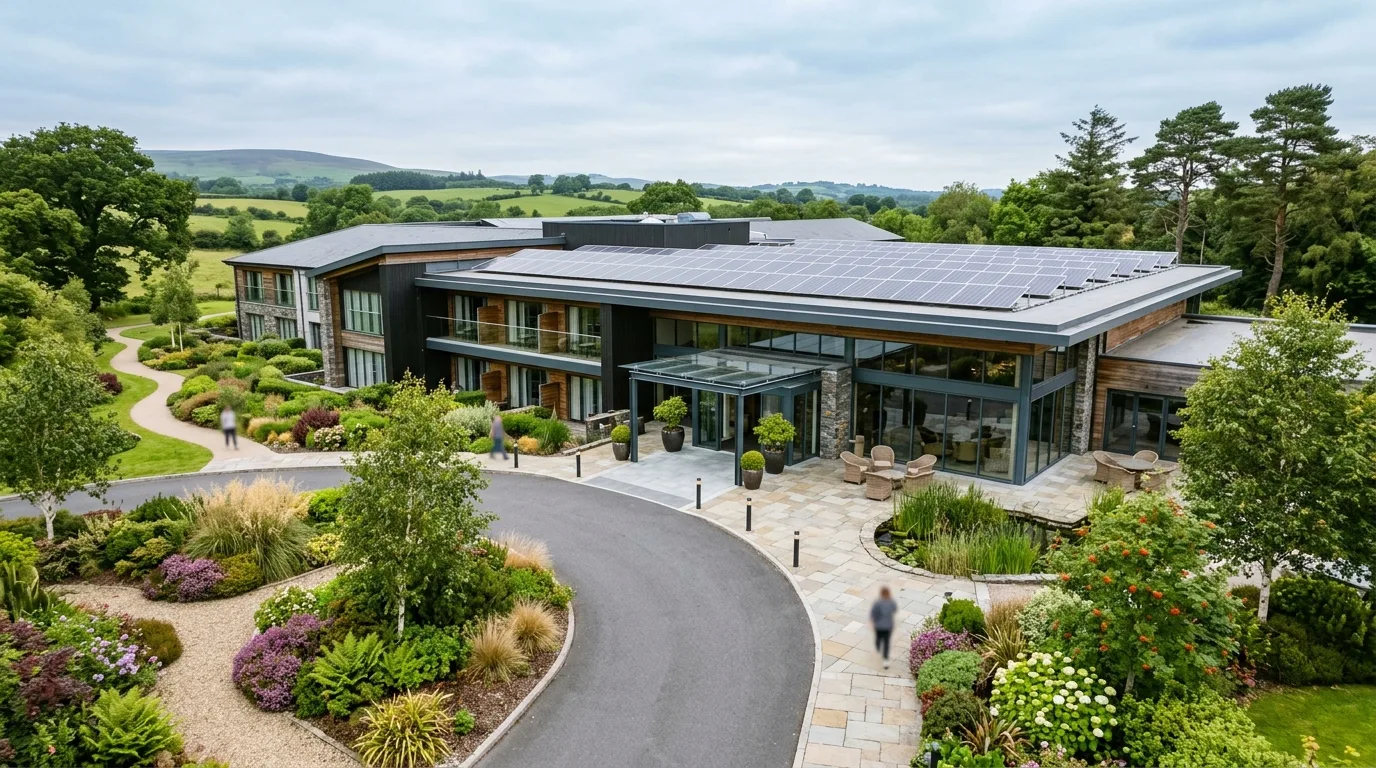
Irish hotels and hospitality businesses have a strong case for commercial solar PV in 2026. The combination of year-round operations, significant electricity demand for HVAC, kitchen, laundry and lighting, and increasing guest expectations on sustainability makes solar PV both economically attractive and brand-positive. This guide covers sizing, planning considerations, seasonality, ESG positioning and real-world payback for hotels, B&Bs, restaurants and event venues.
Why hospitality fits commercial solar
Irish hotels and hospitality businesses share several characteristics that suit solar PV:
- Year-round operation. Unlike retail or office buildings, hotels run 24/7/365 with consistent base load.
- High daytime demand. Kitchen, laundry, conference rooms, pool, gym - all run during peak solar hours.
- Large roof areas. Most modern hotels and many older country houses have significant roof area suitable for PV.
- Owner-operator structure. Most Irish hotels are owner-operated, so the entity buying solar benefits directly from the savings.
- Sustainability positioning. Major tour operators and corporate booking platforms increasingly favour properties with credible sustainability credentials.
Hotel electricity demand profile
A typical Irish 3-star hotel consumes 8,000-15,000 kWh per bedroom per year. A 100-bedroom hotel uses 800,000-1.5M kWh annually. Key load drivers:
- HVAC (35-50% of total): heating, cooling, ventilation across guest rooms and public areas
- Kitchen (15-25%): fridges, freezers, ovens, dishwashers, extract
- Laundry (5-15%): washers, dryers (often on-site for chain hotels)
- Lighting (8-15%): guest rooms, public areas, exterior
- Pool/spa (5-15% where present): pumps, filtration, heating
- Hot water (5-15%): showers, kitchens, cleaning
- Other (5-10%): lifts, IT, AV, signage
The daytime portion of this load is typically 50-70% of total, with peaks at breakfast (8-10am), lunch (12-2pm) and check-in/dinner prep (3-6pm). Solar generates strongly through all of these windows.
Sizing for typical Irish hotels
Rule of thumb in 2026:
- 20-room boutique hotel / large B&B: 30-50 kWp PV
- 50-room mid-market hotel: 80-150 kWp PV
- 100-room hotel: 150-300 kWp PV
- 200-room hotel/resort: 300-600 kWp PV
- Country house with weddings and events: 50-100 kWp PV plus battery storage
Constraints typically include roof structure (older listed buildings), planning sensitivity (heritage or visual amenity), and grid connection capacity.
Heritage and protected structure considerations
Many Irish hotels are housed in country houses, period buildings or listed structures. Planning permission may be required even for rooftop solar in these cases. Typical accommodations:
- Solar on outbuildings (stable blocks, function rooms, leisure centres) rather than the main building
- Solar on rear-facing slopes only on the main building
- Ground-mount on outlying paddocks (subject to planning)
- Carport over staff parking or coach drop-off areas
Engagement with the Local Authority Conservation Officer is essential for any listed building. Allow 3-6 months for design iteration and planning consent on protected structures.
Seasonality - the hospitality challenge
Irish hotels have variable seasonality:
- City-centre hotels: relatively flat year-round demand from business and tourist traffic
- Coastal/holiday hotels: strong summer peak, lower winter occupancy
- Wedding/conference venues: peak May-October, quieter winter
- Golf resorts: strong April-October, lighter winter
Solar generation also has strong seasonality - approximately 75% of annual yield in April-September. For hotels with summer-peaked demand, this seasonality aligns beautifully. For hotels with strong winter trading (Christmas markets, ski packages, business in city centres), winter generation is modest and solar should be sized for shoulder-season demand.
Indicative 2026 economics
Worked example for an Irish 100-bedroom hotel with 1.2M kWh annual consumption:
- 200 kWp solar PV system
- Capex: €230,000 ex-VAT
- Non-Domestic Microgen Grant: ~€150,000
- ACA tax relief on remaining €80,000 at 12.5% corporation tax: €10,000
- Net capex after grant + ACA: ~€70,000
- Annual generation: ~180,000 kWh at 900 kWh/kWp
- Self-consumption: 88% = 158,400 kWh at 27c/kWh = €42,768
- Export: 12% = 21,600 kWh at 14c/kWh = €3,024
- Total annual saving: ~€45,792
- Simple payback: ~1.5 years on net capex
- 25-year cumulative saving: €1M+
Smaller hotels see proportionally similar returns. The grant cap typically affects 250 kWp+ projects rather than typical hotel sizes.
ESG positioning and certifications
Solar PV directly supports hotel sustainability certifications:
- Green Tourism (UK & Ireland) - silver/gold/platinum awards reference renewable energy
- Green Hospitality Programme - Irish-specific certification including solar criteria
- BREEAM In-Use - renewable energy contributes to credits
- LEED for Hospitality - similar credit structure
- Booking.com Travel Sustainable - level depends on renewable energy share
For brand-affiliated hotels (Marriott, IHG, Hilton, Accor), parent sustainability commitments often require subsidiaries to reduce Scope 2 emissions on a defined timeline. Solar PV is one of the most visible and cost-effective ways to achieve this.
Guest-facing benefits
Increasingly, hotels promote their solar installations directly to guests:
- Lobby digital display showing live generation
- Sustainability page on the hotel website
- Hospitality industry awards entries
- Tour operator and OTA sustainability filters
- Corporate sales pitches to ESG-conscious customers
Several Irish hotels have reported tangible bookings uplifts from prominent sustainability positioning, particularly for the German, Scandinavian and US corporate markets.
Battery storage for hotels
Battery storage typically delivers modest value for hotels because self-consumption ratios are already high. The exception is:
- Hotels with significant peak-demand charges (above 500 kVA capacity)
- Hotels participating in time-of-use tariffs with overnight cheaper rates
- Hotels with EV chargers wanting to shift PV generation to overnight EV charging
- Properties with backup generator displacement objectives
A 100-200 kWh battery on a typical 100-room hotel costs €60,000-€120,000 and delivers €8,000-€15,000 per year of additional value. Payback 6-10 years - reasonable but secondary to the PV business case.
Pool and leisure centre integration
For hotels with leisure facilities, solar PV pairs particularly well with:
- Pool heat pumps (replacing oil or LPG pool heating)
- Pool dehumidification (significant year-round load)
- Hot water heat pumps for the leisure centre showers
- EV chargers for guests and staff
A combined solar + pool heat pump + EV charger project at a leisure hotel can transform the energy profile, often achieving 60-80% renewable energy share.
Practical installation considerations
- Avoid peak season. Schedule installation in shoulder months (Feb-April or Oct-Nov) to minimise disruption to guests.
- Roof access via lifts or cranes. Plan logistics carefully; many hotels have constrained vehicle access.
- Noise control. Installation noise impacts guest experience; restrict to defined hours.
- Aesthetic considerations. Where the roof is visible from public areas, dark all-black modules and concealed mounting are worth the modest premium.
- Brand signage. Many hotel chains have specific requirements about visible equipment - confirm with brand standards team.
Bottom line
Solar PV for Irish hotels and hospitality businesses in 2026 delivers strong financial returns (1.5-3 year payback typical), tangible ESG benefits, and growing guest-facing brand value. Heritage and protected structure considerations need careful planning engagement. Most hotels can comfortably size to roof area without hitting grid constraints. The opportunity is mature and well-trodden - and credible sustainability positioning is increasingly a competitive necessity rather than a nice-to-have.
Get 3 free commercial solar quotes — free and no obligation.
Frequently asked questions
How big a solar system does an Irish 100-room hotel need?
Typically 150-300 kWp depending on roof area and electrical capacity. This generates around 135,000-270,000 kWh per year and typically displaces 12-25% of total hotel electricity consumption.
Can I install solar on a listed or protected hotel building?
Yes, with planning permission. Typical accommodations include rear-slope mounting, solar on outbuildings (stables, function rooms), and ground-mount on outlying land. Engagement with the Conservation Officer is essential.
What is the typical payback on Irish hotel solar in 2026?
1.5-3 years on net capex (after Non-Domestic Microgen Grant and ACA tax relief) for properly sized systems. Hotels typically achieve 85-95% self-consumption thanks to year-round operations and strong daytime demand.
Does solar PV help with hotel sustainability certifications?
Yes. Solar contributes directly to Green Tourism, Green Hospitality Programme, BREEAM In-Use, LEED for Hospitality, and Booking.com Travel Sustainable scores. Brand-affiliated hotels often have parent-company Scope 2 reduction commitments that solar directly supports.
Should hotels add battery storage to their solar installation?
Usually as a Phase 2. The core PV business case is strong without batteries. Storage adds value for hotels with high peak-demand charges, time-of-use tariffs, EV charging programmes, or backup generator displacement objectives.
Sources & further reading
- Green Hospitality Programme Ireland — Green Hospitality
- Failte Ireland Sustainable Tourism — Failte Ireland
- Non-Domestic Microgeneration Grant — SEAI