Huawei Commercial Inverter Ireland 2026: SUN2000-100KTL Review
Huawei SUN2000-100KTL three-phase string inverters dominate the cost-effective end of Irish commercial solar in 2026. Here is how they stack up, what they cost, and what to watch.
By Smart Solar Editorial · Updated 15 May 2026 · 9 min read
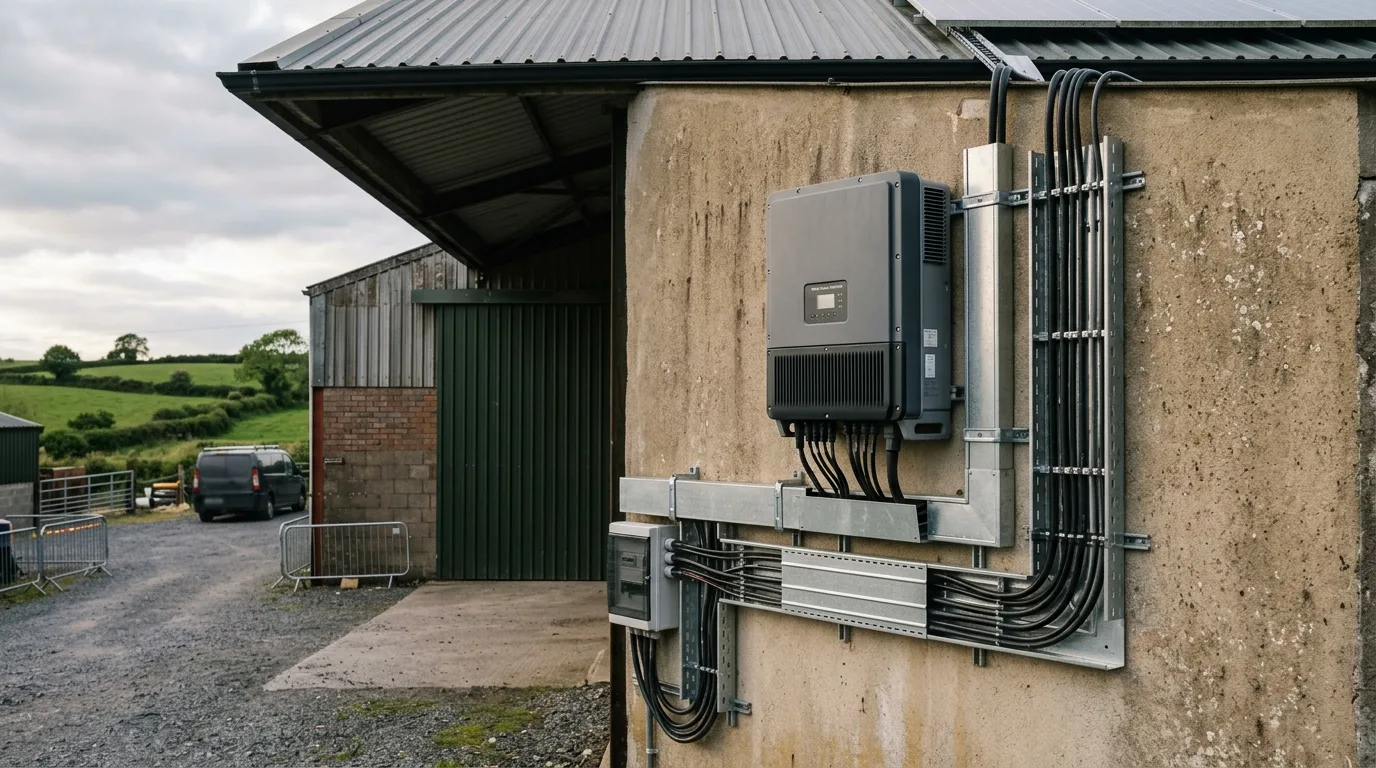
Huawei has become the most-deployed commercial inverter brand on cost-sensitive Irish projects in 2026. The SUN2000-100KTL and its smaller siblings (50KTL, 60KTL, 75KTL) deliver string-inverter simplicity with smart MPPT density that has narrowed the gap to optimiser platforms. This review covers what to expect, where Huawei wins, and the considerations specific to Irish commercial installations.
The SUN2000-100KTL in one paragraph
Huawei's 100 kW three-phase string inverter packs 10 independent MPP trackers into a single 90 kg wall-mounted unit. It accepts up to 22 strings, has an integrated DC switch, AC switch, surge protection on both sides, anti-PID functionality, and IP66 protection. The display is replaced by smartphone connectivity over Bluetooth and the FusionSolar app. On a typical Irish 200 kWp rooftop, two SUN2000-100KTLs replace what would have been six 33 kW string inverters or one large central inverter.
Why 10 MPPTs matter
Module-level MPPT (SolarEdge) gives one MPPT per module pair. Traditional string inverters give one MPPT per 2-3 strings. The Huawei 10-MPPT design sits in between: each MPPT handles 1-2 strings, which means:
- Mismatched strings (different lengths, slight shading differences, orientation tweaks) lose less yield.
- A failed string takes down 10% of the inverter, not 30-50%.
- The inverter handles roof complexity that would have needed multiple SMAs.
For Irish industrial buildings with two or three pitches, plant rooms and rooftop obstructions, this MPPT density delivers most of the SolarEdge benefit at string-inverter capex.
2026 pricing
Indicative Irish supply-only prices in 2026 (EPC margin and accessories extra):
- SUN2000-50KTL: ~€2,800-€3,200
- SUN2000-75KTL: ~€3,800-€4,400
- SUN2000-100KTL-M2: ~€4,800-€5,600
- SUN2000-100KTL-M3: ~€5,200-€6,000 (newer model with 12 MPPTs)
- Smart Logger 3000A: ~€600-€800
- Smart Power Sensor (DDSU666-H or DTSU666-H): ~€180-€280
For a 200 kWp project the Huawei inverter package typically lands at €11,000-€14,000 supply-only - meaningfully cheaper than equivalent SolarEdge by €15-€20k once optimisers are added.
Monitoring with FusionSolar
The FusionSolar platform has matured significantly since 2022. In 2026 it offers:
- Real-time per-string production data
- Smart I-V curve diagnosis (detects degraded modules without disconnecting strings)
- AI-driven fault prediction
- Export limit configuration for NC7 compliance
- Modbus TCP integration with BMS
- Multi-site rollup for portfolio owners
- ESG and carbon reporting exports
The mobile app is genuinely usable. Facilities managers without solar training can interpret the dashboard within 10 minutes. The string-level monitoring (paired with smart current sensors) gives sub-string granularity without needing module-level hardware.
Where Huawei wins
- Capex. 25-35% cheaper than SolarEdge for equivalent kWp on standard roofs.
- MPPT density. 10-12 MPPTs handles complex roofs that would have required SolarEdge a few years ago.
- Smart diagnostics. I-V curve scanning has caught early PID degradation, junction-box failures and connector corrosion on Irish coastal sites.
- Single-unit simplicity. One inverter, no roof-level optimisers, lower component count.
- Strong distribution. Available through most major Irish wholesalers and EPCs.
Where Huawei is not the right choice
- Heavily shaded sites. True module-level shading still favours SolarEdge optimisers.
- SafeDC requirements. Without optimisers, DC strings remain at full voltage during maintenance. Some insurers and heritage sites require SafeDC, which Huawei now offers via its Smart PV Optimiser accessory (sold separately).
- Government and critical-national-infrastructure projects. A small number of Irish public-sector and infrastructure clients still exclude Huawei on procurement-policy grounds. Check your client policy before specifying.
- Module mixing. Mixing module models on the same string is less forgiving than with optimisers.
Warranty
- Standard inverter warranty: 5 years
- Extended warranty: paid options to 10, 15 or 20 years
- Smart Logger: 5 years standard
The standard 5-year warranty is short by 2026 commercial PV norms. Always buy the 10-year extension at minimum - it is typically €350-€600 per 100 kW inverter and well worth it. The 20-year extension is reasonable for institutional owners and PPA structures.
Grid-code compliance for Ireland
The SUN2000-100KTL is on the ESB Networks Approved Equipment List, with G99/EN 50549-2 compliance and EirGrid grid-code certification for the >50 kW segment. Export limiting works reliably with the Smart Power Sensor measuring at the main incomer; tested down to 0 kW export for sites that need to remain non-exporting under their NC7 conditions.
Installation considerations specific to Ireland
- Outdoor wall mount. Huawei specs IP66 and the units handle Irish weather well, but always install under an overhang where possible to extend lifetime.
- Coastal sites. Specify the C5-Marine corrosion-protected variant within 5 km of the coast.
- Cooling. Forced air convection means a 1.5 m clearance front and 0.5 m sides; tight plant-room installs need to be carefully designed.
- Network connection. Use Ethernet over fibre or hardwired Cat6 - Wi-Fi monitoring is unreliable on metal-clad industrial buildings.
Irish EPCs and distribution
Huawei commercial inverters are stocked by Activ8, Enerpower, Powerlink and most Tier-2 EPCs. Lead times in 2026 are typically 3-6 weeks. Spare parts (fans, DC switches, surge modules) are well-distributed across Ireland through approved service partners.
Field-tested commissioning checklist for Huawei commercial inverters
Before signing off the Huawei plant on an Irish commercial install, walk the engineer through this checklist:
- Firmware to current release. SUN2000-100KTL shipped between 2023–2025 typically arrives on an older SPL release that lacks the latest export-limit refinements. Confirm firmware is on the FusionSolar-recommended SPL build (current 2026 release exposes faster export-limit response, sub-2-second).
- Smart Power Sensor (DTSU666-H) wired correctly. CT clamps must be on the line side of the main incomer, with the K1/K2 orientation arrows pointing towards the grid. Reversed CTs cause ghost export readings and shut the inverter into anti-island protection.
- Earth leakage device coordination. Type B RCD upstream is required by EN 50549-2 for transformerless inverters. Type A or AC RCDs will nuisance-trip with Huawei DC fault currents.
- I-V curve baseline. Run the FusionSolar I-V diagnosis on every string within the first month and store as the year-zero reference. Annual reruns then quickly identify modules drifting more than 3% from baseline.
- Smart Logger 3000A LAN priority. Disable Wi-Fi on the Smart Logger after commissioning. Metal-clad warehouses cause Wi-Fi dropouts that disrupt FusionSolar's 5-minute logging cadence.
Bottom line
Huawei SUN2000-100KTL is the default specification for cost-sensitive Irish commercial solar in 2026 on standard roofs. The 10-12 MPPT design, mature monitoring, and 25-35% capex advantage over SolarEdge make it the right choice for most warehouse, manufacturing and farm-building installs. Buy the warranty extension, deploy the Smart Logger properly, and Huawei delivers 20+ years of low-friction commercial solar generation.
Get 3 free commercial solar quotes — free and no obligation.
Frequently asked questions
How many MPPTs does the Huawei SUN2000-100KTL have?
The current SUN2000-100KTL-M3 has 12 independent MPP trackers; earlier M2 variants have 10. Either is enough to handle most complex Irish commercial roofs without splitting into multiple inverters.
What warranty should I buy with a Huawei commercial inverter?
The standard warranty is 5 years. Always upgrade to at least 10 years - typically €350-€600 per unit. For institutional or PPA-backed projects, take the 20-year extension.
Is Huawei approved by ESB Networks for commercial connections?
Yes. The SUN2000-50KTL, 75KTL and 100KTL are listed on the ESB Networks Approved Equipment List and are compliant with EN 50549-2 and Irish grid-code requirements for NC7 connections.
Can Huawei do export limiting for NC7 zero-export sites?
Yes. Paired with the Smart Power Sensor at the main incomer, the inverter can dynamically limit export down to 0 kW or any defined kW threshold required by the ESB Networks connection agreement.
How does Huawei compare to SolarEdge on price?
On a 200 kWp Irish commercial project, Huawei is typically €15,000-€20,000 cheaper than SolarEdge once optimisers are included. The difference narrows on small or heavily shaded sites.
Sources & further reading
- Huawei FusionSolar Commercial Inverters — Huawei FusionSolar
- ESB Networks Approved Equipment — ESB Networks
- EN 50549-2 Grid Connection Standard — CENELEC