SMA Commercial Inverter Review 2026: Sunny Highpower and Sunny Tripower CORE Ireland
SMA Sunny Highpower and Tripower CORE inverters remain the premium choice for Irish institutional and large-commercial solar in 2026. Here is what you get, what it costs, and when SMA is the right call.
By Smart Solar Editorial · Updated 15 May 2026 · 9 min read
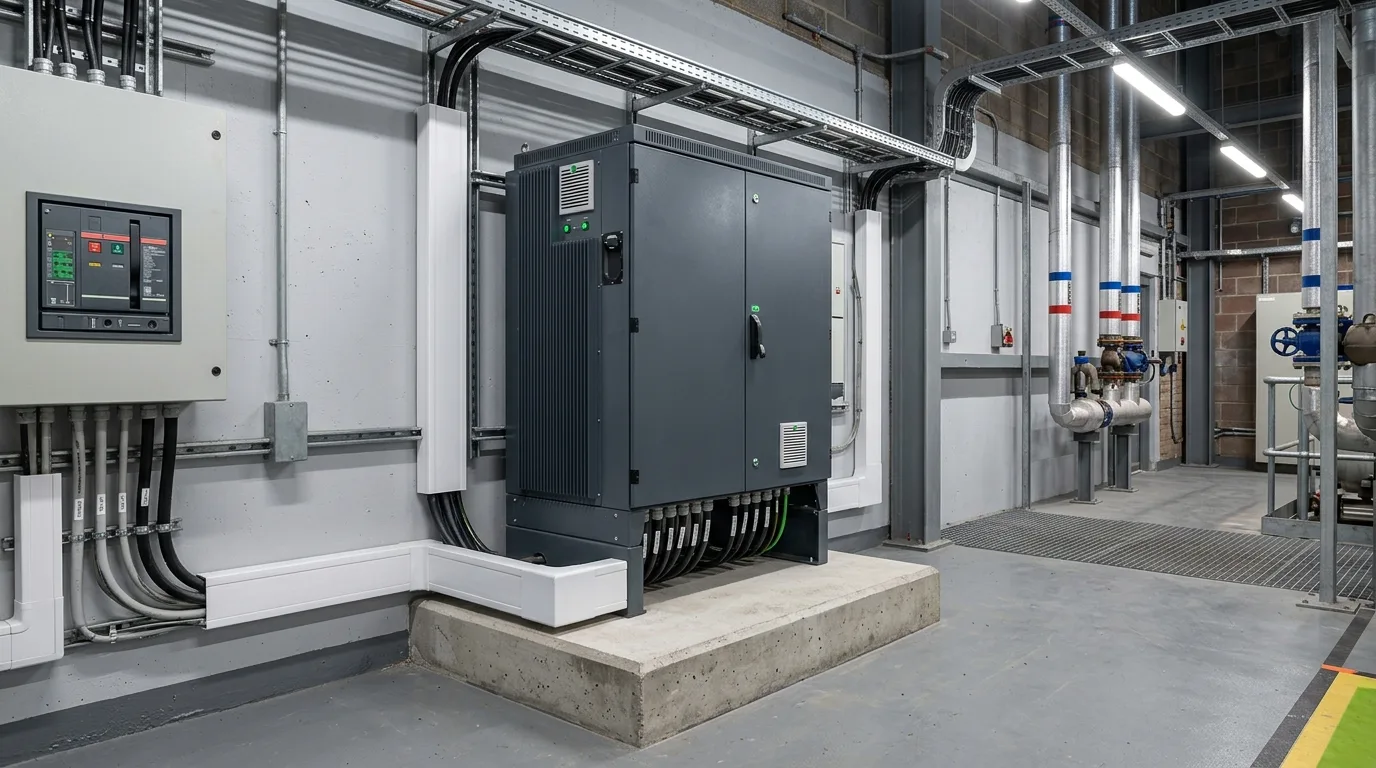
SMA is the legacy heavyweight of European solar inverters. Founded in Kassel in 1981, they shaped the technical standards that the rest of the industry follows. On Irish commercial sites in 2026, SMA's Sunny Highpower PEAK3 and Sunny Tripower CORE ranges remain the default choice for institutional clients, large industrial sites, and PPA-backed projects where bankability matters more than capex. This review covers what you get for the premium, where SMA still leads, and where Huawei and SolarEdge have caught up.
The SMA range for Irish commercial work
In 2026 the commercial-relevant SMA models are:
- Sunny Tripower CORE1 (33-62 kW): floor-standing string inverter, six MPPTs, designed for fast commercial rooftop deployment without wall-mounting
- Sunny Tripower CORE2 (110 kW): larger floor-standing version with 12 MPPTs, IP66, integrated DC switch
- Sunny Highpower PEAK3 (150-250 kW): centralised commercial inverter for large rooftop or ground-mount
- Sunny Central UP (1.5-4.6 MW): utility-scale, occasionally seen on the largest Irish ground-mount projects
For a typical 200-500 kWp Irish commercial rooftop, the Tripower CORE2 110 kW or two Sunny Highpower 150 kW units are the bread-and-butter specification.
What makes SMA different
- Engineering pedigree. SMA inverters frequently outlast their warranty periods by 5-10 years in field. Long-term reliability data from European fleets shows mean time between failure measured in decades, not years.
- Service network. SMA has a direct service presence in Ireland and the UK with on-site engineers, not just spare-part logistics. For PPA contracts where uptime matters, this is significant.
- Bankability. Every project finance lender and PPA off-taker accepts SMA without question. Some still raise eyebrows at newer Chinese brands - SMA never appears on exclusion lists.
- Grid-code expertise. SMA wrote much of the early European grid-code documentation. Their products are typically the first to be certified against new requirements.
- Floor-standing form factor. The CORE range stands on the roof or ground rather than wall-mounting. This speeds up installation by 30-50% on large flat rooftops where wall space is limited.
2026 pricing
Indicative supply-only prices in Ireland in 2026:
- Sunny Tripower CORE1 50 kW: ~€4,500-€5,200
- Sunny Tripower CORE2 110 kW: ~€8,500-€9,800
- Sunny Highpower PEAK3 150 kW: ~€11,000-€13,000
- Sunny Highpower PEAK3 250 kW: ~€16,500-€19,000
For a 200 kWp Irish project, the SMA inverter package typically lands at €18,000-€22,000 supply-only - meaningfully above Huawei (€11,000-€14,000) and modestly below SolarEdge once optimisers are factored in.
The price premium over Huawei is roughly 50-70%. The question is whether the extra €7-€10k delivers commensurate value over a 25-year project life. For a PPA or institutional asset, yes. For a self-funded SME, probably not.
Monitoring with Sunny Portal and ennexOS
SMA monitoring has two layers:
- Sunny Portal Powered by ennexOS - the cloud-based platform, free for inverter-level monitoring
- Data Manager M / Data Manager M Lite - on-site gateway for string monitoring, export control, and Modbus integration
In 2026 the platform offers:
- String-level production monitoring (with Data Manager and optional string monitor cards)
- Active power and reactive power control for grid services
- Export limit configuration to any defined kW
- Modbus TCP/RTU integration with BMS
- API access for ESG reporting
- Multi-site portfolio rollup for owners
The interface is functional rather than pretty. Compared to SolarEdge ONE or Huawei FusionSolar it feels more "engineer's tool" than "facilities-manager dashboard". Not a problem for technical teams; sometimes a problem for non-technical owners.
Where SMA still wins
- Institutional and PPA-backed projects. Bankability and long-term reliability matter more than capex.
- Large rooftop and ground-mount. Floor-standing CORE units speed up installation and simplify maintenance access.
- Public sector procurement. Some Irish public-sector frameworks effectively shortlist SMA based on track-record requirements.
- Grid services revenue. SMA's grid-services controllers are the most flexible if you want to participate in DS3 or future grid-services markets.
- Long asset lives (30+ years). SMA inverters often run beyond their nominal lifetime with only fan and capacitor replacements.
Where SMA is not the right choice
- Tight capex projects. A 30-50% inverter premium can shift payback by 6-12 months.
- Complex shaded sites. No optimiser equivalent in the SMA range; MPPT count is lower than Huawei's smart string design.
- Module-level monitoring requirements. Not available natively without third-party hardware.
Warranty
- Standard: 5 years
- Active warranty extensions: 10, 15, 20 and 25 years available
- Replacement service includes on-site exchange in Ireland and the UK for systems above 100 kW
The on-site replacement is a meaningful differentiator. Where Huawei and SolarEdge ship a replacement to the site for the EPC to install, SMA's commercial service tier sends an SMA engineer to swap the unit. For institutional and PPA projects this dramatically simplifies the O&M contract.
Grid-code compliance for Ireland
All current SMA commercial inverters are on the ESB Networks Approved Equipment List with full G99/EN 50549-2 compliance, dynamic active power control, fault ride-through and reactive power capability appropriate for the Irish grid code. The Data Manager M handles export limiting and power control natively.
When to specify SMA
Default to SMA when:
- The project is PPA-backed or institutional
- The site is large (300 kWp+) ground-mount or flat rooftop
- Long-term bankability and direct service matter
- Grid services participation is on the roadmap
- The asset will be on a balance sheet for 25+ years
Default away from SMA when:
- Capex is the binding constraint
- The roof is complex or shaded (Huawei MPPT density or SolarEdge optimisers fit better)
- Quick payback drives the decision
Bottom line
SMA Sunny Tripower CORE and Sunny Highpower PEAK3 are the premium specification for Irish commercial solar in 2026. They cost more, but for institutional and PPA-backed projects they deliver bankability, direct Irish service, and a 25+ year operating life that justifies the premium. For cost-driven SME projects, Huawei or SolarEdge typically wins. Pick SMA where the asset matters more than the capex.
Get 3 free commercial solar quotes — free and no obligation.
Frequently asked questions
Is SMA worth the price premium over Huawei?
For PPA-backed, institutional and large ground-mount projects, yes. The bankability, direct Irish service network, and 25+ year operating life justify the 30-70% capex premium. For self-funded SME rooftops where payback drives the decision, Huawei typically wins.
What warranty does SMA offer on commercial inverters?
5 years standard with paid extensions available to 10, 15, 20 or 25 years. Commercial service tiers include on-site replacement by an SMA engineer in Ireland and the UK for systems above 100 kW.
Which SMA inverter is right for a 200 kWp Irish project?
Either two Sunny Tripower CORE2 110 kW units (floor-standing, fast install) or one Sunny Highpower PEAK3 250 kW with the array slightly oversized. Both are widely deployed on Irish 200-300 kWp rooftops.
Is SMA approved by ESB Networks for NC7 commercial connections?
Yes. All current Sunny Tripower CORE and Sunny Highpower PEAK3 models are on the ESB Networks Approved Equipment List with full grid-code and export-limiting compliance.
Does SMA support module-level monitoring?
Not natively. SMA monitors at string level with the Data Manager and optional string monitor cards. For module-level visibility, specify SolarEdge instead.
Sources & further reading
- SMA Commercial Solutions — SMA Solar Technology AG
- Sunny Highpower PEAK3 — SMA Solar Technology AG
- ESB Networks Generator Connections — ESB Networks