Underfloor Heating vs Radiators with a Heat Pump: What's Best for Irish Homes?
Underfloor heating achieves higher SCOP with a heat pump, but it is not always feasible or cost-effective in Irish retrofits. This guide compares underfloor heating and radiators across all the dimensions that matter for Irish homeowners — efficiency, cost, comfort, and retrofit practicality.
By Smart Solar Editorial · Updated 15 May 2026 · 8 min read
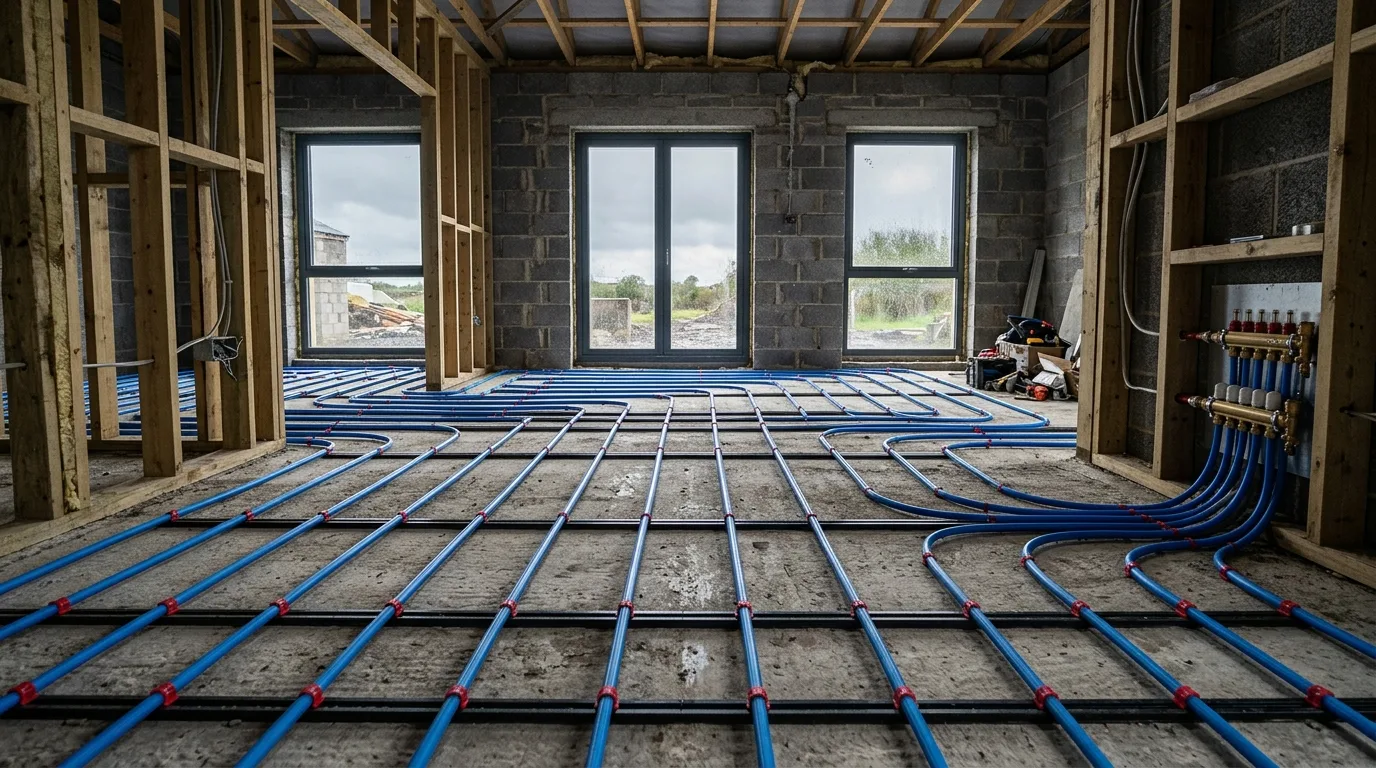
The choice between underfloor heating (UFH) and radiators is one of the most consequential decisions in a heat pump installation. It directly affects your system's efficiency (SCOP), your running costs, the comfort of your home, and the feasibility and cost of your retrofit project.
For Irish homeowners, the answer is rarely black-and-white. Many homes end up with a hybrid approach — underfloor heating on the ground floor (often already installed) and upgraded radiators upstairs — which offers an excellent balance of efficiency and practicality.
The Efficiency Case for Underfloor Heating
The fundamental reason UFH works so well with heat pumps is flow temperature. UFH systems distribute heat through a grid of pipes embedded in the floor, heating the entire floor surface to a relatively low temperature (around 25–30°C). The large surface area compensates for the low temperature — the room receives the same amount of heat from a 30°C floor as it would from a small radiator at 70°C.
For the heat pump, producing water at 35–40°C is dramatically more efficient than producing it at 55–65°C:
| Heating Emitter | Flow Temperature | Typical SCOP |
|---|---|---|
| Wet underfloor heating (screed) | 30–38°C | 4.0–4.8 |
| Low-temperature panel radiators (new) | 40–45°C | 3.5–4.2 |
| Standard retrofit radiators (upgraded) | 45–55°C | 3.0–3.8 |
| Standard retrofit radiators (unchanged) | 55–65°C | 2.5–3.2 |
For a home with a 15,000 kWh annual heat demand:
- UFH at SCOP 4.2: 3,571 kWh electricity → ~€571/year at 16c
- Standard retrofit radiators at SCOP 3.0: 5,000 kWh → ~€800/year
UFH saves approximately €229/year compared to standard retrofit radiators — a significant ongoing benefit.
UFH in New Builds: The Standard Choice
In Irish new builds built to NZEB (Nearly Zero Energy Building) standards, wet underfloor heating in the ground floor slab is now virtually universal. It is designed from the start as the primary heat emitter, optimised for heat pump flow temperatures of 30–40°C.
Many new builds also extend UFH to the first floor, either as a screed system or as a dry-board (Warmup, Nu-Heat, or similar) thin system installed on top of the existing subfloor. First-floor UFH gives maximum efficiency throughout the home.
For anyone building a new home in Ireland in 2026, the recommendation is straightforward: install wet UFH on both floors if budget allows. The incremental cost during construction (€2,000–€4,000 additional for first-floor UFH) is modest compared to the lifetime efficiency gain.
UFH Retrofit in Existing Irish Homes: Feasibility Assessment
Retrofitting underfloor heating into an existing Irish home is more complex and expensive than installing it during construction. The feasibility depends on floor construction type:
Concrete Slab Ground Floor (Most Common in Irish Homes)
A ground floor on a concrete slab can accept a wet UFH retrofit as a screed overlay:
- Remove existing floor covering
- Lay 50–80 mm of insulation board (rigid PIR, e.g., Kingspan Kooltherm K103)
- Install UFH pipe on insulation clips
- Pour 40–75 mm self-levelling screed over pipes
- Replace floor covering (tiles, engineered timber, vinyl)
Cost: €60–€100/m² installed (including screed, insulation, and pipe). A 60 m² ground floor: €3,600–€6,000.
Considerations:
- Raises floor level by 100–150 mm — door frames and skirtings need modification
- Disrupts kitchen units, bathrooms, and fitted furniture
- Takes 4–6 weeks of construction work
- Excellent long-term investment if you are doing a comprehensive retrofit anyway
Suspended Timber Ground Floor (Older Irish Homes)
Pre-1970s Irish homes with suspended timber floors over a ventilated void can accept UFH in two ways:
Below-joist (sprung floor system): UFH pipes suspended below the floor joists with aluminium spreader plates. Accessed from below (through the ground floor void via an external access point). Avoids disturbing the floor covering.
- Cost: €40–€70/m² installed
- Less effective than screed — the void reduces heat transfer efficiency
Dry-board overlay: A thin UFH system (Nu-Heat LoPro or similar) bonded to the timber subfloor with 20–30 mm aluminium-infill boards and low-profile pipe. Raises floor level by only 20–30 mm.
- Cost: €50–€80/m²
- Good heat transfer if properly installed
First Floor (Timber Joisted — Most Irish Homes)
First-floor UFH in an existing home requires either:
- Dry-board overlays on top of the existing floor (20–30 mm height increase, minimal disruption)
- Below-joist installation if accessible from below (often not possible)
Cost: €50–€80/m². A 50 m² first floor: €2,500–€4,000.
Many Irish retrofit projects choose not to install UFH on the first floor due to disruption and cost, using upgraded radiators instead. This hybrid approach (UFH downstairs at 38°C, radiators upstairs at 50°C) allows a blended system SCOP of approximately 3.5–4.0 — a good practical compromise.
Comfort Comparison: UFH vs Radiators
UFH comfort advantages:
- Even warmth at floor level — no cold spots
- No visible radiators — full wall space available
- Floor feels warm underfoot — particularly pleasant in bathrooms and kitchens
- No localised hot spots or convection draughts from radiators
- Silent operation — no water sounds from radiators
Radiator comfort advantages:
- Faster response — room heats up more quickly from cold
- Room-by-room TRV control is easier and more responsive
- No risk of UFH damage from furniture legs or falling objects
In practice, both systems maintain comfortable room temperatures in a well-designed heat pump installation. The UFH "luxury" perception is well-founded but the efficiency advantage is the more financially compelling argument.
Control and Scheduling Differences
UFH control: UFH in a concrete screed has a high thermal mass — it takes 1–3 hours to respond to setpoint changes. This makes it unsuitable for on/off scheduling (which works for radiators). Instead, UFH is best controlled with:
- Weather compensation: Flow temperature automatically adjusted based on outdoor temperature
- Continuous low-temperature operation: Run at 35–40°C constantly, let the thermal mass maintain temperature
- Night-rate pre-charge: Pre-heat the screed during cheap night-rate hours; screed holds heat for 6–8 hours
Radiator control: Radiators respond within 30–60 minutes and are well-suited to time-based scheduling. TRVs allow room-by-room control. Standard scheduling (boost in morning and evening, setback during the day) works well.
Which Should You Choose?
Choose underfloor heating if:
- You are building a new home (install as part of construction — most cost-effective time)
- You are doing a comprehensive ground-floor renovation anyway (kitchen extension, full renovation)
- Maximum SCOP and minimum running costs are the priority
- You have a ground-floor concrete slab (most cost-effective retrofit scenario)
Choose radiators (upgraded) if:
- You are doing a standard retrofit without major floor works
- Budget is limited — radiator upgrades (€250–€450 each) are far cheaper than UFH
- You have a suspended timber ground floor (UFH retrofit is disruptive and expensive)
- You want faster heat response (useful in variable-use rooms)
Choose a hybrid (UFH downstairs, radiators upstairs) if:
- You already have UFH on the ground floor (common in 1990s+ Irish homes)
- You are doing a ground-floor renovation alongside the heat pump installation
- You want to phase the investment — UFH now where it is easy, radiators elsewhere
For most Irish retrofit projects in 2026, the hybrid approach (taking advantage of any existing UFH and upgrading radiators where needed) delivers a good balance of efficiency improvement and practical cost.
Get 3 free heat pump quotes — free and no obligation.
Frequently asked questions
Is underfloor heating more efficient than radiators with a heat pump?
Yes. UFH runs at 30–40°C flow temperature, giving SCOP of 4.0–4.8. Upgraded radiators at 45–50°C give SCOP of 3.3–4.0. Standard retrofit radiators at 55–65°C give SCOP of 2.5–3.2. The efficiency advantage of UFH is approximately 20–30% over standard retrofit radiators.
How much does underfloor heating cost to retrofit in an Irish home?
Wet UFH retrofit in a concrete slab ground floor costs €60–€100/m² installed. A 60 m² ground floor costs €3,600–€6,000. Dry-board UFH systems for timber floors cost €50–€80/m². First-floor UFH in a timber-joisted house costs €50–€80/m² for dry-board overlay.
Can I have underfloor heating upstairs in an Irish home?
Yes. For first-floor bedrooms in a timber-joisted house, a dry-board low-profile UFH system (Nu-Heat, Warmup, or similar) can be installed with a floor height increase of only 20–30 mm. Cost is €50–€80/m². This is the preferred approach in new builds but can be retrofitted in existing homes.
What floor coverings work with underfloor heating?
The best floor coverings for UFH are ceramic or porcelain tiles (highest thermal conductivity), natural stone, and vinyl/LVT. Engineered timber works but check the manufacturer's guidelines for temperature limits. Deep-pile carpet is the worst option as it insulates the floor from above, dramatically reducing heat transfer.
Can I run underfloor heating and radiators from the same heat pump?
Yes. Many Irish homes have a hybrid system — UFH on the ground floor (lower flow temperature zone, typically 35–40°C) and radiators on the first floor (higher temperature zone, 45–55°C). This requires a mixing valve or separate circuit for the UFH zone and is a standard configuration that most heat pump installers design routinely.
Sources & further reading
- SEAI Heat Pump Technical Assessment — Sustainable Energy Authority of Ireland
- SEAI Heat Pump Technology Overview — Sustainable Energy Authority of Ireland