Heat Pump Buffer Tank Explained: Do You Need One for Your Irish Home?
Buffer tanks are a source of confusion in many Irish heat pump quotes. Some installers include them as standard; others say they are unnecessary. This guide explains what a buffer tank does, when you genuinely need one, and when it is an unnecessary cost.
By Smart Solar Editorial · Updated 15 May 2026 · 7 min read
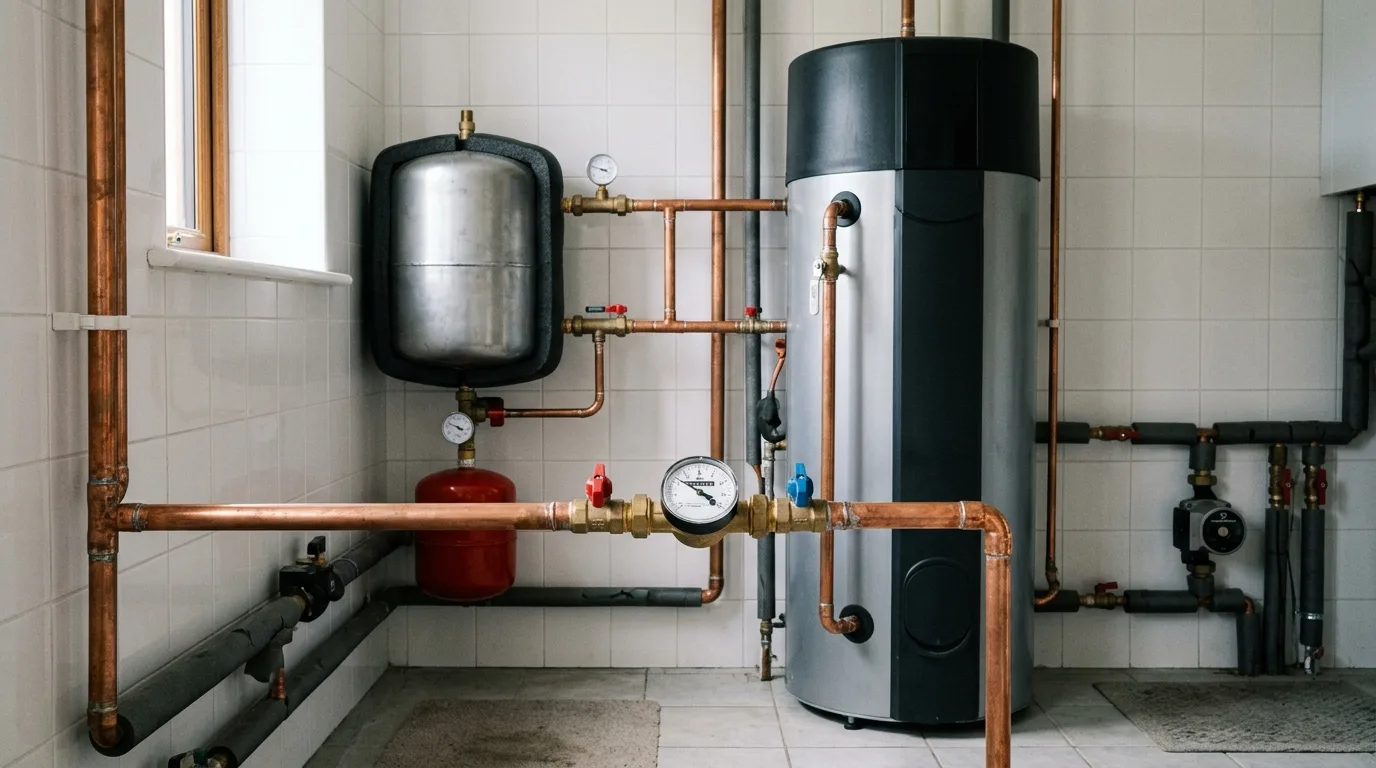
A buffer tank (sometimes called a buffer vessel or hydraulic buffer) is a small water storage tank that sits in the heat pump's heating circuit. It is used in specific situations to prevent the heat pump's compressor from starting and stopping too frequently — a problem known as short cycling.
Whether you need a buffer tank depends on your specific heating system design. For many modern Irish installations, a buffer tank is unnecessary. In others, it is essential for system longevity and efficiency. Understanding the difference will help you evaluate installer quotes more accurately.
Why Heat Pumps Can Short-Cycle
Short cycling occurs when a heat pump's compressor switches on, quickly satisfies the thermostat demand, and then switches off — only to switch back on again a few minutes later as the temperature drops. This is problematic because:
- Compressor wear: Each start-up event puts stress on the compressor. A compressor designed for 6–8 start-ups per hour can be damaged by 20–30 starts per hour over time.
- Efficiency loss: Every start-up consumes a surge of electricity. Frequent starts reduce the effective efficiency of the system.
- Comfort issues: Frequent on/off cycling creates temperature oscillations rather than steady warmth.
Modern inverter-driven heat pumps (Daikin Altherma 3, Mitsubishi Ecodan, Samsung EHS) modulate their output rather than switching on/off. They can run at 30–50% of rated capacity to match low heating demand, greatly reducing short cycling. This is why buffer tanks are less necessary than they were with older fixed-speed heat pump technology.
What a Buffer Tank Does
A buffer tank adds thermal mass to the heating circuit — a volume of water that can absorb and release heat, smoothing out the heat pump's operation:
- When the heat pump runs, it heats the buffer tank first
- The heating circuit draws heat from the buffer tank, not directly from the heat pump
- The heat pump can run for longer, more efficient cycles to heat the buffer tank
- When the buffer tank is hot enough, the heat pump pauses; the buffer continues to supply heat to the radiators
The buffer tank is essentially a "shock absorber" in the heating circuit, preventing the heat pump from reacting directly to small changes in room temperature that would otherwise cause short cycling.
Buffer Tank Sizes
Buffer tanks for domestic heat pumps in Ireland are typically 50–100 litres:
| Heat Pump Output | Recommended Buffer (if needed) |
|---|---|
| 5–8 kW | 50–80 litres |
| 8–12 kW | 80–100 litres |
| 12–16 kW | 100–150 litres |
A 100-litre buffer tank stores approximately 4.5 kWh of heat energy (at a 40°C temperature differential between full and minimum useful temperature). This provides approximately 20–40 minutes of heating supply to a moderately insulated home without the heat pump running.
When Is a Buffer Tank Actually Required?
A buffer tank is generally required or recommended in the following situations:
1. Small or few radiators relative to heat pump size: If a home has very few radiators (e.g., a small apartment or flat) and an 8+ kW heat pump, the heating system volume may be too small for the heat pump to run in long, efficient cycles. The buffer tank adds the needed system volume.
Minimum system volume guideline: At least 20 litres of total system water volume per kW of heat pump output is a rough rule of thumb. A 10 kW heat pump needs at least 200 litres in the heating circuit. Most homes with 8–12 radiators have 100–150 litres. In this case, a 50–100 litre buffer tops up the system volume.
2. Two-zone systems with zone valves: When zone valves close (e.g., bedrooms zone turns off at night), the remaining open circuit may have too little water volume for the heat pump. A buffer tank decouples the heat pump from the zone valve system, allowing it to run continuously and transfer heat to whichever zone calls for it.
3. High-temperature heat pumps with existing small radiators: An HT heat pump running at 65°C to overcome undersized radiators may short-cycle more than a standard system. A buffer tank provides the additional volume to enable longer cycles.
4. Older fixed-speed (non-inverter) heat pump models: Older fixed-speed heat pumps cannot modulate their output and are more prone to short cycling. Buffer tanks were much more commonly specified with these older models. Modern inverter-driven models often do not need them.
When Is a Buffer Tank NOT Required?
Most modern inverter heat pump installations in medium to large Irish homes do not need a buffer tank because:
- Inverter compressors modulate down to 30–50% of rated capacity, naturally preventing short cycling
- Homes with 8+ radiators have sufficient system volume
- Modern heat pump controllers (Daikin, Mitsubishi, Samsung) have built-in logic to prevent excessive cycling
If your installer recommends a buffer tank for a 3-bed home with standard radiators and a modern inverter heat pump, it is worth asking them to justify the recommendation. It may be unnecessary and add €500–€800 to the project cost without benefit.
Conversely, if your installer does not recommend a buffer tank for a system that has very few radiators or multiple zone valves, ask whether the system volume has been calculated and whether cycling is a concern.
Cost of a Buffer Tank in Ireland
A 50-litre insulated buffer tank, supply and install: approximately €350–€550 A 100-litre insulated buffer tank, supply and install: approximately €450–€800
This includes the tank, pipe connections, insulation, flow meter, and installation labour. It does not include any changes to the heating circuit configuration.
Integration with the Heat Pump System
A buffer tank is installed in the primary loop between the heat pump and the secondary heating circuit (radiators or UFH). Common configurations:
Series buffer: The buffer tank sits in line between the heat pump and the radiators. Simple but the entire circuit water passes through the buffer.
Parallel buffer (hydraulic separator): The buffer tank connects in parallel with a low-loss header or hydraulic separator. This decouples the primary (heat pump) circuit from the secondary (emitter) circuit hydraulically, allowing independent flow rates. This is the preferred configuration for two-zone systems and for heat pumps with very different flow rates from the emitter circuit.
Alternatives to a Buffer Tank
Weather compensation: A well-configured weather compensation curve reduces the heat pump's tendency to short-cycle by continuously running at lower output rather than high-output bursts. This is available on all modern Daikin, Mitsubishi, Samsung, and Grant heat pumps.
Low-loss header: A low-loss header (also called a hydraulic separator) achieves some of the hydraulic decoupling benefits of a buffer tank without the thermal storage. It is cheaper (€150–€300 installed) and may be sufficient for two-zone installations that do not need additional system volume.
Correctly sized heat pump: An oversized heat pump will short-cycle even with a buffer tank. Correct sizing (from an accurate EN 12831 heat loss calculation) is the root solution to cycling problems.
Summary: Buffer Tank Decision Guide
| Situation | Buffer Tank Needed? |
|---|---|
| New build, UFH throughout, correctly sized heat pump | Unlikely |
| Standard retrofit, 8+ radiators, inverter heat pump | Usually not |
| Small home (<70 m²), few radiators | Yes |
| Two-zone system with zone valves | Recommended |
| Fixed-speed (older) heat pump | Yes |
| Oversized heat pump for the home | Yes (but better to resize) |
| Large home with many zones | Recommended |
Get 3 free heat pump quotes — free and no obligation.
Frequently asked questions
Do I need a buffer tank for a heat pump in Ireland?
Not always. Most modern inverter-driven heat pumps in standard Irish homes (with 8+ radiators and adequate system volume) do not require a buffer tank. They are more necessary in small homes with few radiators, two-zone systems, or older fixed-speed heat pumps.
What does a buffer tank cost in Ireland?
A 50–100 litre buffer tank costs €350–€800 supply and installed in Ireland in 2026, depending on size and complexity of integration.
What is short cycling in a heat pump?
Short cycling is when the heat pump compressor starts and stops too frequently — often every few minutes — rather than running in longer, efficient cycles. It causes compressor wear, reduces efficiency, and can be addressed by adding a buffer tank, correctly sizing the heat pump, or enabling weather compensation.
Can a buffer tank improve my heat pump's efficiency?
Indirectly, yes. By allowing the heat pump to run in longer, more stable cycles rather than short bursts, a buffer tank can improve effective COP and reduce compressor wear. However, for most modern inverter heat pumps in appropriately designed systems, the efficiency benefit is small.
What is the difference between a buffer tank and a hot water cylinder?
A buffer tank stores heating circuit water (typically 50–100 litres) to provide hydraulic buffering and prevent short cycling. A hot water cylinder (150–300 litres) stores domestic hot water for showers and taps at a much higher temperature. They serve completely different functions and are separate components.
Sources & further reading
- SEAI Heat Pump Technical Guidance — Sustainable Energy Authority of Ireland
- Heat Pump Association — System Design Guidance — Sustainable Energy Authority of Ireland