Heat Pump Hot Water Cylinder Sizing: What Size Do You Need in Ireland?
The hot water cylinder is a critical component of any air-to-water heat pump installation. Getting the size, specification, and controls right determines both your comfort and your system's energy efficiency. This guide covers everything Irish homeowners need to know.
By Smart Solar Editorial · Updated 15 May 2026 · 7 min read
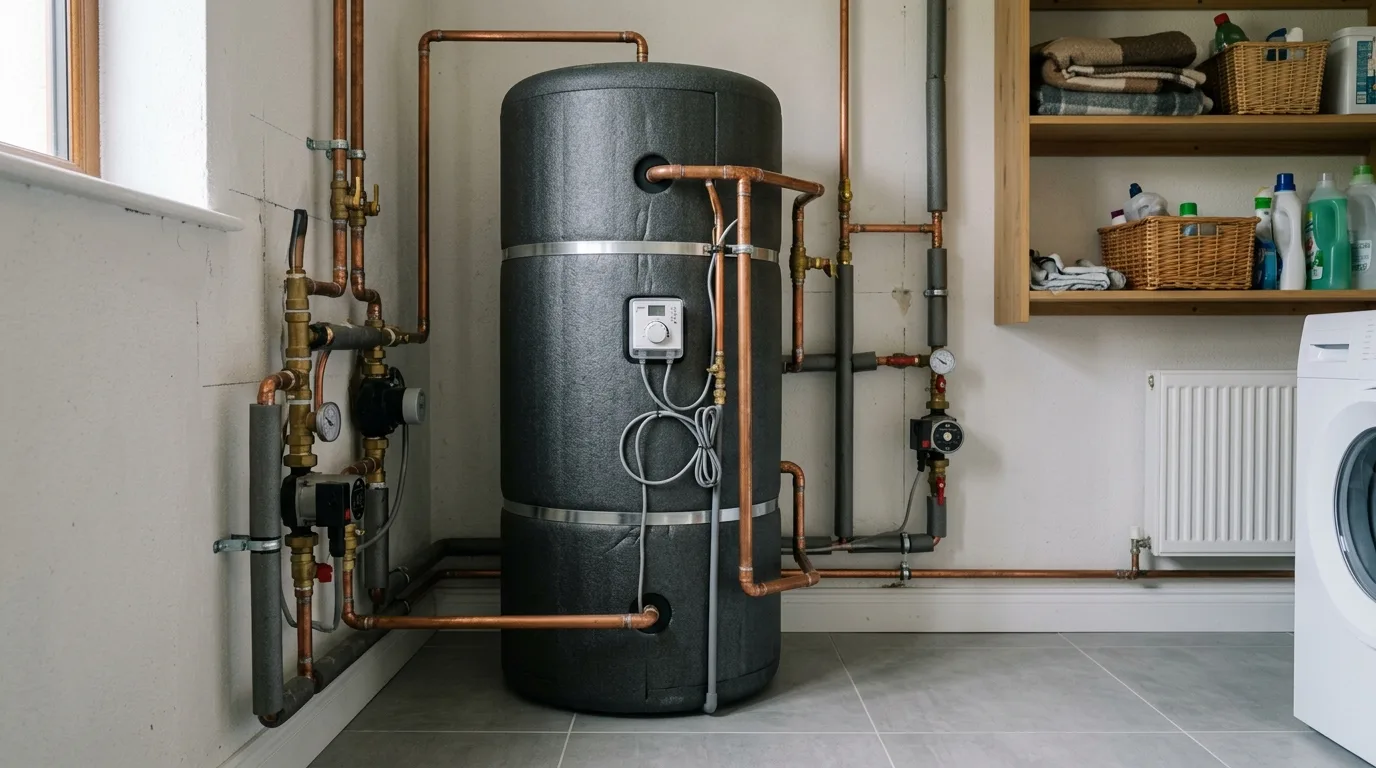
The hot water cylinder is one of the most important — and most frequently underspecified — components in an Irish heat pump installation. Unlike a gas combi boiler that heats water on demand, an air-to-water heat pump heats and stores hot water in a well-insulated cylinder. Getting the cylinder size, specification, and controls right directly affects your comfort (will you always have enough hot water?) and your system's efficiency (is the heat pump working optimally?).
This guide covers every aspect of hot water cylinder selection for Irish heat pump installations.
Why Heat Pumps Need a Cylinder
Air-to-water heat pumps heat water to a target temperature (typically 50–55°C) and store it in an insulated cylinder. This stored hot water is then available on demand for showers, baths, dishwashers, and hand-washing.
The stored approach is more efficient than on-demand heating for heat pumps because:
- Heat pumps work best with consistent, extended run times — not short bursts. Heating a large cylinder overnight during cheap-rate electricity is far more efficient than heating small amounts on demand throughout the day.
- Lower flow temperatures are more efficient. A heat pump heating a cylinder to 50°C achieves COP 2.8–3.2. If forced to heat small amounts on demand to 60°C rapidly, COP drops to 2.0–2.4.
- Scheduling flexibility. You can heat the cylinder entirely during cheap night-rate hours (11pm–8am), using the stored heat throughout the next day without incurring day-rate electricity costs.
Gas combi boiler owners: If your home currently has a gas combi boiler with no hot water cylinder, you must add a cylinder as part of the heat pump installation. This is a standard part of most installer quotes and costs €700–€1,500 depending on size and specification.
Types of Heat Pump Cylinders
Twin Coil (Indirect) Cylinder
The most common specification for heat pump installations. Contains two coils:
- Lower coil: Connected to the heat pump's heating circuit. The heat pump heats this coil, which transfers heat to the stored water. Sized for maximum heat transfer at low flow temperatures (45–55°C).
- Upper coil (or immersion element): Connected to the solar thermal panel (if fitted) or serves as a backup immersion element. Also used for the weekly Legionella protection cycle.
This is the standard specification for SEAI grant-eligible installations.
Direct Cylinder
A cylinder heated directly by an immersion element. Not used with heat pumps (direct electric heating at 100% efficiency is far less efficient than heat pump heating at 300%+). However, a direct immersion is included as a backup in most twin-coil heat pump cylinders.
Heat Pump-Specific Integrated Cylinder
Some systems (Joule Cyclone Aire, Panasonic Aquarea tank units) include the cylinder as part of the indoor unit, with the heat exchanger and controls integrated. These are functionally equivalent to a twin-coil indirect cylinder but in a factory-assembled package.
How to Size Your Hot Water Cylinder
Rule of Thumb: 40–50 Litres per Person
The simplest sizing guide:
| Household | Recommended Cylinder Size |
|---|---|
| 1–2 people | 150–180 litres |
| 3 people | 200 litres |
| 4 people | 200–250 litres |
| 5+ people | 250–300 litres |
These figures assume a heat pump heating the cylinder once per day (or during night-rate hours).
More Detailed Sizing Factors
Shower vs bath usage: High-shower households need more hot water stored than bath-only households. A power shower uses 12–20 litres per minute. Two people showering simultaneously in a household with one large shower can use 50–80 litres in 5 minutes.
Simultaneous demand: A 4-person household where multiple family members shower in the morning needs a cylinder sized to handle simultaneous demand, not just daily total demand.
Heat pump recovery rate: A 5 kW heat pump heating a 200-litre cylinder from 45°C to 55°C (at COP 2.8) takes approximately 1.3 hours. If the cylinder is depleted below a critical level, the heat pump must reheat — potentially during day-rate hours if your night window has ended.
The solution: Slightly oversizing the cylinder (250 litres instead of 200 litres for a 4-person home) provides a buffer against unexpected high demand without significantly increasing standing heat loss.
Recommended Irish Cylinder Specifications
A heat pump cylinder for an Irish home should meet the following minimum specifications:
Insulation: At least 50 mm of polyurethane foam. Better-spec cylinders use 65–80 mm. Standing heat loss should not exceed 1.5–2.0 kWh/24 hours.
Coil size: The lower heat pump coil should be sized for maximum heat transfer at low temperature. SEAI guidelines specify a minimum coil area sufficient for the system's rated heat pump output. Ask your installer or cylinder supplier to confirm coil performance data.
Immersion element: 3 kW immersion element (standard in Ireland). Used for Legionella protection cycle and emergency backup.
KIWA or equivalent certification: Look for KIWA NL or similar certification confirming quality and compliance.
Volume of heating water in the heat pump coil: Larger coil volume means less temperature shock to the heat pump circuit, contributing to efficiency.
Legionella: The Hot Water Safety Requirement
Legionella pneumophila bacteria can grow in hot water stored between 20°C and 45°C. To prevent Legionella risk, Irish guidelines (following HSA recommendations and EN 806) require:
- Hot water storage above 55°C (which kills Legionella over time)
- A minimum of one pasteurisation cycle per week at 60°C for 1 hour or equivalent
Most air-to-water heat pumps cannot consistently reach 60°C from the heat pump cycle alone (though high-temperature models like Daikin Altherma H HT can reach 70°C). The standard approach for non-HT heat pumps is:
- Heat pump heats cylinder to 50–55°C (daily, typically on night rate)
- Once per week, a brief immersion boost at 3 kW heats the cylinder to 60°C for the Legionella pasteurisation cycle
The immersion boost for the weekly Legionella cycle consumes approximately 3–6 kWh per week (3 kW × 1–2 hours) = 156–312 kWh/year. At 26 c/kWh day rate, this adds approximately €40–€80/year to running costs. Schedule the Legionella cycle during the night-rate window to reduce this further.
Irish Cylinder Brands and Suppliers
Joule: The Joule Cyclone hot water cylinder is widely specified for heat pump installations in Ireland. Available in 170–300 litres, with twin-coil and solar options.
OSO: A Norwegian brand with strong presence in Ireland. OSO cylinders are specified by many premium installers.
Telford Cylinders: UK and Irish market supplier, widely available through Irish heating merchants.
Grant: Grant-branded cylinders designed for compatibility with Grant Aerona heat pumps.
Daikin-matched cylinders: Daikin supplies matched cylinders for the Altherma range.
Integration with Solar PV (Diverter)
If you have or plan to install solar PV panels, a solar diverter (Eddi by MyEnergi, iBoost by Marlec, or similar) can redirect surplus solar electricity to the cylinder's immersion element — providing effectively free hot water during solar-generating periods.
This combination — heat pump + twin coil cylinder + solar diverter + solar PV — represents the most efficient possible hot water system for an Irish home. The solar panels provide free hot water from spring to autumn; the heat pump covers winter hot water at its most efficient. Annual hot water electricity cost can fall to near zero for 6–7 months.
What Happens to the Existing Cylinder?
If your home has an existing hot water cylinder, it may be reusable if:
- It is 200 litres or larger
- It has a well-insulated jacket (50+ mm foam)
- It has (or can be retrofitted with) a suitably sized lower coil for heat pump use
- It is in good condition (no corrosion, suitable pressure rating)
In most Irish retrofits, the existing cylinder is replaced with a new, correctly specified heat pump cylinder. The cost difference between reusing and replacing is typically €700–€1,200 for the new cylinder, but the efficiency and safety benefits of a correctly specified unit usually justify replacement.
Get 3 free heat pump quotes — free and no obligation.
Frequently asked questions
What size hot water cylinder do I need for a heat pump in Ireland?
For a family of 4, a 200–250 litre twin-coil heat pump cylinder is the recommended size. Smaller households (2–3 people) can use a 150–200 litre cylinder. Larger households (5+) should consider 250–300 litres. Slightly oversizing provides a buffer for high-demand periods.
Do I need a new cylinder when installing a heat pump?
In most Irish retrofits, yes. The existing cylinder may be too small, lack a suitably sized heat pump coil, or be poorly insulated. A new 200–250 litre heat pump cylinder costs €700–€1,200 and is typically included in the installer's quote.
What is a twin-coil cylinder and do I need one?
A twin-coil (indirect) cylinder has two heat exchange coils. The lower coil is connected to the heat pump circuit; the upper coil or immersion is used for solar top-up or Legionella boost. Twin-coil is the standard specification for heat pump installations in Ireland.
How does the heat pump heat the water to a safe temperature to prevent Legionella?
Most heat pumps heat the cylinder to 50–55°C daily via the heat pump. Once per week, a brief immersion boost heats the cylinder to 60°C for a pasteurisation cycle (kills Legionella bacteria). This is automatically scheduled by the heat pump controller and consumes 3–6 kWh per week.
Can I use a solar diverter with my heat pump cylinder?
Yes. A solar diverter (Eddi, iBoost) redirects surplus solar PV electricity to the cylinder's immersion element, providing free solar-heated water during spring and summer. This combination significantly reduces heat pump electricity consumption for hot water and is one of the most cost-effective renewable energy upgrades for an Irish home.
Sources & further reading
- SEAI Heat Pump Technical Requirements — Sustainable Energy Authority of Ireland
- HSA Legionella Guidelines for Domestic Hot Water — Health and Safety Authority Ireland