Heat Pump Service and Maintenance in Ireland: Complete Homeowner Guide
A heat pump is a low-maintenance heating system compared to an oil or gas boiler — but it is not zero-maintenance. Regular servicing protects your manufacturer warranty, maintains efficiency, and identifies problems before they become expensive failures. This guide tells you exactly what to do and when.
By Smart Solar Editorial · Updated 15 May 2026 · 9 min read
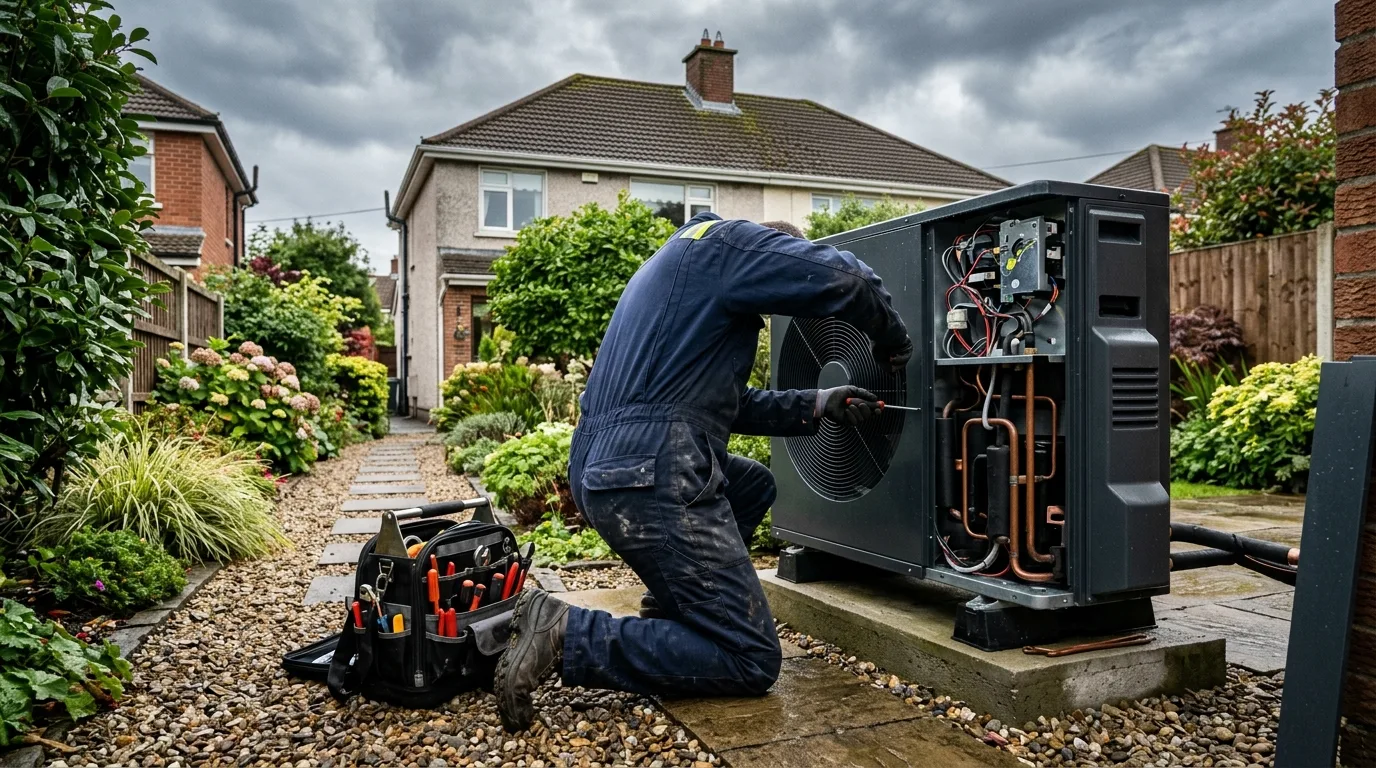
One of the most appealing features of an air source heat pump is how little attention it needs compared to an oil boiler. There is no annual boiler service, no burner to clean, no combustion chamber to inspect. But "low maintenance" does not mean "no maintenance." Proper servicing of your heat pump protects your warranty, sustains the efficiency that justifies the running cost savings, and identifies issues — like low refrigerant charge or a failing component — before they become a breakdown in January.
This guide covers what an annual heat pump service involves, what you can maintain yourself between services, when you need to call an engineer, and how to keep records that protect your warranty.
How Often Does a Heat Pump Need Servicing?
Annual professional service: Most manufacturers (Daikin, Mitsubishi, Samsung, Grant, Joule) recommend an annual service by a qualified engineer. This is typically a condition of extended manufacturer warranties (the 5 → 7 year compressor warranty extension for Daikin and Grant, for example).
Homeowner checks: Monthly or seasonal checks that you carry out yourself — no engineer required.
Reactive service: If the heat pump displays a fault code, produces unusual noise, or fails to heat the home adequately, call your service engineer promptly.
The annual service schedule is less demanding and less expensive than oil or gas boiler servicing (no combustion analysis, no flue gas measurement, no burner replacement). Irish heat pump service costs typically range from €80 to €150 per visit depending on location and the scope of the service.
What an Annual Professional Service Includes
A thorough annual heat pump service in Ireland covers:
Outdoor Unit Checks
Coil condition and cleaning: The outdoor heat exchanger coil accumulates dirt, dust, pollen, and occasionally moss or lichen. A dirty coil reduces heat transfer efficiency, increasing electricity consumption and potentially causing the compressor to overwork. The engineer cleans the coil using a specialist fin comb and cleaning solution.
Fan inspection: The outdoor fan blade is checked for damage and balance. A damaged or unbalanced fan causes vibration, noise, and reduced airflow across the coil.
Defrost cycle verification: Irish winters require the heat pump to periodically defrost its outdoor coil. The engineer checks that the defrost cycle operates correctly — activating when needed and terminating correctly when the coil is clear.
Refrigerant pressure check: Using manifold gauges connected to the system's service ports, the engineer checks the high-side and low-side refrigerant pressures against manufacturer specifications. Pressure outside the normal range indicates either overcharge, undercharge, or a leak. Refrigerant work is legally restricted to F-gas certified engineers.
Electrical connections: Terminals at the outdoor unit are checked for corrosion, tightening, and correct connection. Loose electrical connections are a common cause of intermittent faults and can damage components over time.
Casing and fixings: The casing panels are checked for damage, screws for security, and anti-vibration mounts for deterioration.
Indoor Unit / Cylinder Checks
Hydraulic system pressure: The sealed water circuit operates at 1.0–1.5 bar (manufacturer-dependent). Low pressure indicates a leak or excessive air venting. The engineer checks the pressure and tops up if needed.
Expansion vessel pre-charge: The expansion vessel absorbs the thermal expansion of water in the system. If the vessel's internal diaphragm fails, pressure fluctuates excessively. The engineer checks the vessel pre-charge pressure and condition.
Circulating pump operation: The pump driving water around the heating circuit is checked for correct operation, flow rate, and any unusual noise. Heat pump pumps typically operate continuously or at variable speed — a seized or failing pump significantly reduces system performance.
Filter and strainer inspection: Most heat pump systems include an inline filter or magnetic separator to capture debris from the water circuit. The engineer cleans or replaces filter elements.
Cylinder thermostat calibration: The hot water cylinder thermostat is verified against the actual water temperature. For systems using Legionella prevention cycles (heating to 60°C periodically), the engineer confirms the cycle is programmed and operating correctly.
Controls and settings review: The engineer reviews the weather compensation curve settings, heating schedules, and hot water scheduling. Settings that were optimal at commissioning may benefit from fine-tuning after a winter of operation — particularly if your tariff has changed (e.g., switching to a night-rate plan).
Documentation
After the service, you should receive a written service report stating:
- Date of service
- Refrigerant pressures (high and low side)
- Hydraulic circuit pressure
- Any findings or recommendations
- Confirmation of any adjustments made
Keep all service records. Manufacturer warranty claims may require evidence of regular servicing. Store service reports with your original warranty documentation.
Homeowner Maintenance: What You Can Do Yourself
Between annual professional services, there are several checks and tasks that require no qualifications and no special tools.
Monthly or Seasonal Checks
Clear the outdoor unit: Check that the area around the outdoor unit is clear of leaves, debris, and overgrown plants. The unit needs at least 0.5 m of clear space on the air inlet side and 1 m or more on the air outlet side (where air is discharged). In autumn, leaves accumulating around the base of the unit can block airflow.
Check the coil for visible blockage: On a well-sited unit, you can visually inspect the coil through the protective grille. If you see visible dirt build-up, it is worth arranging a service sooner rather than waiting. In Irish gardens, climbing plants growing into the unit are a common and damaging issue.
Check system pressure: Many heat pump indoor units display the system pressure on the controller screen or a pressure gauge on the hydraulic module. Most systems should read 1.0–1.5 bar. If pressure drops repeatedly below 1.0 bar, there may be a minor leak — contact your engineer.
Listen for unusual noise: Heat pumps make noise during operation (fan, compressor, refrigerant flow, water pump). Learn what your system sounds like when running normally. A new rattling, clanking, or hissing sound is worth investigating. A hissing sound may indicate a refrigerant leak.
Check that the defrost cycle completes: During cold, damp weather, you may see steam rising from the outdoor unit — this is normal during the defrost cycle. What is not normal is the defrost cycle running continuously or the unit remaining iced over for hours. This indicates a fault.
Review your energy consumption: Your heat pump controller (or the smart app — Daikin Onecta, Mitsubishi MELCloud, Samsung SmartThings, Grant Smart) shows energy consumption data. A sudden increase in electricity use for the same heating output indicates a loss of efficiency — possibly a dirty coil, low refrigerant, or failing component. Annual service intervals are a sensible framework; if consumption jumps mid-year, do not wait for the annual service date.
Cylinder and Hot Water
Check cylinder pressure relief valve annually: The hot water cylinder has a pressure relief valve (PRV) that opens if pressure exceeds safe limits. Lift the lever briefly to confirm it moves freely and reseals. If it drips continuously after testing, it may need replacement — a straightforward task for a plumber.
Check anode rod (if applicable): Some cylinders use a sacrificial anode rod to protect against corrosion. Check your cylinder manual — if an anode is fitted, it should be inspected every 3–5 years.
Legionella prevention: Confirm your controller is programmed for a weekly or monthly Legionella prevention cycle (heating the cylinder to 60°C). This is typically set at commissioning, but it is worth verifying the schedule annually.
When to Call Your Engineer Between Annual Services
Contact your service engineer immediately if:
- The heat pump displays a fault code and does not reset after a power cycle
- The outdoor unit remains iced over for more than 2 hours in normal winter conditions (not extreme frost)
- Heating output has noticeably dropped (rooms that were warm are now cold)
- Hot water is not reaching normal temperature
- The system pressure is consistently below 0.8 bar or above 2.0 bar
- You hear a hissing sound near the outdoor unit (possible refrigerant leak)
- The system short-cycles repeatedly (switches on and off every few minutes without completing a heating run)
- You notice a wet patch under or near the indoor unit
Refrigerant Servicing: What Homeowners Cannot Do
Any work involving the refrigerant circuit — including checking refrigerant charge, adding refrigerant, leak testing with electronic detectors, or replacing components in the refrigerant loop — is legally restricted to F-gas Category 1 certified engineers. This applies to all common heat pump refrigerants: R32, R410A, and R134a.
R290 (propane) systems such as the Grant Aerona have additional requirements: engineers must hold specific R290/flammable refrigerant training beyond standard F-gas certification.
Attempting refrigerant work without certification is illegal in Ireland, voids your manufacturer warranty, and is genuinely dangerous. Leave all refrigerant-related work to your certified service engineer.
Service Contract vs. Pay-As-You-Go
Some installers and service companies offer annual service contracts covering:
- One annual service visit
- Priority call-out in the event of a breakdown
- Parts labour coverage (sometimes)
Typical contract cost: €120–€200 per year depending on coverage level.
Pay-as-you-go service: €80–€150 per visit (no priority call-out, no parts coverage).
If your heat pump is still under manufacturer warranty (first 5–7 years), parts costs for genuine defects are covered by the manufacturer anyway — so a basic annual service contract without parts coverage offers the key benefit of priority scheduling in winter, when demand for service engineers peaks.
After the manufacturer warranty period, a more comprehensive service contract (including call-out and labour) may offer better value, particularly for older systems where component failures become more likely.
Manufacturer-Specific App Monitoring
Modern heat pumps from the main brands sold in Ireland offer app-based monitoring that can complement your annual service:
- Daikin Onecta: Energy consumption tracking, error code history, remote settings adjustment
- Mitsubishi MELCloud: Performance logging, historical COP data, fault notification
- Samsung SmartThings: Energy monitoring, remote scheduling, fault alerts
- Grant Smart: System status, hot water and heating controls
Setting up the app monitoring at installation (or shortly after) gives you a continuous view of system performance. Many engineers also use app data to diagnose faults remotely before a site visit — reducing call-out time and often resolving issues without a visit.
Record Keeping for Warranty Purposes
Manufacturers recommend — and for extended warranties may require — annual servicing. Keep:
- All service reports (date, engineer name, pressure readings, actions taken)
- Manufacturer warranty registration confirmation (register within 30 days of installation)
- Original commissioning sheet from installation
- Any parts replacement invoices
Store physical copies and a digital scan in cloud storage. If a warranty claim arises after the installer who originally installed the system has ceased trading, direct manufacturer warranty claims are processed much more smoothly with complete documentation.
Cost of Heat Pump Ownership: Service in Context
For a heat pump installed at €17,000 (net of €6,500 grant = €10,500 net cost), over a 15-year lifespan the annual service budget of €120/year adds up to €1,800 — a minor proportion of the total system cost. Viewed differently, the annual service that catches a refrigerant leak early (a €200 fix) prevents compressor damage that could cost €1,500–€3,500 to repair. Regular servicing is not a cost — it is an investment in the system's 15–20 year lifespan.
Get 3 free heat pump quotes — free and no obligation.
Frequently asked questions
How often should a heat pump be serviced in Ireland?
An annual professional service is recommended by all major manufacturers (Daikin, Mitsubishi, Samsung, Grant, Joule). This is also typically a condition of extended warranty coverage (5 → 7 years on Daikin and Grant compressor warranties). Between annual services, monthly homeowner checks of the outdoor unit clearance, system pressure, and energy consumption are good practice.
How much does a heat pump service cost in Ireland?
A professional annual heat pump service in Ireland typically costs €80–€150. Service contracts covering one annual visit plus priority call-out are typically €120–€200 per year. Costs vary by location (rural call-out may attract a travel charge) and the scope of the service.
Can I service my own heat pump in Ireland?
Basic homeowner maintenance — clearing debris from around the outdoor unit, checking system pressure, monitoring energy consumption, and verifying the Legionella prevention cycle — requires no qualifications. However, any work involving the refrigerant circuit (refrigerant pressure checks, top-ups, leak testing) is legally restricted to F-gas Category 1 certified engineers. Attempting refrigerant work without certification is illegal and voids your warranty.
Does my heat pump warranty require annual servicing?
Extended manufacturer warranties (e.g., Daikin's 7-year compressor warranty, Grant's 7-year extension) are typically conditional on annual professional servicing. Standard 5-year warranties generally do not require annual service to remain valid, but keeping service records is strongly advisable if you later need to make a claim. Always check your specific warranty documentation.
What does a heat pump service engineer check?
A full annual service covers: outdoor coil cleaning, fan inspection, defrost cycle verification, refrigerant pressure check, electrical connection inspection, indoor unit hydraulic pressure check, expansion vessel condition, circulating pump operation, filter cleaning, cylinder thermostat calibration, controls and weather compensation settings review, and issue of a written service report.
Sources & further reading
- SEAI Heat Pump Grant — Contractor Code of Practice — Sustainable Energy Authority of Ireland
- EPA Ireland — F-Gas Regulation — Environmental Protection Agency Ireland