How Do Heat Pumps Work in Ireland? A Complete Guide for Irish Homeowners
Heat pumps extract renewable heat from the air or ground and deliver it to your home at efficiencies gas boilers can never match. This guide explains the science, the Irish climate realities, and what to expect from a modern heat pump installation.
By Smart Solar Editorial · Updated 15 May 2026 · 8 min read
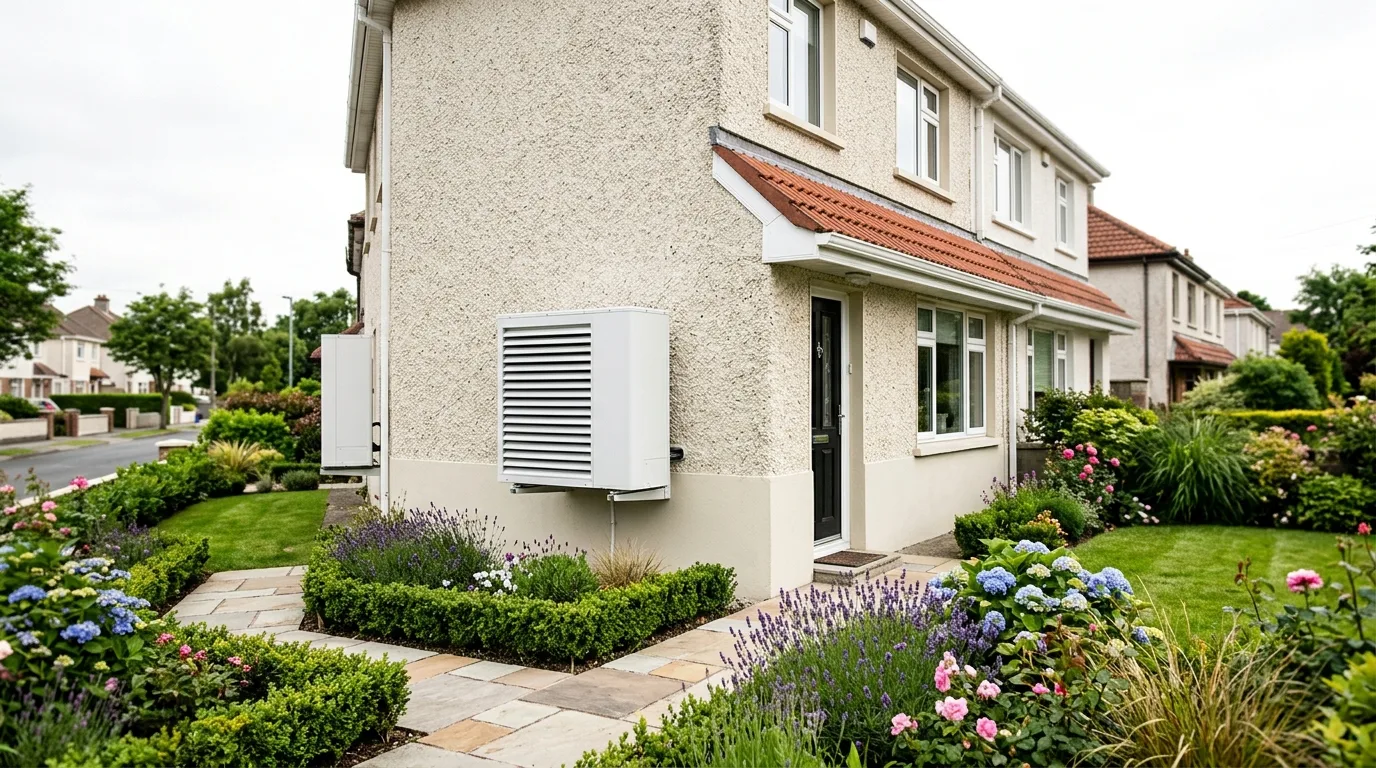
Understanding how heat pumps work in Ireland begins with one counterintuitive insight: a heat pump does not generate heat the way a gas boiler does. It moves heat that already exists in the outdoor air (or ground) into your home. This distinction is the reason heat pumps can deliver €3–€4 of heating value for every €1 of electricity they consume — an efficiency rate simply impossible with any combustion appliance.
The Refrigeration Cycle Explained
The physics behind a heat pump is identical to the physics inside your refrigerator, just run in reverse and at a much larger scale. There are four key stages:
1. Evaporation: A liquid refrigerant at very low pressure flows through an outdoor heat exchanger (the evaporator). Even at temperatures as low as −15°C, the outdoor air contains enough thermal energy to boil the refrigerant and turn it into a low-pressure gas. Modern refrigerants like R32 or the newer R290 (propane) have extremely low boiling points, making this possible even in cold Irish winters.
2. Compression: The compressor — the heart of the system — squeezes the low-pressure gas into a high-pressure gas. Compressing the gas raises its temperature significantly, sometimes to 60–80°C in modern systems.
3. Condensation: The hot, high-pressure gas flows into an indoor heat exchanger (the condenser). Here it releases its heat into your home's heating system — your radiators, underfloor heating, or hot water cylinder — and condenses back into a liquid.
4. Expansion: The liquid passes through an expansion valve, dropping back to low pressure and low temperature, and the cycle begins again.
The key number that describes how efficiently this cycle runs is the Coefficient of Performance (COP). A COP of 3.5 means the heat pump delivers 3.5 kWh of heat for every 1 kWh of electricity consumed. Irish-certified systems typically achieve seasonal COPs (SCOP) of 3.0–4.5 depending on the system design and house type.
Why Ireland's Climate Suits Heat Pumps Well
Many Irish homeowners assume that the country's damp, mild winters are a disadvantage for heat pumps. In fact, the opposite is true. Ireland's Atlantic maritime climate means that even in January, the average daily temperature in most of the country stays above 5°C. Heat pump efficiency improves as outdoor temperatures rise — and Ireland rarely experiences the prolonged cold snaps that stress heat pump systems in continental European countries.
The climate zone used for Irish heat pump assessments is EN 14825 Climate Zone H3 (Strasbourg), which is slightly cooler than the actual Irish average. In reality, most Irish heat pumps outperform their rated SCOP figures in service because actual winters are milder than the standard test conditions.
SEAI's heat pump data confirms that air-to-water heat pumps across Ireland achieve average SPFs (Seasonal Performance Factors, a real-world equivalent to SCOP) of 3.2–3.8 in typical retrofits, and 3.6–4.2 in well-insulated new builds.
Types of Heat Pump Systems Available in Ireland
Air-to-Water Heat Pumps
This is by far the most common type installed in Irish homes, accounting for over 90% of domestic heat pump installations. An outdoor unit — roughly the size of a large air conditioning unit — draws heat from the outdoor air and transfers it to water that circulates through your home's wet heating system (radiators or underfloor heating). The same system heats your domestic hot water via a hot water cylinder.
Leading brands in the Irish market include:
- Daikin Altherma 3 (H HT for high-temperature retrofit, R for standard)
- Mitsubishi Ecodan (Ultraquiet and Power Inverter ranges)
- Samsung EHS (TDM Plus and Mono HQ ranges)
- Grant Aerona⁴ R290 (Irish-designed, natural refrigerant)
- Joule Cyclone Aire (integrated cylinder units)
- Panasonic Aquarea (J and T-Cap series)
Air-to-Air Heat Pumps
These systems heat (and cool) air directly, without a wet heating circuit. They are essentially high-efficiency reverse-cycle air conditioners. While popular in new Scandinavian-style homes and some apartments, they are less suitable for most Irish retrofits because they cannot integrate with existing radiator systems or heat domestic hot water.
Ground Source Heat Pumps
Ground source heat pumps extract heat from the earth via buried pipes (horizontal ground loops) or boreholes (vertical). The ground temperature at 1–2 m depth in Ireland remains a remarkably stable 10–12°C year-round, giving ground source systems higher efficiency than air source in cold weather. However, the installation cost (€20,000–€35,000) and land area required make them less popular than air-to-water systems for typical Irish semi-detacheds or terraced houses.
How a Heat Pump Heats Your Home
An air-to-water heat pump connects to your home's existing or new wet heating circuit. The heat pump raises water to a flow temperature, which is then pumped through your radiators or underfloor heating circuits.
The critical efficiency principle is this: lower flow temperatures require less compressor work, producing a higher COP. A system running at 35°C flow temperature (ideal for underfloor heating) might achieve COP 4.2. The same system at 55°C flow temperature (for older, smaller radiators) might only achieve COP 2.8.
This is why heat pump installers assess your home's heating distribution system carefully. If your radiators were sized for an oil boiler running at 70–80°C, they will likely need to be upgraded or supplemented for a heat pump to run efficiently at 45–55°C.
The Domestic Hot Water Element
Most Irish homes heat domestic hot water to at least 55°C to prevent Legionella bacteria growth — a legal requirement. Modern air-to-water heat pumps handle this in two ways:
- Direct hot water production: High-temperature heat pumps (like Daikin Altherma 3 H HT) can produce water at up to 70°C entirely from the heat pump cycle.
- Immersion boost: Standard heat pumps heat the cylinder to 50–55°C via the heat pump, with a supplementary electric immersion element boosting to 60°C for a weekly Legionella protection cycle.
A correctly sized hot water cylinder — typically 200–300 litres for a family home — is essential. The cylinder should be well-insulated (at least 50 mm of foam) and ideally solar-compatible if you plan to add solar panels later.
SEAI Heat Pump Grant and BER Requirements
Since the introduction of Ireland's National Heat Pump Strategy, SEAI has made heat pump grants the centrepiece of its domestic retrofit programme. In 2026, the SEAI Heat Pump Grant provides:
- €6,500 towards the cost of an air-to-water heat pump installation
- €200 towards the cost of a technical assessment (pre-installation survey)
To qualify, your home must meet one of two criteria:
- Hold a BER of B2 or better (indicating sufficient insulation for a heat pump to run efficiently), or
- Have a technical assessment completed by an SEAI-registered assessor confirming that the building can achieve an SCOP of at least 2.5 with the proposed installation.
The technical assessment route opens the grant to older homes — 1960s–1980s houses — provided the assessor confirms the heating system design can deliver adequate comfort at viable efficiency.
All grant-supported installations must be carried out by an installer on the SEAI's National Register of Heat Pump Contractors.
Running Costs in Practice
For a typical four-bedroom semi-detached Irish home with a heat demand of approximately 12,000 kWh per year, a heat pump with an SCOP of 3.5 would consume roughly 3,430 kWh of electricity to deliver that heat. At a night-rate electricity tariff of around 14 cent/kWh (using a smart meter and night-rate plan from providers like Electric Ireland, Energia, or SSE Airtricity), the annual heating cost would be approximately €480–€600.
Compared to a typical oil boiler consuming 1,500–1,800 litres of heating oil at €0.95–€1.10/litre (€1,425–€1,980/year), the savings are substantial — especially as carbon taxes on fossil fuels continue rising under Ireland's Climate Action Plan.
Key Takeaways
- Heat pumps move heat rather than generate it, achieving efficiencies of 300–400%
- Ireland's mild maritime climate is well-suited to air source heat pump operation
- Air-to-water heat pumps are the dominant technology for Irish homes
- Lower flow temperatures produce higher efficiency — radiator sizing matters
- SEAI grants of €6,500 (+ €200 technical assessment) are available in 2026
- A 4-bed home can heat for €480–€600/year on a smart electricity tariff
Get 3 free heat pump quotes — free and no obligation.
Frequently asked questions
Do heat pumps work in cold Irish winters?
Yes. Modern inverter-driven heat pumps operate efficiently down to −15°C or lower. Ireland's winters rarely fall below −5°C for extended periods, so a heat pump experiences very few low-efficiency operating hours. Most systems achieve their rated SCOP or better in real Irish conditions.
How much does a heat pump cost to run in Ireland?
A typical 4-bed Irish home with a 12,000 kWh annual heat demand and a heat pump SCOP of 3.5 will use around 3,430 kWh of electricity per year for heating. At a smart night-rate tariff of 14 c/kWh, that equates to roughly €480 per year — significantly less than oil or gas heating.
What SEAI grant is available for heat pumps in Ireland in 2026?
The SEAI heat pump grant in 2026 provides €6,500 towards an air-to-water heat pump installation, plus €200 towards a technical assessment. Your home must have a BER of B2 or better, or a technical assessment confirming SCOP of 2.5+ is achievable.
Can a heat pump replace my oil boiler in an older Irish house?
Yes, in many cases, though the home may need some insulation improvements and larger radiators to allow the heat pump to run at lower flow temperatures. A technical assessment will confirm suitability and may unlock the SEAI grant even without a B2 BER rating.
Which heat pump brands are most popular in Ireland?
The most popular brands in the Irish market are Daikin Altherma, Mitsubishi Ecodan, Samsung EHS, Grant Aerona, Joule Cyclone, and Panasonic Aquarea. All are available from SEAI-registered installers and carry the necessary certifications for grant eligibility.
Sources & further reading
- SEAI Heat Pump Grant — Sustainable Energy Authority of Ireland
- National Heat Pump Strategy — Department of the Environment, Climate and Communications
- ESB Networks Smart Metering — ESB Networks