Air to Water vs Air to Air Heat Pump: Which Is Right for Your Irish Home?
Air-to-water and air-to-air heat pumps both extract heat from outdoor air, but they distribute it very differently. Understanding the distinction is critical before you invest — and it determines whether you qualify for the SEAI grant.
By Smart Solar Editorial · Updated 15 May 2026 · 8 min read
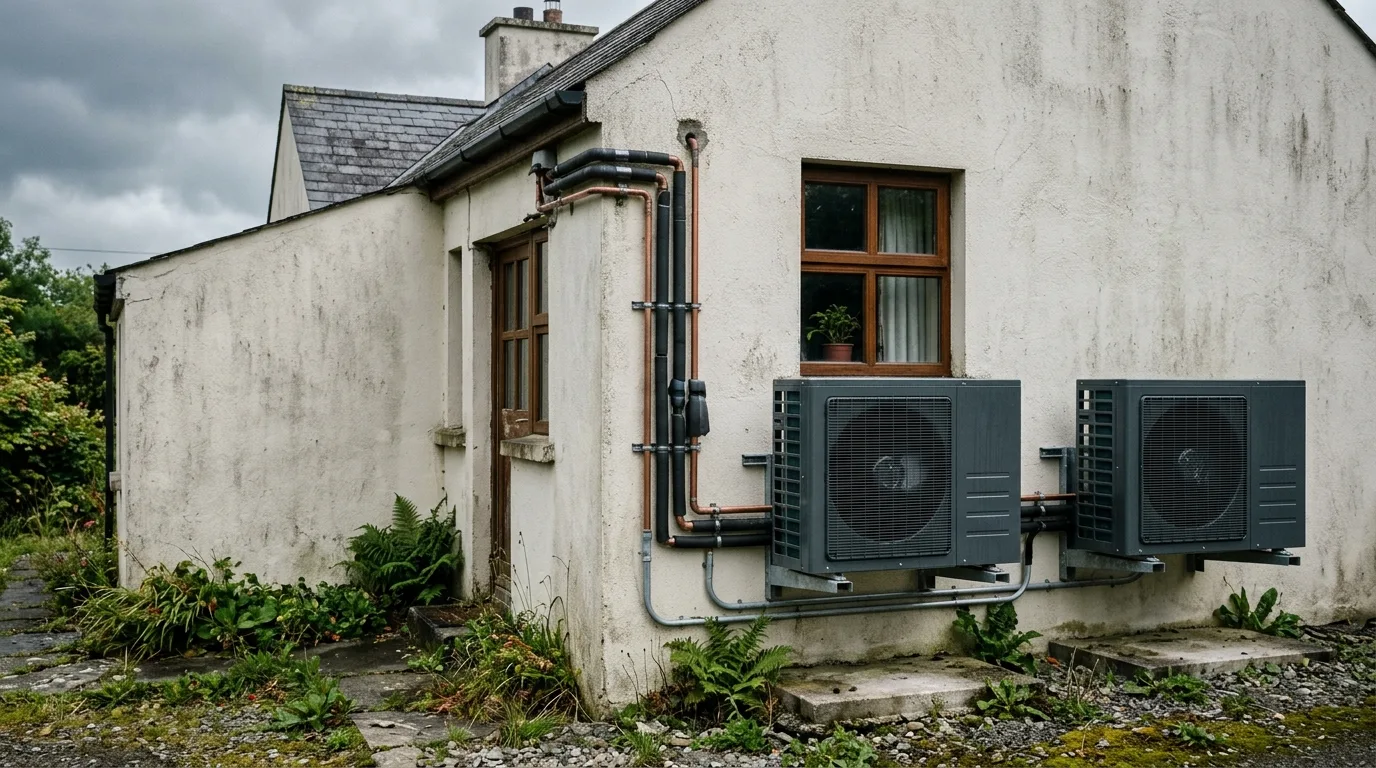
When Irish homeowners begin researching heat pumps, one of the first questions they encounter is the air to water vs air to air heat pump debate. Both technologies extract renewable heat from outdoor air using the same refrigeration cycle, but the way they deliver that heat inside your home is fundamentally different — and that difference has major implications for running costs, comfort, hot water, and SEAI grant eligibility.
What Is an Air-to-Water Heat Pump?
An air-to-water heat pump transfers heat from outdoor air into water that circulates through a wet central heating system. This water flows through your radiators or underfloor heating pipes, and a separate coil inside a hot water cylinder heats your domestic hot water. The system is fully integrated and replaces your oil or gas boiler entirely.
Air-to-water is by far the dominant heat pump technology in Ireland. It suits the vast majority of Irish homes because most properties already have a wet central heating system with radiators and a hot water cylinder. Brands like Daikin Altherma, Mitsubishi Ecodan, Samsung EHS, Grant Aerona⁴, Joule Cyclone Aire, and Panasonic Aquarea all offer air-to-water models for the Irish market.
Key characteristics:
- Heats radiators, underfloor heating, and domestic hot water
- Replaces oil or gas boiler completely
- Requires a hot water cylinder (200–300 litres typical)
- Qualifies for the SEAI heat pump grant of €6,500
- SCOP typically 3.0–4.2 depending on flow temperature and house insulation
- Outdoor unit connects to indoor hydraulic module or integrated cylinder unit
What Is an Air-to-Air Heat Pump?
An air-to-air heat pump transfers heat from outdoor air directly into indoor air via fan coil units or wall-mounted split units — similar in appearance to a conventional air conditioning unit. There is no wet heating circuit and no hot water production. The system heats air in winter and cools it in summer.
Air-to-air systems are widely used in Scandinavian homes, Japanese apartments, and are growing in popularity for Irish new builds and apartments that have been designed from scratch for this type of heating. Brands offering air-to-air systems in Ireland include Daikin, Mitsubishi, Samsung, Panasonic, and LG.
Key characteristics:
- Heats and cools indoor air directly via fan units
- No wet heating circuit, no radiators, no hot water cylinder
- Cannot produce domestic hot water (requires a separate electric shower/immersion)
- Does not qualify for the SEAI heat pump grant (grant is for air-to-water only)
- COP typically 3.5–5.5 at mild temperatures
- Very fast response — heats a room in minutes
SEAI Grant Eligibility: A Critical Difference
This is perhaps the most important distinction for Irish homeowners in 2026. The SEAI heat pump grant of €6,500 applies exclusively to air-to-water heat pump systems. Air-to-air systems are not eligible. This is because the SEAI grant programme targets full whole-home heating replacement — replacing oil or gas boilers — which only air-to-water systems can do.
If you are planning a retrofit of an existing Irish home and want to avail of the €6,500 grant (plus €200 for a technical assessment), you must choose an air-to-water system installed by an SEAI-registered contractor.
Suitability for Different Home Types
Air-to-Water: Best For
- Retrofit homes with existing wet central heating (radiators and a hot water cylinder)
- New builds designed around underfloor heating at 35°C flow temperature
- Homes seeking a complete boiler replacement with a single system
- Anyone who wants SEAI grant funding
- Homes with reasonable insulation (BER B3 or better recommended for best efficiency, B2+ for grant eligibility without technical assessment)
Air-to-Air: Best For
- New builds or apartments designed specifically for air-to-air distribution
- Properties where a wet heating circuit is impractical or very expensive to install
- Homes in mild climates needing both heating and cooling (e.g., south-facing, highly glazed new builds)
- Holiday homes or secondary residences where fast response matters
- Supplementary heating in a room or home office
Running Costs Compared
For a typical four-bedroom semi-detached Irish home with a 12,000 kWh annual heat demand:
Air-to-Water at SCOP 3.5:
- Electricity consumed: ~3,430 kWh/year
- At 14 c/kWh night rate: ~€480/year for space heating
- Plus hot water: add ~€150–€200/year
Air-to-Air at COP 4.0 (space heating only):
- Electricity consumed: ~3,000 kWh/year for space heating
- Plus a separate immersion heater for hot water: add €400–€700/year depending on usage
- Total system running cost often higher than air-to-water despite higher space heating COP
This illustrates that while air-to-air units are very efficient at heating space, the addition of electric resistance hot water (which is 100% efficient at best, compared to 300%+ for a heat pump hot water cylinder) significantly increases total annual energy costs.
Installation Complexity and Cost
Air-to-water heat pump installation (typical Irish retrofit):
- Outdoor unit, indoor hydraulic module, hot water cylinder
- Connection to existing or new radiator/underfloor circuit
- Typical installed cost: €15,000–€22,000 before grant
- After SEAI grant: €8,500–€15,500
- Installation time: 2–4 days
Air-to-air heat pump installation:
- Outdoor unit, wall-mounted indoor units in each room
- No wet plumbing required
- Typical installed cost: €4,000–€12,000 depending on number of indoor units
- No SEAI grant available
- Installation time: 1–2 days
Comfort and Control
Air-to-water systems deliver a steady, even warmth through radiators or underfloor heating — a comfort profile Irish homeowners are familiar with. Modern systems include smart thermostats (Daikin's Onecta, Mitsubishi's MELCloud, Samsung SmartThings) that allow time-of-use scheduling aligned with cheap electricity tariffs.
Air-to-air systems respond faster but can create uneven temperature distribution — warmer near the fan unit, cooler in corners and rooms without units. They can create draughts and require regular filter cleaning. In a well-designed ducted air-to-air system, these issues are largely resolved, but ducted installation is significantly more expensive and almost always a new-build consideration.
Which System Should You Choose?
For the vast majority of Irish homeowners in 2026, air-to-water is the correct choice. It offers:
- Full system replacement (space heating + hot water)
- SEAI grant eligibility (€6,500)
- Compatibility with existing wet heating infrastructure
- Superior long-term running economics when total hot water costs are included
- The comfort profile Irish families expect from central heating
Air-to-air makes sense in specific scenarios: new builds designed for it from the ground up, apartments where wet plumbing is impractical, or as a supplemental heating/cooling solution in individual rooms.
If you are unsure, an SEAI-registered technical assessor can evaluate your home and recommend the most appropriate system type during a technical assessment (cost: €200, grant-eligible). This assessment also satisfies the grant requirement if your BER is below B2.
Get 3 free heat pump quotes — free and no obligation.
Frequently asked questions
Does the SEAI grant cover air-to-air heat pumps?
No. The SEAI heat pump grant of €6,500 applies only to air-to-water heat pump systems. Air-to-air systems are not eligible because they do not replace a full wet central heating and hot water system.
Can an air-to-air heat pump heat my whole Irish home?
It can provide space heating throughout the home if multiple indoor units are installed in each room, but it cannot produce domestic hot water. You would need a separate electric shower or immersion heater, which increases total running costs significantly.
Which is more efficient, air to water or air to air?
Air-to-air heat pumps achieve higher COP for space heating alone, typically 3.5–5.5. However, when you account for the separate electric hot water system needed with air-to-air, the total energy cost of an air-to-water system is usually lower for an Irish family home.
Can I get both heating and cooling from an air-to-water heat pump?
Some high-end air-to-water systems (e.g., Daikin Altherma with cooling-enabled indoor units) can provide cooling in summer, but this requires specific fan coil units or ceiling cassettes rather than standard radiators. It is more common in commercial or premium residential applications.
What is the typical lifespan of an air-to-water heat pump in Ireland?
A well-maintained air-to-water heat pump should last 15–20 years. The compressor is the most critical component and typically comes with a 5-year warranty, extendable to 7–10 years on many Daikin, Mitsubishi, and Samsung models when installed by a registered contractor.
Sources & further reading
- SEAI Heat Pump Grant Eligibility — Sustainable Energy Authority of Ireland
- SEAI Technical Assessment for Heat Pumps — Sustainable Energy Authority of Ireland