Ground Source vs Air Source Heat Pump Ireland: Which Should You Choose?
Ground source heat pumps are more efficient but far more expensive. Air source heat pumps are the practical choice for most Irish homes. This guide breaks down the real differences in Irish conditions so you can make the right decision.
By Smart Solar Editorial · Updated 15 May 2026 · 9 min read
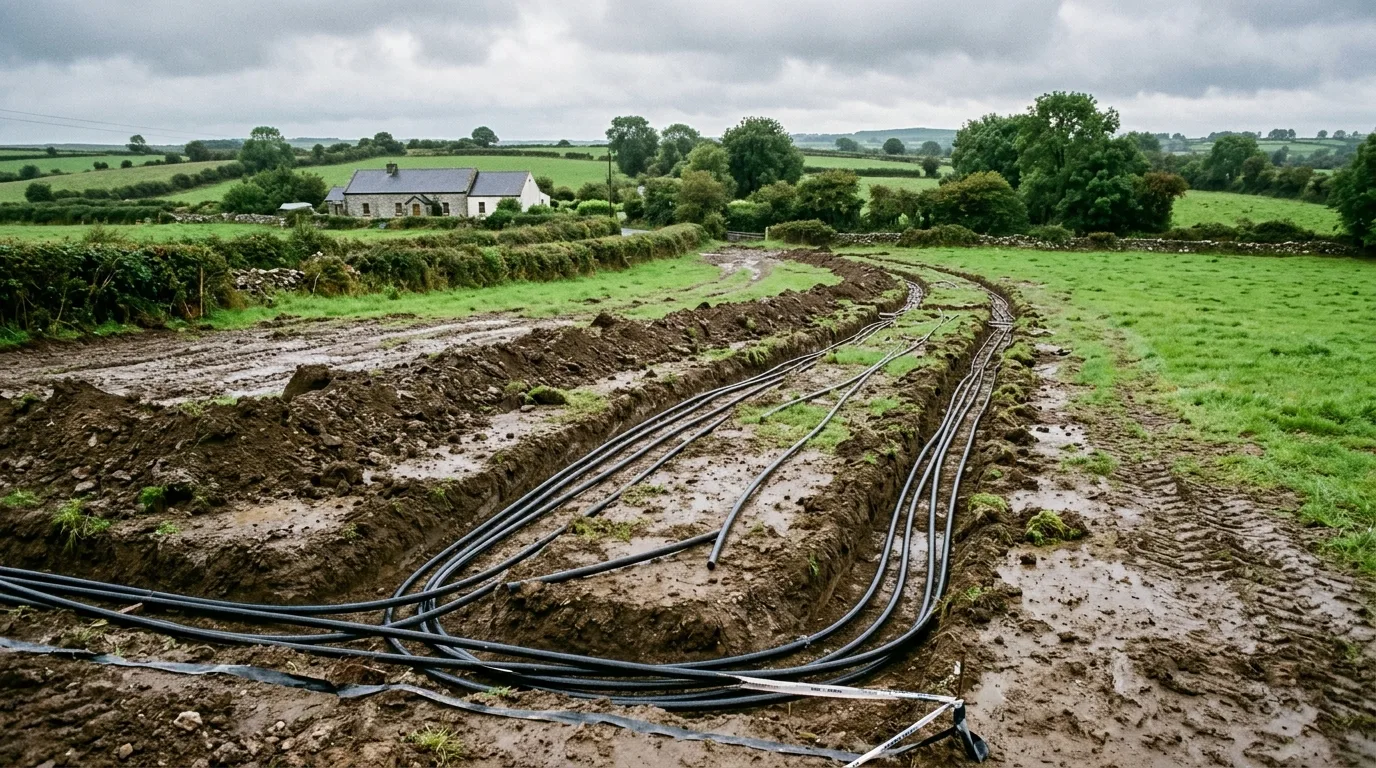
The ground source heat pump vs air source heat pump decision is one of the most important choices Irish homeowners face when planning a heat pump installation. Both technologies are proven, both qualify for SEAI grants, and both can heat an Irish home efficiently. But the differences in upfront cost, land requirements, efficiency, and suitability mean they are right for very different situations.
How Each System Works
Air Source Heat Pumps
Air source heat pumps extract heat from outdoor air using a refrigerant cycle. An outdoor unit — similar in size to a large air conditioning unit — sits on the side or rear of your house and draws in ambient air. Even at −15°C, the air contains enough thermal energy to run the system efficiently. The heat is transferred into water that circulates through your radiators or underfloor heating.
Leading air source heat pump brands in Ireland include Daikin Altherma, Mitsubishi Ecodan, Samsung EHS, Grant Aerona⁴ R290, Joule Cyclone Aire, and Panasonic Aquarea. These systems are compact, can be installed in 1–3 days, and require only a relatively small outdoor footprint.
Ground Source Heat Pumps
Ground source heat pumps (also called geothermal heat pumps) extract heat from the ground rather than the air. The ground temperature in Ireland at a depth of 1.5–2 m remains a stable 10–12°C year-round — significantly warmer than the average winter air temperature. This stable heat source means the heat pump operates at a more consistent, high efficiency throughout the heating season.
There are two main types of ground collector:
Horizontal ground loops: Plastic pipes laid in shallow trenches at 1–2 m depth across a large area of garden. A rough guide is 20–30 m of trench per kW of heat pump capacity, meaning a 10 kW system might require 200–300 m of trench covering 300–600 m² of garden area. This rules out most suburban gardens in Irish towns and cities.
Vertical boreholes: Pipes inserted into drilled boreholes to depths of 50–150 m. These require significantly less land area (just the borehole head) but drilling is expensive — typically €4,000–€8,000 per borehole, with most Irish homes requiring 2–4 boreholes.
Efficiency Comparison: COP and SCOP
Ground source heat pumps consistently achieve higher seasonal efficiency than air source systems in cold weather because the ground temperature never falls as low as air temperature. However, in Ireland's mild maritime climate, this advantage is less pronounced than in colder continental European climates.
| System Type | Typical SCOP (Irish Conditions) |
|---|---|
| Air source heat pump (underfloor heating) | 3.2 – 4.2 |
| Air source heat pump (radiators, 55°C) | 2.6 – 3.2 |
| Ground source heat pump (horizontal loop) | 3.8 – 4.8 |
| Ground source heat pump (borehole) | 4.0 – 5.2 |
For a typical 4-bed Irish home with a 12,000 kWh annual heat demand:
- Air source at SCOP 3.5: 3,430 kWh electricity → ~€480/year at 14 c/kWh night rate
- Ground source at SCOP 4.5: 2,667 kWh electricity → ~€373/year at 14 c/kWh night rate
The ground source system saves roughly €107/year in running costs in this example — a meaningful but not dramatic difference in Ireland's climate.
Installation Costs in Ireland
This is where the comparison becomes stark:
Air Source Heat Pump (air-to-water):
- Typical installed cost: €15,000–€22,000 (including all labour, materials, cylinder, controls)
- SEAI grant: €6,500
- Net cost after grant: €8,500–€15,500
Ground Source Heat Pump (horizontal ground loop):
- Typical installed cost: €20,000–€28,000 (excavation, pipe laying, unit, cylinder)
- Requires large garden area
- SEAI grant: €6,500 (same grant applies)
- Net cost after grant: €13,500–€21,500
Ground Source Heat Pump (vertical borehole):
- Typical installed cost: €28,000–€40,000 (drilling, grouting, pipe, unit, cylinder)
- Minimal land area required
- SEAI grant: €6,500
- Net cost after grant: €21,500–€33,500
The payback calculation for ground source must account for the higher upfront cost versus the modest running cost saving. In most Irish scenarios, the payback period for the additional cost of ground source over air source is 25–40 years — longer than the system's expected lifespan. This is why air source dominates the Irish market.
SEAI Grant: Same Amount, Different Barriers
Both air source and ground source heat pumps qualify for the SEAI heat pump grant of €6,500, plus €200 for a technical assessment. The grant requirements are the same: BER B2 or better, or a technical assessment confirming SCOP 2.5+ is achievable.
However, ground source installations also require:
- Planning considerations for ground disturbance (check with your local authority)
- Groundwater assessments in some cases
- Specialist ground loop contractors (fewer available than air source installers)
- Appropriate soil or rock conditions (dry sandy soil is poor for horizontal loops; highly conductive rock is best for boreholes)
When Ground Source Makes Sense in Ireland
Despite the economics favouring air source for most homeowners, there are specific scenarios where ground source is the right choice:
Rural homes with large land area: If you have 0.5+ acres of garden and the thought of a visible outdoor unit bothers you, horizontal ground loops buried beneath the garden offer a completely invisible installation.
Heritage and protected structures: Properties where an outdoor unit on the exterior would be problematic from a planning or aesthetic perspective may benefit from the ground source option, which has no visible external components.
Homes requiring very high efficiency: If your home cannot achieve adequate insulation levels (e.g., a listed stone farmhouse where the walls cannot be insulated), the higher SCOP of a ground source system may be needed to make the economics work.
New builds on large plots: A rural new build with 0.75+ acres can integrate horizontal ground loops during the construction phase at relatively low incremental cost if the ground excavation is planned from the start.
Noisy neighbourhoods or sensitive neighbours: Ground source heat pumps have no outdoor fan unit and therefore produce no audible outdoor noise — an advantage if noise is a concern.
When Air Source Is the Clear Winner
For the majority of Irish homes — urban and suburban semi-detacheds, terraced houses, houses on standard suburban plots — air source heat pump is the practical and economical choice:
- Lower upfront cost (€6,000–€15,000 less than ground source)
- No land area requirement
- 2–3 day installation rather than 1–2 week project
- Wider installer availability across Ireland
- Modern units (Daikin Altherma 3, Mitsubishi Ecodan Ultra Quiet) operate as quietly as 45 dB — quieter than a normal conversation
- SCOP performance is only modestly below ground source in Ireland's climate
Noise, Planning and Neighbour Considerations
Air source heat pumps produce some operational noise from the outdoor fan. The planning rules in Ireland (SI 235 of 2011 as amended) require that the unit does not cause the average sound level at the nearest neighbour's habitable room window to exceed 45 dB(A) during the night. Most modern units comply with this when installed with standard setbacks. See our dedicated guide on heat pump noise rules in Ireland for full details.
Ground source units produce no outdoor noise — the compressor and controls are entirely housed indoors.
The Verdict for 2026
For 95%+ of Irish homeowners, an air source heat pump is the appropriate choice. The lower cost, simpler installation, wider contractor availability, adequate Irish performance, and same SEAI grant level make it difficult to justify the premium for ground source in most situations.
Ground source remains the right choice for specific rural, large-plot, heritage, or noise-sensitive scenarios where its advantages — invisible installation, superior efficiency, no outdoor noise — justify the higher cost.
If you are unsure, commission a technical assessment from an SEAI-registered assessor (€200, grant-eligible). A competent assessor will evaluate your site, soil conditions, home energy demand, and budget to recommend the most appropriate system.
Get 3 free heat pump quotes — free and no obligation.
Frequently asked questions
Is a ground source heat pump more efficient than air source in Ireland?
Yes, ground source typically achieves SCOP 3.8–5.2 versus air source at 3.2–4.2 in Irish conditions. However, the difference in running costs is modest in Ireland's mild climate — often €100–€200/year — which rarely justifies the €10,000–€20,000 higher installation cost.
How much land do you need for a ground source heat pump in Ireland?
Horizontal ground loops require roughly 300–600 m² of usable garden area for a typical Irish family home. Vertical boreholes need much less surface area but cost €4,000–€8,000 per borehole, with most homes requiring 2–4 boreholes.
Do ground source and air source heat pumps qualify for the same SEAI grant?
Yes. Both qualify for the €6,500 SEAI heat pump grant and the €200 technical assessment grant. The eligibility criteria (BER B2+ or technical assessment confirming SCOP 2.5+) are the same for both system types.
Do I need planning permission for a ground source heat pump in Ireland?
Potentially, yes. Horizontal ground loops buried in your garden generally do not require planning permission, but drilling boreholes may require notification to or approval from your local authority. Always check with your county council before proceeding.
What is the lifespan of a ground source heat pump?
The heat pump unit itself typically lasts 20–25 years. The ground loop pipes have a design life of 50+ years. Ground source systems have fewer weather-exposed components than air source, which can contribute to longevity in harsh coastal locations.
Sources & further reading
- SEAI Heat Pump Grant — Sustainable Energy Authority of Ireland
- SEAI Home Heating — Heat Pump Technology Overview — Sustainable Energy Authority of Ireland
- Planning and Development Regulations 2001 (as amended) — Exempted Development — Department of Housing, Local Government and Heritage