Heat Pump COP and SCOP Explained: What the Numbers Mean for Irish Homes
COP and SCOP are the two efficiency numbers that determine how much electricity your heat pump uses — and therefore how much you pay to heat your home. This guide explains both metrics clearly and shows how to use them when comparing systems for Irish conditions.
By Smart Solar Editorial · Updated 15 May 2026 · 7 min read
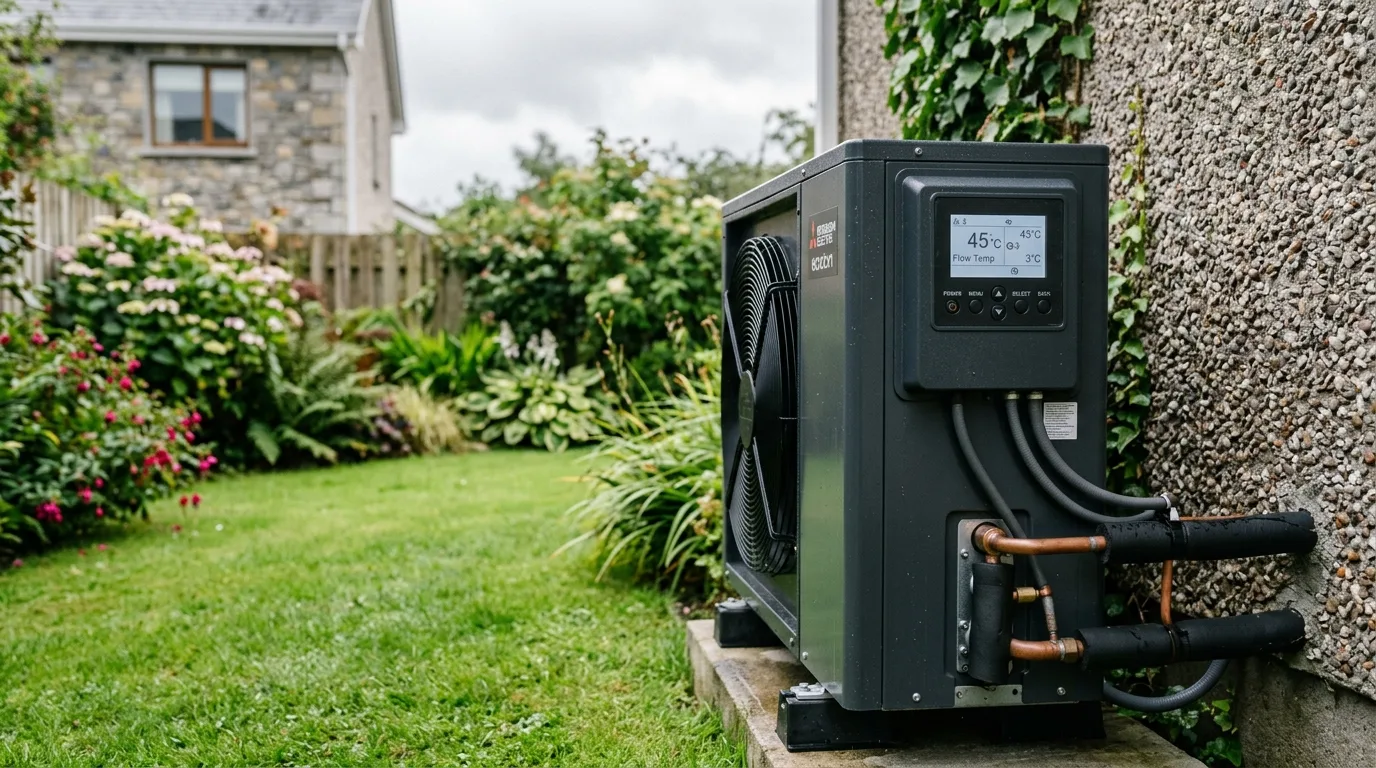
When comparing heat pumps for your Irish home, two efficiency numbers will appear constantly in brochures, specifications, and conversations with installers: COP (Coefficient of Performance) and SCOP (Seasonal Coefficient of Performance). Understanding the difference between these two figures — and which one actually matters for your electricity bill — is essential before you invest €15,000–€22,000 in a new heating system.
What Is COP?
COP stands for Coefficient of Performance. It is a measure of heat pump efficiency at a single, specific test condition. A COP of 3.5 means the heat pump delivers 3.5 kWh of heat for every 1 kWh of electricity it consumes under those exact conditions.
The test conditions used are standardised by European standard EN 14511. The most common test point for domestic heat pumps is:
- A7/W35: Outdoor air temperature 7°C, water leaving the heat pump at 35°C
- A2/W35: Outdoor air temperature 2°C, water at 35°C (a colder outdoor test point)
- A7/W55: Outdoor air temperature 7°C, water at 55°C (higher flow temperature, lower COP)
- A−7/W35: Outdoor air temperature −7°C, water at 35°C (cold condition test)
The COP drops as outdoor temperature falls or as flow temperature rises. A Daikin Altherma 3 might achieve COP 4.6 at A7/W35 but only COP 2.8 at A−7/W55. This is why the COP at a single test point is not sufficient for comparing real-world heating costs.
What Is SCOP?
SCOP stands for Seasonal Coefficient of Performance. It represents the average efficiency of the heat pump across a full heating season, accounting for all the different outdoor temperatures, flow temperatures, and load conditions the system experiences over the course of a year.
SCOP is calculated using the methodology in EN 14825 and is referenced to a specific climate zone. The three European climate zones defined in EN 14825 are:
- H1 (Helsingborg/Sweden): Cold climate (design temperature −10°C)
- H2 (Strasbourg/France): Average climate (design temperature −10°C)
- H3 (Athens/Greece): Warm climate (design temperature +2°C)
Ireland uses climate zone H3 for its national heat pump standards and SEAI assessments, as Ireland's winters are mild by European standards. However, the SEAI technical assessment process requires that the design confirms an in-situ SCOP of at least 2.5 for grant eligibility.
Why SCOP Is the Number That Matters
For your actual electricity bill, SCOP is the figure that counts. A simplified calculation for a typical Irish home:
Annual heat demand: 12,000 kWh (four-bedroom semi-detached, BER C1 retrofit)
Annual electricity consumption for heating = Heat demand ÷ SCOP
| SCOP | Electricity Used | Cost at 14c/kWh Night Rate |
|---|---|---|
| 2.5 | 4,800 kWh | €672/year |
| 3.0 | 4,000 kWh | €560/year |
| 3.5 | 3,429 kWh | €480/year |
| 4.0 | 3,000 kWh | €420/year |
| 4.5 | 2,667 kWh | €373/year |
Moving from a poorly designed system at SCOP 2.5 to a well-designed system at SCOP 4.0 saves almost €300 per year on this home's heating bill — a difference of over €6,000 over a 20-year system lifetime. Choosing the system and installer carefully, and optimising the heating distribution design, can therefore be worth far more than any initial discount on the equipment price.
How Flow Temperature Affects SCOP
The biggest single lever affecting your heat pump's real-world SCOP is the flow temperature — the temperature of the water leaving the heat pump and entering your radiators or underfloor heating.
Lower flow temperatures are more efficient. The relationship is roughly:
- 35°C flow temperature (underfloor heating): SCOP 3.8–4.5
- 45°C flow temperature (larger low-temperature radiators): SCOP 3.2–3.8
- 55°C flow temperature (standard retrofit radiators): SCOP 2.7–3.2
- 65°C flow temperature (old cast iron radiators): SCOP 2.2–2.6
This is why the choice between underfloor heating and radiators matters so much, and why many installers recommend upgrading radiators to larger low-temperature emitters as part of a heat pump installation. See our guide on heat pump radiator sizing for full details.
SCOP for Leading Brands in Ireland
The following SCOP figures are published under EN 14825 H2 climate zone (Strasbourg), which is the standard used on EU energy labels. Real-world Irish performance (H3/milder) is typically 10–15% higher.
Daikin Altherma 3 H HT (high-temperature)
- SCOP at W55: 3.3–3.6 (depending on unit size)
- Suitable for retrofit with existing standard radiators
Daikin Altherma 3 R (standard)
- SCOP at W35: 4.5–5.1
- SCOP at W55: 2.9–3.2
- Ideal for well-insulated homes with underfloor heating
Mitsubishi Ecodan Power Inverter
- SCOP at W35: 4.38–4.72
- SCOP at W55: 3.21–3.42
Samsung EHS Mono HQ
- SCOP at W35: 4.1–4.6
- SCOP at W55: 3.0–3.2
Grant Aerona⁴ R290
- SCOP at W35: 4.2–4.8
- Runs on low-GWP R290 refrigerant (propane)
Panasonic Aquarea T-Cap
- SCOP at W35: 4.1–4.7
- High-capacity models available for larger Irish homes
SPF: The Real-World Equivalent of SCOP
SPF (Seasonal Performance Factor) is sometimes used to describe actual measured performance after installation. Unlike SCOP (which is calculated from lab tests), SPF is measured from real heat pump monitoring data.
SEAI and the Sustainable Energy Research Group (SERG) at UCC have conducted real-world monitoring of Irish heat pump installations. Their findings show:
- New-build homes with underfloor heating: average SPF of 3.6–4.2
- Well-insulated retrofits (BER B2+) with upgraded radiators: average SPF of 3.0–3.6
- Poorly matched retrofits (BER C or lower, original radiators): average SPF of 2.4–2.8
This data reinforces that installation quality and system design have at least as much impact on real-world efficiency as the choice of heat pump brand.
COP vs SCOP: When to Use Each
| Metric | When to Use It |
|---|---|
| COP at A7/W35 | Comparing the raw efficiency of different models at mild outdoor conditions |
| COP at A2/W35 | Understanding cold-weather performance in a typical Irish winter |
| COP at A7/W55 | Understanding performance when running higher flow temps (older radiators) |
| SCOP (EN 14825 H2 or H3) | Comparing full-season energy consumption and running costs |
| SPF | Evaluating actual post-installation performance from monitoring data |
When asking an installer for quotes, request the SCOP at W35 and W55 for each model they propose. If they cannot provide these figures, that is a red flag. Reputable installers from Daikin, Mitsubishi, Samsung, Grant, Joule, and Panasonic all publish full EN 14825 performance data in their product documentation.
The SEAI 2.5 SCOP Threshold
The SEAI requires that any heat pump installation supported by the €6,500 grant must be capable of achieving an in-situ SCOP of at least 2.5. This threshold is evaluated as part of the technical assessment. A SCOP of 2.5 is a relatively modest target — it essentially means the heat pump must be roughly 2.5 times more efficient than direct electric heating. In practice, well-designed systems in Irish conditions almost always exceed this significantly.
If the technical assessment finds that the proposed installation cannot reliably achieve SCOP 2.5 (typically because the home is too leaky or the radiator system is too undersized), the assessor will recommend remediation works (insulation, radiator upgrades) before proceeding with the heat pump installation.
Get 3 free heat pump quotes — free and no obligation.
Frequently asked questions
What is a good SCOP for a heat pump in Ireland?
In Irish conditions, a well-designed air-to-water heat pump installation should achieve a real-world SPF of 3.0–4.0. Systems with underfloor heating in new builds or well-insulated retrofits regularly exceed 3.8. The SEAI minimum requirement for grant eligibility is SCOP 2.5.
What is the difference between COP and SCOP?
COP is the efficiency at one specific test condition (e.g., outdoor temperature 7°C, flow temperature 35°C). SCOP is the average efficiency over the entire heating season, accounting for varying outdoor temperatures and operating conditions. SCOP is the more useful number for comparing annual running costs.
Does a higher SCOP always mean lower running costs?
Yes, for the same heat demand. Higher SCOP means less electricity used per unit of heat delivered. However, the flow temperature your radiator system requires has a bigger impact on real-world SCOP than the choice of brand, which is why radiator sizing and system design are so important.
Why does flow temperature affect heat pump efficiency so much?
The heat pump compressor has to work harder — using more electricity — to raise refrigerant to higher temperatures. Every 1°C increase in flow temperature reduces COP by approximately 2–3%. Running at 35°C instead of 55°C can improve SCOP by 30–50%, which translates directly into lower electricity bills.
How do I find the SCOP for a specific heat pump model?
SCOP data is published in each manufacturer's product documentation and on the EU Energy Label. Ask your installer for the EN 14825 SCOP data sheet for any model they propose. The key figures to request are SCOP at W35, W45, and W55 for Irish climate conditions.
Sources & further reading
- SEAI Heat Pump Technical Assessment Requirements — Sustainable Energy Authority of Ireland
- EN 14825 — Heat Pump Seasonal Performance Standard — Sustainable Energy Authority of Ireland