How Much Electricity Does a Heat Pump Use in Ireland? 2026 Guide
A heat pump's electricity consumption depends on your home's heat demand, the system's SCOP, and how you manage your hot water heating. This guide gives you real numbers for typical Irish homes and shows how smart tariffs can cut your bill significantly.
By Smart Solar Editorial · Updated 15 May 2026 · 8 min read
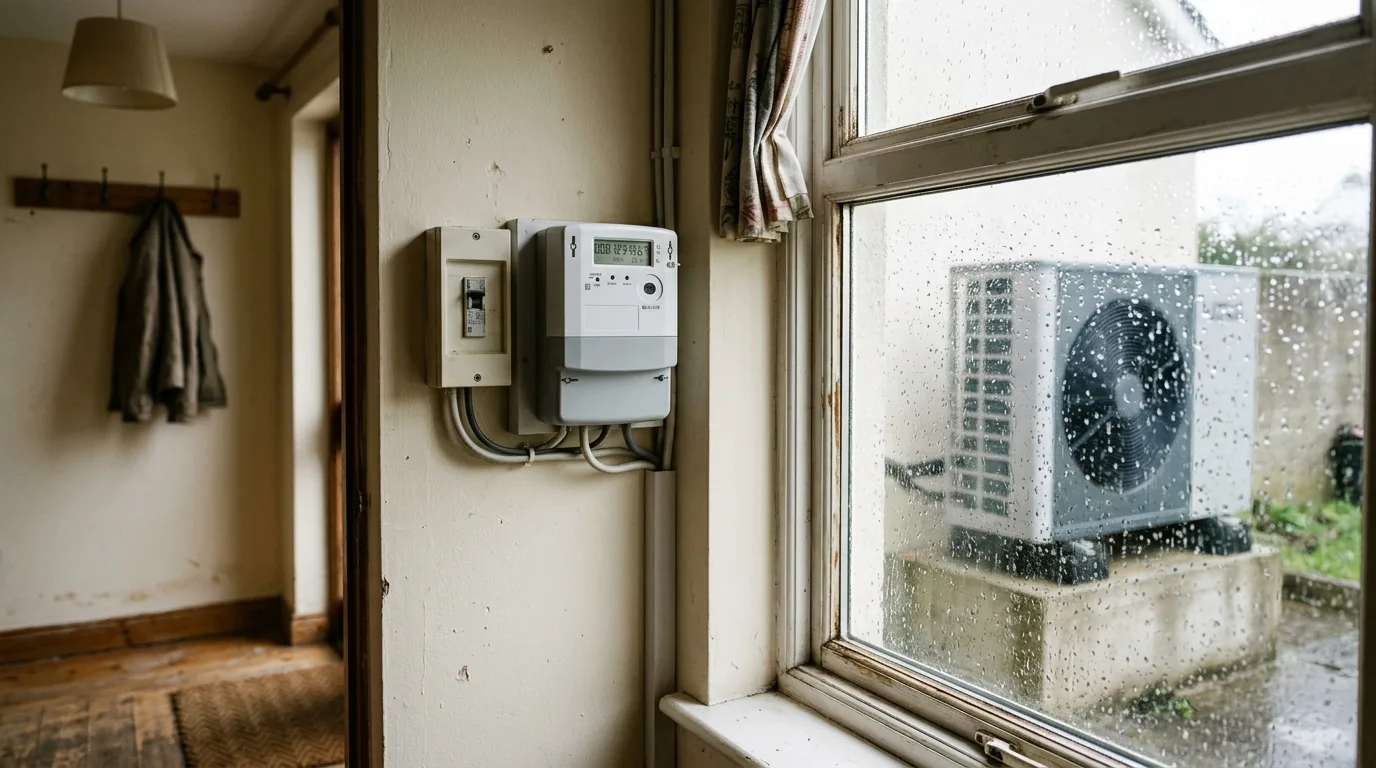
One of the most common questions from Irish homeowners considering a heat pump is simple: how much electricity will it use? The answer depends on four key factors: your home's heat demand, your heat pump's SCOP (efficiency rating), your domestic hot water requirements, and how you schedule your system to take advantage of cheap electricity tariffs. This guide walks through real calculations so you can estimate your own situation.
Understanding Heat Demand in Irish Homes
Before calculating electricity consumption, you need to know how much heat your home needs. Heat demand is measured in kilowatt-hours (kWh) per year and depends on your home's size, insulation level, and BER rating. The table below shows typical annual heat demands for Irish homes at different BER ratings:
| BER Rating | 3-Bed Semi (90 m²) | 4-Bed Semi (120 m²) | 5-Bed Detached (160 m²) |
|---|---|---|---|
| A2 | 4,000–6,000 kWh | 5,500–8,000 kWh | 7,000–10,000 kWh |
| B2 | 7,000–10,000 kWh | 9,000–13,000 kWh | 12,000–17,000 kWh |
| C1 | 10,000–14,000 kWh | 13,000–18,000 kWh | 17,000–24,000 kWh |
| D1 | 14,000–20,000 kWh | 18,000–26,000 kWh | 24,000–34,000 kWh |
These figures are for space heating only. Domestic hot water adds a further 2,500–4,500 kWh/year of heat demand for a typical Irish family (equivalent to roughly 700–1,300 kWh of electricity at heat pump COP).
The Electricity Consumption Formula
The formula is straightforward:
Annual electricity consumption = Annual heat demand ÷ SCOP
Where SCOP is the Seasonal Coefficient of Performance — the average efficiency of your heat pump over the full year. For Irish conditions:
- New build with underfloor heating: SCOP typically 3.8–4.5
- Good retrofit with upgraded radiators: SCOP typically 3.2–3.8
- Standard retrofit with existing radiators: SCOP typically 2.8–3.2
Worked Example: 4-Bed Semi-Detached, BER C1 Retrofit
This is the most common scenario for Irish heat pump retrofits:
- Home: 4-bed semi-detached, 120 m², BER C1 (before works)
- After insulation upgrade: BER B2 (assumed post-retrofit)
- Annual space heating demand: 12,000 kWh
- Annual hot water demand: 3,500 kWh of heat
- Total heat demand: 15,500 kWh/year
- System SCOP: 3.5 (air-to-water, upgraded radiators at 50°C flow)
- Annual electricity consumption: 15,500 ÷ 3.5 = 4,429 kWh/year
At a standard electricity rate of around 26–28 c/kWh, this would cost €1,152–€1,240/year.
However, with a smart night-rate tariff (available from Electric Ireland, Energia, Bord Gáis, and SSE Airtricity to customers with smart meters), you can schedule your heat pump and immersion heater to run primarily during cheap-rate hours (typically 11pm–8am at around 12–14 c/kWh). If you move 70% of your heat pump usage to night rate:
- 70% at 13c: 3,100 kWh × €0.13 = €403
- 30% at 26c: 1,329 kWh × €0.26 = €346
- Total: ~€749/year
This is a saving of over €400/year compared to running the heat pump on the standard day rate — a compelling reason to install a smart meter and switch to a time-of-use tariff.
Electricity Consumption by Home Size
Using SCOP 3.5 and BER B2 heat demands as a reference:
| Home Size | Annual Heat Demand | Annual Electricity | Cost at 13c Night Rate |
|---|---|---|---|
| 3-bed semi (BER B2) | 10,500 kWh | 3,000 kWh | €390/year |
| 4-bed semi (BER B2) | 13,500 kWh | 3,857 kWh | €501/year |
| 5-bed detached (BER B2) | 18,000 kWh | 5,143 kWh | €669/year |
| 4-bed semi (BER C1) | 15,500 kWh | 4,429 kWh | €575/year (mixed rate) |
These running costs compare very favourably with oil heating (typically €1,400–€2,000/year for a 4-bed semi) or gas heating (€1,100–€1,600/year).
Hot Water: A Significant Chunk of Total Consumption
Domestic hot water heating often accounts for 25–35% of a heat pump's total electricity use. A family of four using showers, baths, dishwasher, and hand-washing might consume 3,500–4,500 kWh of heat for hot water per year.
Most modern air-to-water heat pumps heat the hot water cylinder via the heat pump at COP 2.5–3.5, then use a brief immersion boost for the weekly Legionella cycle (at 60°C). If you have solar panels, a solar diverter (like the MyEnergi Eddi) can send surplus solar electricity to the immersion heater, reducing the heat pump's hot water workload significantly.
Impact of Radiator Flow Temperature on Consumption
The flow temperature your heating system runs at has a dramatic impact on electricity consumption. If your radiators are undersized for a heat pump and the system must run at 60°C instead of 45°C, the electricity consumption increases substantially:
Same home, same heat demand (12,000 kWh space heating), different flow temperatures:
- Flow at 35°C (underfloor heating), SCOP 4.2 → 2,857 kWh electricity
- Flow at 45°C (upgraded radiators), SCOP 3.5 → 3,429 kWh electricity
- Flow at 55°C (standard retrofit radiators), SCOP 3.0 → 4,000 kWh electricity
- Flow at 65°C (old small radiators), SCOP 2.5 → 4,800 kWh electricity
The difference between the best and worst case is nearly 2,000 kWh/year — almost €260/year at 13 c/kWh. This is why proper radiator sizing and potential upgrades are so important.
Smart Meter and Night Rate: The Heat Pump Game-Changer
ESB Networks has been rolling out smart meters across Ireland since 2019. If your home does not yet have a smart meter, you can request one through your electricity supplier (Electric Ireland, Energia, Bord Gáis, SSE Airtricity, etc.) or directly through ESB Networks. Installation is free.
Once you have a smart meter, you can switch to a time-of-use tariff that makes night-time electricity significantly cheaper. Typical 2026 tariff structures:
- Day rate (8am–11pm): 25–28 c/kWh
- Night rate (11pm–8am): 11–14 c/kWh
- Peak rate (5pm–7pm on some tariffs): 28–34 c/kWh (avoid heavy usage here)
Heat pump control systems from Daikin (Onecta app), Mitsubishi (MELCloud), and Samsung (SmartThings) all allow time-of-use scheduling. You can programme the heat pump to pre-heat your home during night rate hours, storing warmth in your home's thermal mass, then reduce heating during expensive daytime hours.
Is a Heat Pump's Electricity Use Higher Than a Standard Home?
Yes, installing a heat pump increases your home's electricity consumption — but your total energy bill falls because you are no longer buying oil or gas. A typical Irish home switching from oil heating to a heat pump:
- Eliminates: 1,400–2,000 litres of heating oil per year (€1,330–€2,200 at 2026 prices)
- Adds: 3,500–5,000 kWh of additional electricity per year (€455–€700 at night rate)
- Net saving: €800–€1,500/year depending on oil usage, home size, and electricity tariff
The total household electricity bill will typically increase by €500–€900/year on the standard rate, but the combination of removing oil costs and using a smart tariff means most families are €700–€1,400 better off per year overall.
Monitoring Your Heat Pump's Electricity Use
All modern heat pumps include energy monitoring via their smart thermostat or app. You can track:
- Daily, weekly, and monthly electricity consumption
- Heating hours vs. hot water hours
- COP and SPF over time
If your heat pump's real-world SPF falls below 2.5, this is a sign the system needs attention — possibly a refrigerant recharge, filter clean, or heating circuit flow temperature adjustment. SEAI recommends annual servicing to maintain efficiency.
Get 3 free heat pump quotes — free and no obligation.
Frequently asked questions
How many kWh does a heat pump use per year in Ireland?
A typical 4-bed semi-detached Irish home with BER B2 rating and a heat pump SCOP of 3.5 uses approximately 3,500–4,500 kWh of electricity per year for combined space heating and hot water. Homes with better insulation or underfloor heating use less; older homes with poorer insulation use more.
How can I reduce my heat pump's electricity use?
The most impactful steps are: ensure your radiators are sized correctly for low-temperature operation (45–50°C), switch to a night-rate smart tariff, add attic and wall insulation to reduce heat demand, and use the heat pump's scheduling app to pre-heat during cheap-rate hours.
Does a heat pump use a lot of electricity compared to other appliances?
A heat pump uses more electricity than most individual appliances, but it replaces a fuel you were previously buying (oil or gas). The typical heat pump adds 3,500–5,000 kWh/year to your electricity use while eliminating €1,400–€2,200/year of oil costs. The net financial impact is positive.
What is the cheapest electricity tariff for a heat pump in Ireland?
Smart night-rate tariffs from Electric Ireland, Energia, Bord Gáis, and SSE Airtricity offer night-time rates of 11–14 c/kWh (2026 rates), versus 25–28 c/kWh during the day. Using a smart meter and scheduling your heat pump to run primarily at night can reduce heating costs by 40–50% compared to running at the standard day rate.
Do I need a smart meter for a heat pump in Ireland?
You do not need a smart meter for the heat pump to work, but it is strongly recommended. A smart meter enables time-of-use tariffs (night rates) that can save €300–€500/year on your electricity bill. Smart meters are being rolled out free of charge by ESB Networks across Ireland.
Sources & further reading
- ESB Networks Smart Metering Programme — ESB Networks
- SEAI Heat Pump Running Costs — Sustainable Energy Authority of Ireland
- Commission for Regulation of Utilities — Electricity Tariffs — Commission for Regulation of Utilities