Heat Pump Radiator Sizing in Ireland: Why It Matters and How It Works
The single biggest mistake in Irish heat pump retrofits is installing the heat pump without addressing undersized radiators. Undersized radiators force the system to run at high flow temperatures, dramatically reducing efficiency. This guide explains how to get it right.
By Smart Solar Editorial · Updated 15 May 2026 · 8 min read
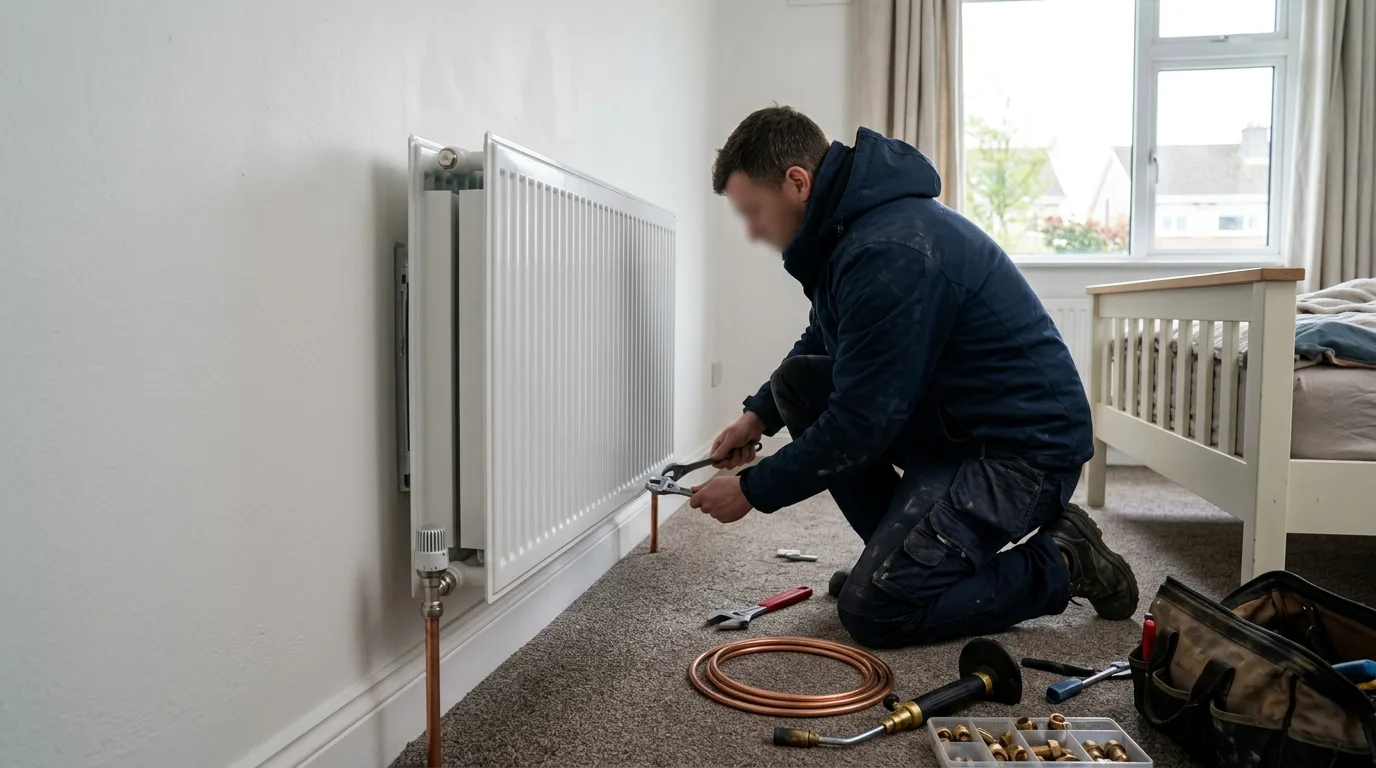
One of the most important — and most frequently overlooked — aspects of a heat pump installation in Ireland is ensuring that the home's radiators are large enough to deliver adequate heat at the low flow temperatures that heat pumps operate at most efficiently.
This is not a trivial issue. The relationship between flow temperature and heat pump efficiency is significant: running at 55°C instead of 45°C can reduce SCOP by 20–30%, adding €200–€400 per year to electricity bills over the system's lifetime. Getting radiator sizing right is therefore one of the most financially impactful decisions in a heat pump installation.
Why Flow Temperature Matters So Much
A heat pump heats water to a target flow temperature, which is then distributed through your radiator system. The compressor works harder — using more electricity — to raise the refrigerant to higher temperatures. This is quantified by the relationship between flow temperature and SCOP:
| Flow Temperature | Typical SCOP (Irish Conditions) |
|---|---|
| 35°C (underfloor heating) | 4.0–4.8 |
| 40°C (large low-temp radiators) | 3.6–4.2 |
| 45°C (upgraded low-temp radiators) | 3.3–3.8 |
| 50°C (standard modern radiators, upsized) | 3.0–3.5 |
| 55°C (typical standard retrofit radiators) | 2.7–3.2 |
| 60°C (small old radiators) | 2.4–2.8 |
| 65°C+ (small 1970s radiators) | 2.0–2.5 |
For a home with a 15,000 kWh annual heat demand:
- At SCOP 3.5 (45°C flow): 4,286 kWh electricity, ~€686/year at 16c blended
- At SCOP 2.6 (60°C flow): 5,769 kWh electricity, ~€923/year at 16c blended
The difference is €237/year — over 20 years, that is almost €5,000 extra electricity cost for the same amount of heat. Spending €1,500–€2,500 on radiator upgrades that save this amount every year is clearly worthwhile.
How Radiators Are Sized: The Basic Principles
A radiator delivers heat through a combination of radiation and convection. Its heat output at a given flow temperature is calculated using the Delta T (temperature difference between the radiator and the room):
Delta T = (Flow temperature + Return temperature) / 2 - Room temperature
At a boiler flow temperature of 75°C and return of 65°C (standard Irish oil boiler setup), the mean water temperature is 70°C. In a room at 21°C, Delta T = 70 − 21 = 49K.
At a heat pump flow temperature of 45°C and return of 40°C, the mean water temperature is 42.5°C. Delta T = 42.5 − 21 = 21.5K.
Since radiator output scales approximately with the power of the Delta T (not linearly), a radiator's heat output at Delta T 21.5K is roughly 35–45% of its rated output at Delta T 49K.
This means: a radiator that delivers 1,500 W at standard boiler conditions only delivers about 600–700 W at heat pump conditions. If the room needs 1,000 W of heat to maintain 21°C, the existing radiator is undersized for heat pump operation.
The Standard Output Rating Trap
Radiators in Ireland are sold with output ratings in Watts at Delta T 50K (the European standard test condition). This corresponds to a mean water temperature of 71°C — close to traditional boiler conditions. When you see "1,500 W" on a radiator datasheet, that is its Delta T 50K rating.
For heat pump operation, you need to request the output at Delta T 25K (typical for 45°C flow, 20°C room) or Delta T 30K (for 50°C flow). Most manufacturers publish this data — it is typically 35–50% of the Delta T 50K figure.
How to Check Whether Your Radiators Are Adequate
Step 1: Calculate room heat loss Your installer should perform a room-by-room heat loss calculation to EN 12831. This tells you how many watts of heat each room needs to maintain the target temperature on a design-cold day.
Step 2: Find your radiators' low-temperature output Using the room radiator model (length × height × type), look up the manufacturer's output at your target flow temperature (say, 45°C). If the radiator datasheet is not available, a conservative estimate: single-panel radiator at Delta T 25K delivers approximately 30% of its Delta T 50K rating.
Step 3: Compare room heat loss to low-temperature output If the radiator's low-temperature output is less than the room's calculated heat loss, that room needs an upgrade.
Step 4: Design the solution Options include:
- Replace with a larger double-panel double-convector (Type 22 or 33) radiator
- Add an additional radiator to the room
- Accept a slightly higher flow temperature in that room (at some efficiency cost)
Which Rooms Most Often Need Radiator Upgrades?
In a typical Irish retrofit, the rooms most likely to need radiator upgrades are:
Upstairs bedrooms: Bedroom radiators were often sized conservatively. They heat a smaller space and are used for shorter periods in traditional oil/gas systems. For a heat pump, these radiators often need to be upsized.
Hall and landing: Hallway radiators are often undersized in older Irish homes (the assumption being that heat would "leak" from living rooms). For efficient heat pump operation, the hall and landing should have adequate heat emitters.
Bathrooms: Standard bathroom radiators (small chrome towel rails) are often extremely undersized for heat pump operation. Either a larger towel rail or a supplementary panel radiator is usually required.
Rooms with large external wall or window areas: Rooms with more heat loss (bay windows, north-facing walls) may have been adequately heated by a boiler at 75°C but be borderline at 50°C.
Ground floor rooms that had the most heat loss: Sometimes ground floor rooms with exposed floors or large windows were given larger radiators anyway, making them more compatible with heat pump temperatures.
Radiator Upgrade Options and Costs
Option 1: Replace with Type 22 or 33 double-panel convector
A single-panel Type 11 radiator (one panel, one convector fin set) replaced with a double-panel double-convector Type 22 (two panels, two fin sets) roughly doubles the heat output. Type 33 (two panels, three fin sets) increases output by approximately 2.5×.
- Supply and install per radiator: €250–€450 depending on size
- 4–6 radiator upgrades for a typical 4-bed: €1,000–€2,700
Option 2: Retrofit low-temperature radiators
Modern low-temperature radiators with larger surface area and high-efficiency fins are designed specifically for heat pump operation. They may cost more than standard replacements but deliver higher output at lower flow temperatures.
- Supply and install: €350–€600 per radiator
Option 3: Fan-assisted radiators
Fan convectors (or fan-assisted radiators) use a small integral fan to improve airflow across the heat exchange fins, dramatically increasing heat output at low flow temperatures. These are popular in retrofit situations where wall space is limited.
- Output at 45°C: 50–80% of rated capacity (significantly better than passive radiators)
- Supply and install: €400–€800 per unit
Option 4: Underfloor heating conversion (ground floor)
For ground floor rooms with existing concrete slab construction, an insulated screed with embedded underfloor heating pipes can be installed. This is expensive (€60–€100/m²) but provides the most efficient heat pump operation at 35–40°C flow.
The Daikin Altherma H HT Alternative
If radiator upgrades are not immediately feasible, consider a high-temperature heat pump (Daikin Altherma 3 H HT, Panasonic Aquarea T-Cap HT) that can operate at up to 65–70°C without an electric top-up. This allows use of existing undersized radiators at slightly lower SCOP (2.8–3.2 vs 3.5–4.0 for a standard unit), with radiator upgrades phased in over time.
What the SEAI Technical Assessment Covers
The SEAI technical assessment specifically evaluates whether the proposed heating system can achieve SCOP 2.5+. If the existing radiators are too small to allow SCOP 2.5 at a reasonable flow temperature, the assessor will specify the minimum upgrades required as a prerequisite for grant eligibility.
In practice, most Irish homes built from the 1980s onwards have radiators that are adequate for heat pump operation at 50–55°C with 1–3 upgrades. Only very old homes with very small radiators may need comprehensive replacement.
Get 3 free heat pump quotes — free and no obligation.
Frequently asked questions
Do I need to replace all my radiators for a heat pump?
In most cases, no. A room-by-room heat loss calculation will identify which specific radiators are undersized for heat pump operation. Typically 2–5 radiators in a 4-bed home need upgrading — usually upstairs bedrooms, bathrooms, and hall/landing. Ground floor living room and kitchen radiators are often already large enough.
What flow temperature should my heat pump radiators run at?
The ideal flow temperature depends on your radiators' size and the room's heat loss. Most well-designed Irish retrofits target 45–50°C flow temperature, which gives SCOP 3.3–3.8. New builds with underfloor heating run at 35–40°C for SCOP 4.0–4.8.
How do I know if my radiators are compatible with a heat pump?
Your heat pump installer should perform a room-by-room heat loss calculation and compare each room's heat requirement against each radiator's output at the target heat pump flow temperature. If the radiator output is insufficient, the installer will recommend an upgrade.
What is a Type 22 radiator and why is it better for heat pumps?
A Type 22 radiator has two panels and two convector fin sets, delivering approximately twice the heat output of a single-panel Type 11 radiator at the same dimensions. This allows it to deliver adequate heat at lower flow temperatures (45–50°C), making it ideal for heat pump retrofits.
How much does a radiator upgrade cost in Ireland?
A radiator upgrade (supply and install of a new double-panel Type 22 or 33 radiator) typically costs €250–€450 per radiator, including labour. A typical 4-bed Irish home needing 4–6 upgrades would cost €1,000–€2,700 for radiator works.
Sources & further reading
- SEAI Technical Assessment Requirements — Sustainable Energy Authority of Ireland
- EN 12831 — Heating Systems in Buildings — Sustainable Energy Authority of Ireland