Heat Pump in an Old House Ireland: Can It Work and What Does It Cost?
Ireland has hundreds of thousands of older homes built before 1980 with solid walls, single-glazed windows, and poor insulation. Can a heat pump work in these houses? The honest answer is: yes, with the right approach. Here is how to do it properly.
By Smart Solar Editorial · Updated 15 May 2026 · 9 min read
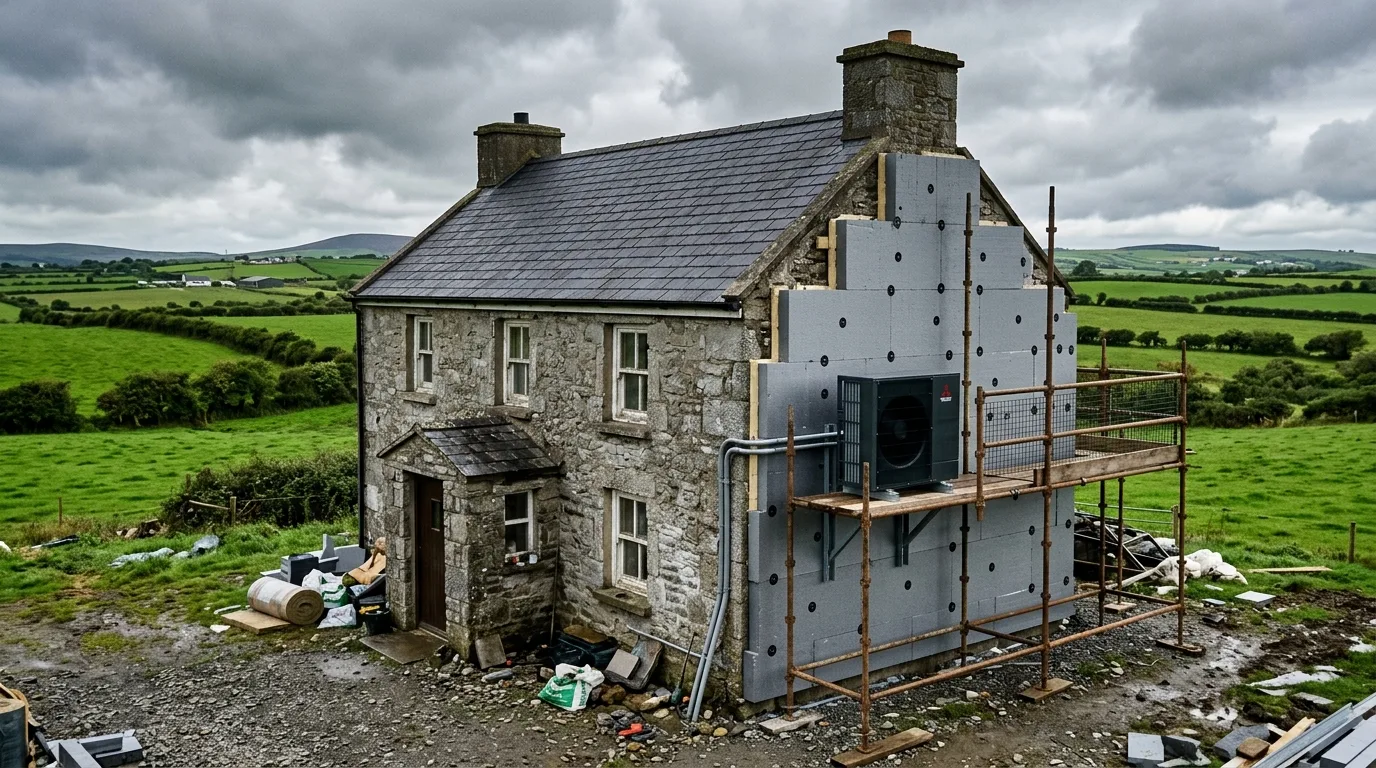
Approximately 40% of Ireland's housing stock was built before 1980. These older homes — stone cottages, Victorian terraces, Edwardian semis, 1950s bungalows — are typically poorly insulated by modern standards and present significant challenges for heat pump installation. But with the right approach, a phased retrofit combining insulation upgrades and a well-designed heat pump system, these homes can achieve comfortable, efficient heating.
This guide addresses the real questions Irish homeowners in older properties are asking in 2026.
The Challenge with Older Irish Homes
Solid walls: Most Irish homes built before 1970 have solid stone or brick walls with no cavity to fill. These walls have poor thermal performance — a typical 600 mm stone wall has a U-value of 1.5–2.0 W/m²K, compared to a modern 300 mm insulated cavity wall at 0.21 W/m²K.
Poor airtightness: Older homes leak air through gaps around windows, doors, floorboards, and fireplace openings. This infiltration heat loss can account for 30–40% of total heat demand.
Undersized heating systems: Older oil or gas systems often ran at 75–80°C because the house was poorly insulated and lost heat quickly. The radiators were sized to compensate for heat loss, not to operate efficiently at low temperatures.
High heat demand: A pre-1980 Irish home without retrofit works might have a heat demand of 20,000–35,000 kWh/year — far too high for a heat pump to deliver efficiently and economically without significant insulation first.
Does a Heat Pump Work Without Full Insulation?
This is the question many owners of older Irish homes want answered honestly. The answer depends on what "work" means:
Technically operational? Yes. A heat pump can be connected to any heating circuit and will produce heat. But if the home is poorly insulated and the heat pump must run at high flow temperatures (65–70°C) to compensate, the SCOP may fall to 1.8–2.2 — barely better than direct electric heating and far more expensive than oil.
Economically sensible? Only with at least some insulation. The SEAI's minimum standard — SCOP 2.5 confirmed by technical assessment — requires a meaningful minimum level of insulation and heating system performance.
Comfortable and efficient? Only with adequate insulation. SEAI's guidance is clear that for a heat pump to work well in an older home, reducing heat demand through insulation is the essential first step.
The SEAI Technical Assessment Route
For homes with BER ratings below B2 — which includes most pre-1980 Irish homes — the SEAI technical assessment (cost: €200, grant-eligible) is the gateway to the €6,500 heat pump grant. The assessment:
- Measures the home's actual heat loss
- Designs a heating system that can achieve SCOP 2.5+ with the proposed heat pump
- Identifies the minimum insulation and radiator upgrades required
- Confirms grant eligibility
Critically, the technical assessment does not require the home to reach BER B2 through insulation alone. It requires that the heating system design — heat pump size, flow temperature, radiator outputs — demonstrates SCOP 2.5+. With careful system design (larger radiators, correct sizing, weather compensation), many BER D homes can qualify for the grant with targeted rather than comprehensive insulation upgrades.
What Insulation Works Are Typically Required?
For a typical pre-1980 Irish home, a technical assessor will usually recommend some combination of:
Attic insulation (mandatory for almost all older homes):
- Laying 300 mm of mineral wool across attic floor joists
- Cost: €1,000–€2,500 depending on attic size and access
- Typical heat demand reduction: 15–25%
External wall insulation (EWI) — for solid-wall homes:
- 80–120 mm of EPS, mineral wool, or phenolic board applied to exterior walls
- Cost: €8,000–€20,000 for a typical Irish home
- Typical heat demand reduction: 25–40%
- Also eliminates cold bridging and improves internal comfort dramatically
Cavity wall insulation (for 1970s–1980s cavity-wall homes):
- Injected EPS beads or bonded mineral wool via drill holes
- Cost: €1,200–€2,500
- Very cost-effective for cavity-wall houses
Window and door replacement:
- Replacing single-glazed or early double-glazed windows with triple-glazed units
- Cost: €800–€1,500 per window; €8,000–€18,000 for a full house
Draught-proofing:
- Sealing gaps around skirting boards, floorboards, fireplace openings
- Cost: €500–€1,500 as a DIY or professional job
The Staged Retrofit Approach
Many Irish homeowners cannot afford to carry out all retrofit works simultaneously. The SEAI One Stop Shop programme allows a staged approach with grants covering:
Heating control upgrade: €700 grant for smart heating controls — can be done as an immediate first step.
Attic insulation: SEAI grant of €800–€1,200 depending on depth. Can be done independently.
Wall insulation: SEAI grants of €700–€4,000 depending on type and home size.
Heat pump: €6,500 grant once minimum standards are met.
A practical staged plan for a BER D1 home might be:
- Year 1: Attic insulation + draught-proofing (brings home to BER C2/C1, cost ~€2,000)
- Year 2: Cavity or external wall insulation (brings home to BER B3/B2, cost ~€5,000–€15,000)
- Year 3: Heat pump installation after technical assessment confirms SCOP 2.5+
Radiator Upgrades in Older Homes
One of the most cost-effective ways to make a heat pump work efficiently in an older home is to upgrade the radiators. Larger radiators — double-panel double-convector types — can deliver the same heat output at 50°C as smaller radiators at 70°C. In a room-by-room assessment, an installer will identify which rooms need radiator upgrades:
- Standard room: replace single panel with double panel convector (€250–€400 per radiator)
- Bathroom: replace with chrome heated towel rail sized for heat pump operation (€300–€500)
- Hall and landing: often need a new radiator added rather than upgraded
The total cost of radiator upgrades across a typical 4-bed older home is usually €1,500–€3,500 — a modest investment relative to the overall heat pump project.
Real Retrofit Example: 1930s Semi-Detached Dublin
- Home: 3-bed Edwardian semi-detached, 95 m², BER D1 on purchase
- Works completed: Attic insulation (€1,500), external wall insulation front and rear (€12,000), new windows (€9,000), draught-proofing (€800) — brings home to BER B2
- Heat pump: 6 kW Daikin Altherma 3, 200-litre cylinder, 4 radiator upgrades — €16,500
- SEAI grants received: €6,500 heat pump + ~€3,500 insulation grants = €10,000
- Total net cost after grants: ~€29,800
- Previous oil bill: €1,900/year; now electricity for heating: ~€420/year
- Annual saving: ~€1,480; combined payback: ~20 years (or ~14 years if oil prices rise 3%/year)
Grants Available for Older Home Retrofit in 2026
| Grant | Value |
|---|---|
| SEAI Heat Pump Grant | €6,500 |
| SEAI Technical Assessment | €200 |
| Attic Insulation Grant | Up to €1,500 |
| Cavity Wall Insulation | Up to €1,700 |
| External Wall Insulation | Up to €8,000 (detached) |
| Window and Door Grant | Up to €4,500 |
| SEAI Home Energy Upgrade Loan | Subsidised, from 3% APR |
The One Stop Shop bundles insulation and heat pump works into a single project with a single point of contact, managing grants on your behalf.
Get 3 free heat pump quotes — free and no obligation.
Frequently asked questions
Can I get the SEAI heat pump grant for an older Irish house with a low BER rating?
Yes, through the technical assessment route. Even if your home's BER rating is below B2, a SEAI-registered assessor can confirm that the proposed heat pump installation will achieve SCOP 2.5+, unlocking the €6,500 grant. This typically requires some insulation upgrades and correctly sized radiators.
Do I need to fully insulate my old house before installing a heat pump?
Not necessarily. The SEAI technical assessment identifies the minimum works required to make the heat pump installation viable. In some cases, attic insulation and radiator upgrades alone are sufficient. External wall insulation is recommended but not always mandatory depending on the specific home and system design.
Will a heat pump work in a stone cottage in Ireland?
Yes, but stone cottages typically require significant insulation works first. External wall insulation or internal dry-lining (which reduces internal room size but preserves external appearance) is the usual solution. A technical assessment will determine the minimum works needed and whether the grant applies.
What is the SEAI One Stop Shop retrofit programme?
SEAI's One Stop Shop allows homeowners to bundle multiple retrofit measures — insulation, heating controls, heat pump — into a single project managed by an approved One Stop Shop provider. Grants are applied across all measures, and the provider handles the paperwork. This is the recommended approach for comprehensive retrofits of older Irish homes.
Is it worth retrofitting a very old house for a heat pump in Ireland?
Financially, the case depends on your baseline heating costs and the extent of retrofit required. If your home is already costing €2,000+/year in oil or gas, even a comprehensive retrofit with a 15-year payback may be worthwhile. SEAI's Home Energy Calculator can model your specific situation. The comfort and air quality benefits are also significant and not fully captured in financial calculations.
Sources & further reading
- SEAI Technical Assessment for Heat Pumps — Sustainable Energy Authority of Ireland
- SEAI One Stop Shop Retrofit — Sustainable Energy Authority of Ireland
- SEAI Home Energy Upgrade Loan — Sustainable Energy Authority of Ireland