BER Rating and the SEAI Heat Pump Grant: What You Need to Know
The SEAI heat pump grant requires either a BER rating of B2 or better, or a technical assessment confirming SCOP 2.5+ can be achieved. This guide explains exactly what this means, how to check your BER, and what to do if your home does not yet meet the B2 threshold.
By Smart Solar Editorial · Updated 15 May 2026 · 7 min read
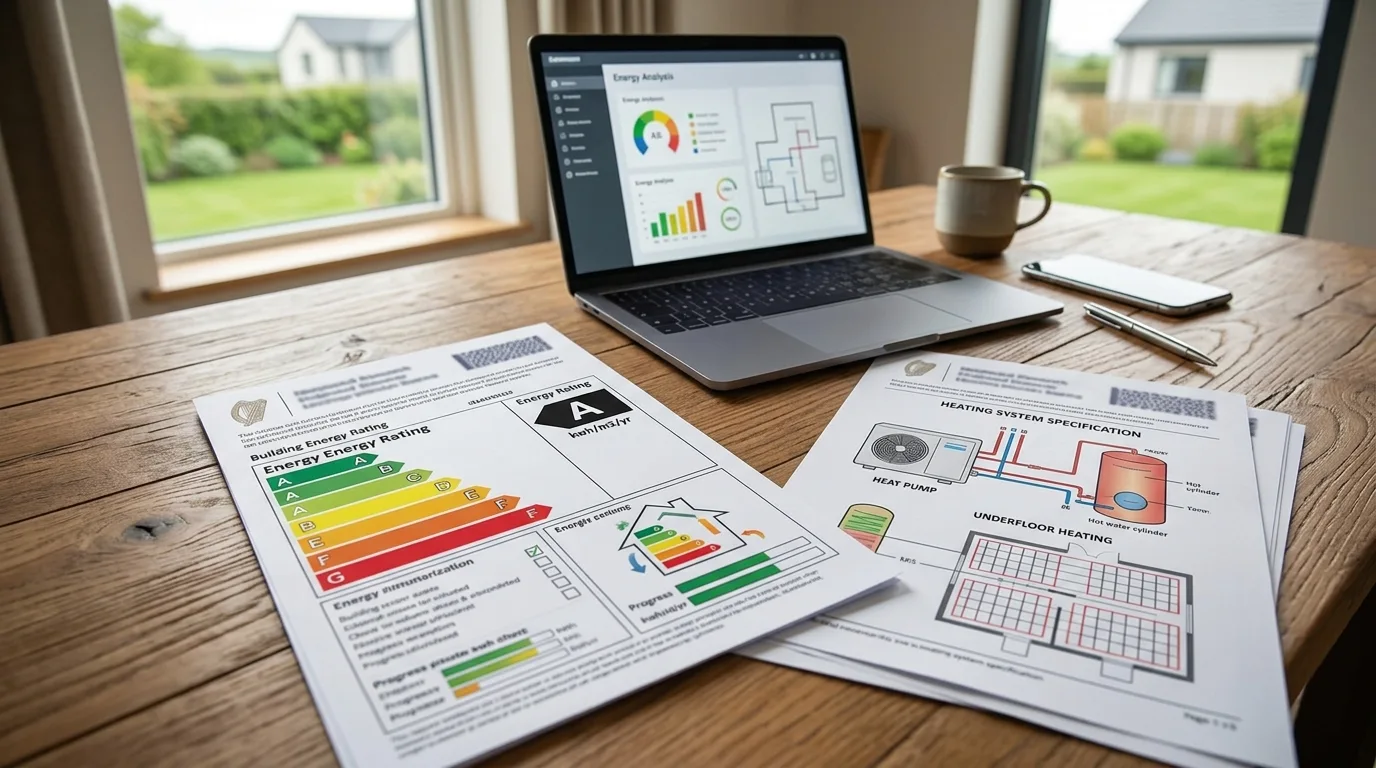
The BER (Building Energy Rating) is Ireland's national system for rating a home's energy performance on a scale from A1 (most efficient) to G (least efficient). It was introduced as part of the EU Energy Performance of Buildings Directive and is now required for all homes sold or rented in Ireland.
In 2026, the BER has become critically important for homeowners seeking the SEAI heat pump grant. Understanding how the BER system works, what rating your home currently has, and how to either improve it or use the alternative technical assessment route is essential knowledge for any Irish homeowner considering a heat pump.
What the BER Scale Means
BER ratings are expressed on a letter scale from A to G, subdivided into:
- A1, A2, A3 (best — nearly zero energy buildings)
- B1, B2, B3
- C1, C2, C3
- D1, D2
- E1, E2
- F
- G (worst)
The rating is calculated using the DEAP (Dwelling Energy Assessment Procedure) methodology, which considers:
- Floor area
- Wall, roof, and floor insulation levels
- Window and door specifications
- Air tightness
- Heating system type and efficiency
- Renewable energy systems (solar PV, solar thermal)
- Lighting
- Ventilation
The result is a primary energy consumption figure in kWh/m²/year. A typical new Irish build at NZEB standard achieves A2 (below 50 kWh/m²/year). A typical 1980s oil-heated home might be D1 (180–250 kWh/m²/year).
SEAI's BER B2 Threshold for Heat Pump Grants
The SEAI requires that homes receiving the heat pump grant either:
Meet BER B2 — which typically corresponds to primary energy consumption below approximately 125 kWh/m²/year, or
Complete a technical assessment confirming that the proposed installation can achieve an in-situ SCOP of at least 2.5.
Why B2? SEAI's reasoning is that homes below B2 typically have insufficient insulation to allow a heat pump to operate efficiently and economically. A heat pump in a poorly insulated home would run at very low SCOP (2.0–2.5), providing minimal improvement over direct electric heating and wasting grant money on an inefficient outcome.
The B2 threshold is a practical proxy for "insulated well enough for a heat pump." But it is not a perfect measure — which is why the technical assessment alternative exists.
How to Check Your BER Rating
If your home was built or sold/rented since 2007: A BER certificate is legally required and should be available in your purchase or tenancy documentation. The certificate lists the BER rating (e.g., "C2") and the unique BER certificate number.
Search the National BER Register: Visit ndber.seai.ie and search by address or certificate number. All issued BER certificates are on this database and are publicly searchable.
Commission a new BER assessment: If your home does not have a BER (e.g., it was built before 2007 and has not been sold or rented recently), you can commission an assessment from an SEAI-registered BER assessor. Typical cost: €150–€250. The assessment takes 2–3 hours and produces a certificate valid for 10 years.
Why Your Current BER May Be Inaccurate
BER assessments are based on what was recorded at the time of the last assessment. If you have carried out works since (new boiler, insulation, solar panels, new windows), your current BER certificate may understate your home's true performance. An updated BER will reflect these improvements.
This is important if you are close to the B2 threshold — a recent attic insulation upgrade or cavity wall fill that was not captured in the last BER assessment could push you over the line.
How to Improve Your BER to Reach B2
For a home currently at BER C1 or C2, reaching B2 is often achievable with targeted improvements:
Most effective upgrades (by BER impact):
| Upgrade | Typical BER Improvement | SEAI Grant |
|---|---|---|
| External wall insulation (solid walls) | 2–3 letter grades | Up to €8,000 |
| Cavity wall insulation | 1–2 letter grades | Up to €1,700 |
| Attic insulation (300 mm) | 1 letter grade | Up to €1,500 |
| New condensing boiler → heat pump | 1–2 letter grades | €6,500 |
| Triple-glazed windows | 0.5–1 letter grade | Up to €4,500 |
| Solar PV (4 kWp) | 0.5–1 letter grade | SEAI solar grant |
| Heating controls | 0–0.5 letter grades | €700 |
A home at BER C2 can typically reach B2 through:
- Cavity wall insulation (C2 → C1)
- Attic insulation top-up to 300 mm (C1 → B3)
- Heat pump installation replacing oil boiler (B3 → B2)
In this scenario, the heat pump installation itself contributes to the BER improvement. Many homes reach B2 through the combined effect of insulation works and heat pump installation.
The Technical Assessment Alternative (for Homes Below B2)
If your home's BER is below B2 and reaching B2 through insulation alone is not feasible or not yet affordable, the SEAI technical assessment provides the alternative pathway to the heat pump grant.
The technical assessment (cost: €200, grant-eligible) evaluates whether the proposed heat pump installation can achieve SCOP 2.5+ in the specific home's conditions. If the assessor confirms this is achievable with the proposed system and any specified prerequisite works, the €6,500 grant applies regardless of the BER rating.
Homes that commonly use the technical assessment route:
- 1970s–1990s homes at BER C1–C2 that cannot easily reach B2 without expensive wall insulation
- Rural homes where external wall insulation is architecturally complex
- Homes where the BER assessment was done before recent improvement works
The SEAI One Stop Shop: BER Improvement Bundled with Heat Pump
SEAI's One Stop Shop programme bundles insulation upgrades and heat pump installation into a single grant-supported project. The One Stop Shop provider:
- Carries out an energy assessment and retrofit plan
- Manages all grant applications (insulation + heat pump)
- Coordinates contractors
- Issues a post-project BER certificate confirming the improvement
For homes at BER D or E that need comprehensive retrofit before a heat pump makes sense, the One Stop Shop is often the most efficient route — both for grant maximisation and for project management.
BER and Resale Value
A BER improvement from D1 to B2 can add significant value to an Irish home. Property market research indicates that homes with BER B2 or better command a premium of €10,000–€30,000 over equivalent homes at C or D ratings, driven by buyers increasingly factoring in running costs and carbon footprint.
Installing a heat pump and reaching BER B2 is therefore both a utility upgrade (lower running costs) and a property value enhancement — making it one of the most financially rational home improvements available in Ireland in 2026.
Get 3 free heat pump quotes — free and no obligation.
Frequently asked questions
Do I need a BER B2 to get the SEAI heat pump grant?
You need either BER B2 or better, OR a technical assessment confirming the proposed heat pump installation can achieve SCOP 2.5+. Many Irish homes below B2 qualify through the technical assessment route.
How do I find my BER rating?
Search the National BER Register at ndber.seai.ie using your property address or certificate number. If your home does not have a BER certificate (pre-2007 homes not recently sold), commission an assessment from an SEAI-registered BER assessor (€150–€250).
Can I improve my BER to B2 without expensive wall insulation?
In many cases, yes. Attic insulation to 300 mm, cavity wall insulation (for 1970s+ homes), and switching from oil to a heat pump can often bring a C1–C2 home to B2 without external wall insulation. A BER assessor can advise on the most cost-effective route for your specific home.
How long does a BER certificate last?
A BER certificate is valid for 10 years. However, if significant energy improvements have been made since the last assessment, it is advisable to commission a new assessment to reflect the current state of the home — particularly if you are close to the B2 grant threshold.
Does installing a heat pump improve my BER rating?
Yes. Replacing an oil or gas boiler with a heat pump typically improves the BER by 1–2 letter grades (e.g., C1 to B3, or B3 to B2), because the DEAP calculation credits the heat pump's significantly higher efficiency compared to fossil fuel boilers.
Sources & further reading
- National BER Register — NDBER — Sustainable Energy Authority of Ireland
- SEAI Heat Pump Grant Eligibility — Sustainable Energy Authority of Ireland