Heat Pump in a 1970s House Ireland: A Practical Retrofit Guide for 2026
Ireland's 1970s housing stock — cavity-wall bungalows, semis, and terraced homes — is actually a better heat pump candidate than many homeowners assume. The cavity wall, attic space, and typically larger rooms can all work in your favour. Here is the guide.
By Smart Solar Editorial · Updated 15 May 2026 · 8 min read
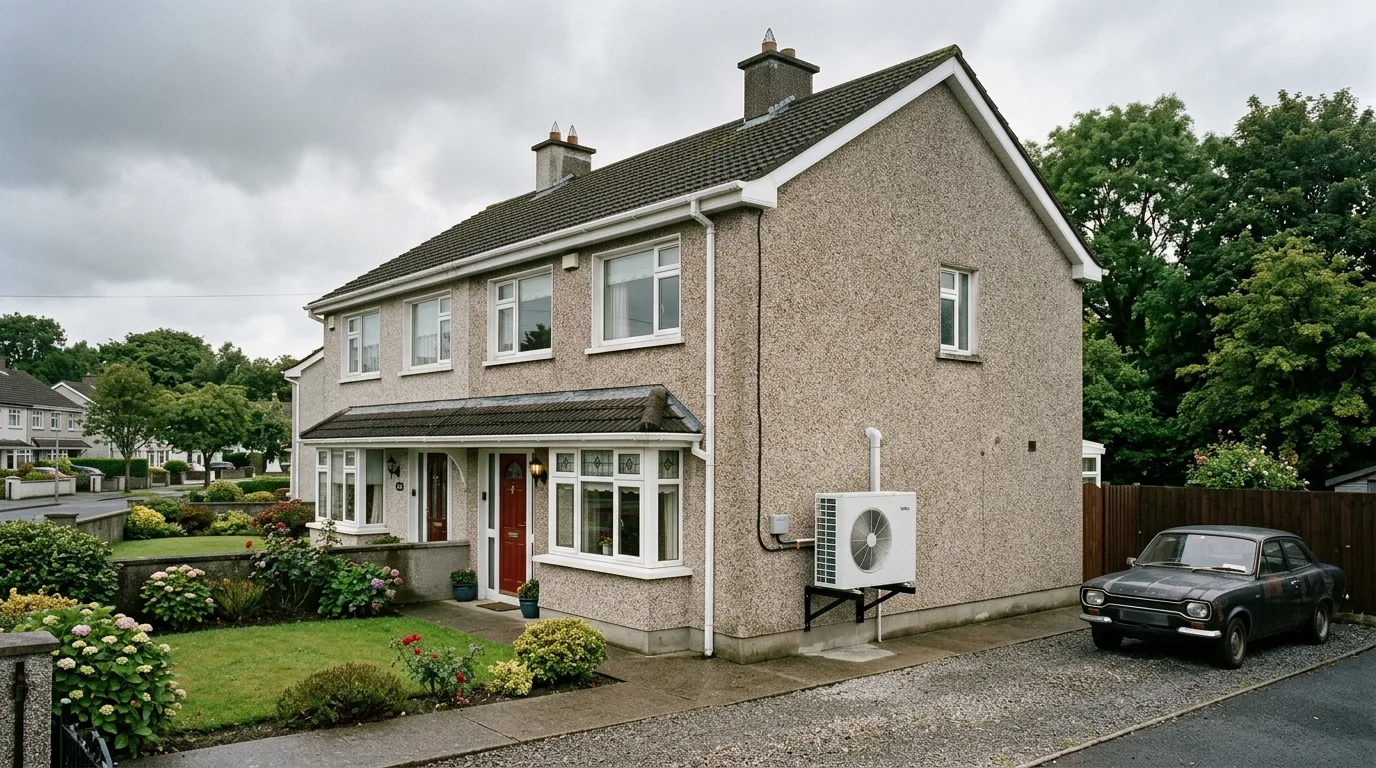
Ireland built an enormous number of homes during the 1970s economic expansion — pebbledash bungalows, cavity-wall semi-detacheds, and larger detached houses across rural counties and suburban estates. These homes have now aged 45–55 years and typically have BER ratings of C1–D2. But despite their age, 1970s Irish homes can be excellent heat pump candidates when the right upgrades are carried out.
What Makes 1970s Houses Different from Older Homes
The critical structural difference between a 1970s home and a pre-1940s home is the introduction of the cavity wall in Irish construction. From the 1970s onwards, most Irish homes were built with cavity walls — two leaves of blockwork separated by a 50–100 mm gap. This cavity can be filled with insulation relatively cheaply and quickly, transforming the wall's thermal performance without affecting the external appearance.
Cavity wall insulation for 1970s homes:
- Drilled injection of EPS (expanded polystyrene) beads, polyurethane foam, or bonded mineral wool
- Typical cost: €1,200–€2,500 for a 3–4 bed semi-detached
- SEAI grant: up to €1,700 (effectively fully funded in many cases)
- Typical heat demand reduction: 20–30%
- Can bring a BER D1 home to C1 or better
This is the single most cost-effective thermal upgrade available to 1970s Irish homes, and it is the first step many retrofit projects take before moving to heat pump installation.
Typical BER Ratings and Heat Demands for 1970s Homes
| 1970s Home Type | Typical BER (Before Works) | Approximate Heat Demand |
|---|---|---|
| 3-bed semi, 90 m² | C2–D1 | 14,000–20,000 kWh/year |
| 4-bed semi, 115 m² | C1–D1 | 18,000–26,000 kWh/year |
| 4-bed bungalow, 130 m² | C1–D2 | 20,000–30,000 kWh/year |
After cavity wall insulation and attic top-up to 300 mm:
| 1970s Home Type | BER After Works | Approximate Heat Demand |
|---|---|---|
| 3-bed semi, 90 m² | B3–C1 | 9,000–14,000 kWh/year |
| 4-bed semi, 115 m² | B3–C1 | 12,000–18,000 kWh/year |
| 4-bed bungalow, 130 m² | C1–B3 | 14,000–21,000 kWh/year |
Further improvements (triple-glazed windows, external wall insulation if needed, draught-proofing) can bring many 1970s homes to BER B2, which unlocks the SEAI heat pump grant without needing a technical assessment.
The SEAI Grant Pathway for 1970s Homes
Route 1 — BER B2 before heat pump: If your home reaches BER B2 through insulation upgrades, you qualify directly for the €6,500 heat pump grant. For many 1970s homes in good structural condition, cavity wall insulation + attic top-up + new windows is sufficient to reach B2.
Route 2 — Technical assessment: If your home is BER B3 or C1 after affordable insulation works, the technical assessment (€200, grant-eligible) can confirm SCOP 2.5+ eligibility. A skilled assessor can often make this work even for BER C1 homes by designing larger radiators and correct heat pump sizing.
Route 3 — One Stop Shop: The SEAI One Stop Shop programme bundles insulation + heat pump into a single grant-supported project. The One Stop Shop provider manages all grants and paperwork.
Practical Insulation Upgrades for 1970s Homes
Attic insulation: Almost all 1970s homes have accessible roof space that can accept additional insulation. If the home has 100 mm of fibreglass from original construction, bringing this up to 300 mm of mineral wool (e.g., Isover Spacesaver) costs €800–€1,500 and qualifies for an SEAI grant of up to €1,500.
Cavity wall insulation: This is the big win for 1970s homes. Injected bead or foam insulation is installed by drilling a series of holes in the mortar joints or blocks, injecting the material, and patching the holes. The exterior appearance is essentially unchanged. Most 1970s cavities are 50–75 mm wide and can accept full-fill insulation.
Important caveat: Some 1970s cavity walls have wall ties that have corroded (known as the wall tie failure problem). Before insulating, a wall tie survey may be needed in homes with visible cracking on external walls. Deteriorated ties can be replaced by retrofit specialists.
Window upgrades: 1970s single-glazed or early double-glazed windows are a major source of heat loss (U-value 4–5 W/m²K vs modern triple-glazed at 0.8 W/m²K). Window replacement is expensive (€800–€1,500 per window) but can be staggered. SEAI provides a window and door grant of up to €4,500.
Radiator Considerations in 1970s Homes
1970s Irish radiators were typically single-panel or double-panel convectors sized for oil or gas flow temperatures of 70–80°C. For efficient heat pump operation at 45–55°C, these radiators may be undersized.
The good news is that 1970s homes were often built with larger living rooms and bedrooms than later decades' estate housing, meaning there is usually wall space to fit larger replacement radiators. A competent installer will perform a room-by-room calculation and specify upgrades where needed.
Typical radiator upgrade cost for a 4-bed 1970s home: €1,500–€3,000 for 4–6 upgraded panels.
Choosing a Heat Pump for a 1970s Irish Home
For a typical 4-bed 1970s semi-detached with BER C1 pre-works (and targeting B2 after works):
Recommended size: 8–10 kW air-to-water heat pump
Popular choices:
- Mitsubishi Ecodan 8.5 kW: Excellent cold-weather performance, quiet operation, very widely installed in Irish retrofits
- Daikin Altherma 3 H HT 8 kW: High-temperature option (up to 70°C) allows reuse of existing radiators without upgrade — useful if budget is tight
- Samsung EHS Mono HQ 8 kW: Compact and efficient, good integration with Samsung smart home ecosystem
- Grant Aerona⁴ R290 8 kW: R290 natural refrigerant, strong rural Irish installer network
Note on high-temperature vs standard heat pumps: For 1970s homes where radiator upgrades are not in the immediate budget, a high-temperature heat pump (Daikin Altherma 3 H HT, Panasonic Aquarea T-Cap HT) can run at 60–65°C and work with existing undersized radiators. Efficiency is lower (SCOP ~2.8–3.2) but still better than oil or gas, and radiator upgrades can be phased in later as budget allows.
Real Example: 1975 Bungalow, County Galway
- Home: 4-bed bungalow, 130 m², oil heat, BER D1 on assessment
- Works completed:
- Attic insulation to 300 mm (€1,200, SEAI grant €1,200 = net €0)
- Cavity wall insulation (€2,200, SEAI grant €1,700 = net €500)
- 4 upgraded radiators (€2,000, no grant)
- 200-litre HP cylinder (included in heat pump quote)
- Heat pump: 10 kW Grant Aerona⁴ R290, installed (€17,500)
- SEAI grants: Heat pump €6,500 + insulation €2,900 = €9,400
- Total net spend: ~€13,500
- Previous oil bill: 2,000 litres/year × €0.98 = €1,960/year
- Estimated heat pump running cost: ~€560/year (SCOP 3.4, night rate)
- Annual saving: ~€1,400; payback on net spend: ~10 years
Key Takeaways
- 1970s Irish homes with cavity walls are cost-effective to insulate compared to solid-wall older homes
- Cavity wall insulation alone (€1,200–€2,500) can significantly improve BER and heat pump viability
- The SEAI technical assessment route means BER B2 is not always required for grant access
- High-temperature heat pumps can work with existing radiators if budget is tight
- Typical annual saving vs oil: €1,000–€1,600/year in a 1970s home
For personalised advice on your 1970s home, commission an SEAI technical assessment (€200, grant-eligible) as the first step.
Get 3 free heat pump quotes — free and no obligation.
Frequently asked questions
Can I install a heat pump in a 1970s cavity-wall house in Ireland?
Yes, and 1970s cavity-wall homes are actually good heat pump candidates. Cavity wall insulation is relatively cheap (€1,200–€2,500), SEAI grants often cover most or all of the cost, and the insulation improvement makes the home much more suitable for low-temperature heat pump heating.
Do 1970s houses need external wall insulation for a heat pump?
Not usually. Cavity wall insulation (injected EPS beads or foam) is the preferred and most cost-effective option for 1970s cavity-wall homes. External wall insulation is typically only needed for solid-wall pre-1970s construction. Your technical assessor will confirm the most appropriate approach.
Will my 1970s radiators work with a heat pump?
Possibly, with some upgrades. 1970s radiators were sized for high-temperature boilers. A heat pump installer will assess each room and identify where larger radiators are needed. Alternatively, a high-temperature heat pump (Daikin Altherma 3 H HT) can work with existing radiators at slightly lower efficiency.
What is the SEAI grant for cavity wall insulation in Ireland?
SEAI provides a grant of up to €1,700 for cavity wall insulation. For many 1970s homes, this covers the majority of the cost. You must use a SEAI-registered contractor for grant-eligible works.
What heat pump brands are best for a 1970s Irish house?
Popular choices for 1970s retrofits include Mitsubishi Ecodan (for reliability and quiet operation), Daikin Altherma 3 H HT (for high-temperature operation with existing radiators), Grant Aerona⁴ (for rural homes with good local service), and Samsung EHS Mono HQ (for value and smart connectivity).
Sources & further reading
- SEAI Heat Pump Grant — Sustainable Energy Authority of Ireland
- SEAI Insulation Grants — Sustainable Energy Authority of Ireland