Heat Pump in an A-Rated New Build Ireland: Why It's the Default Choice
Since 2021, all new Irish homes must achieve a minimum A2 BER rating, which practically mandates heat pump heating. If you are buying or building a new home, here is everything you need to know about your heat pump from day one.
By Smart Solar Editorial · Updated 15 May 2026 · 7 min read
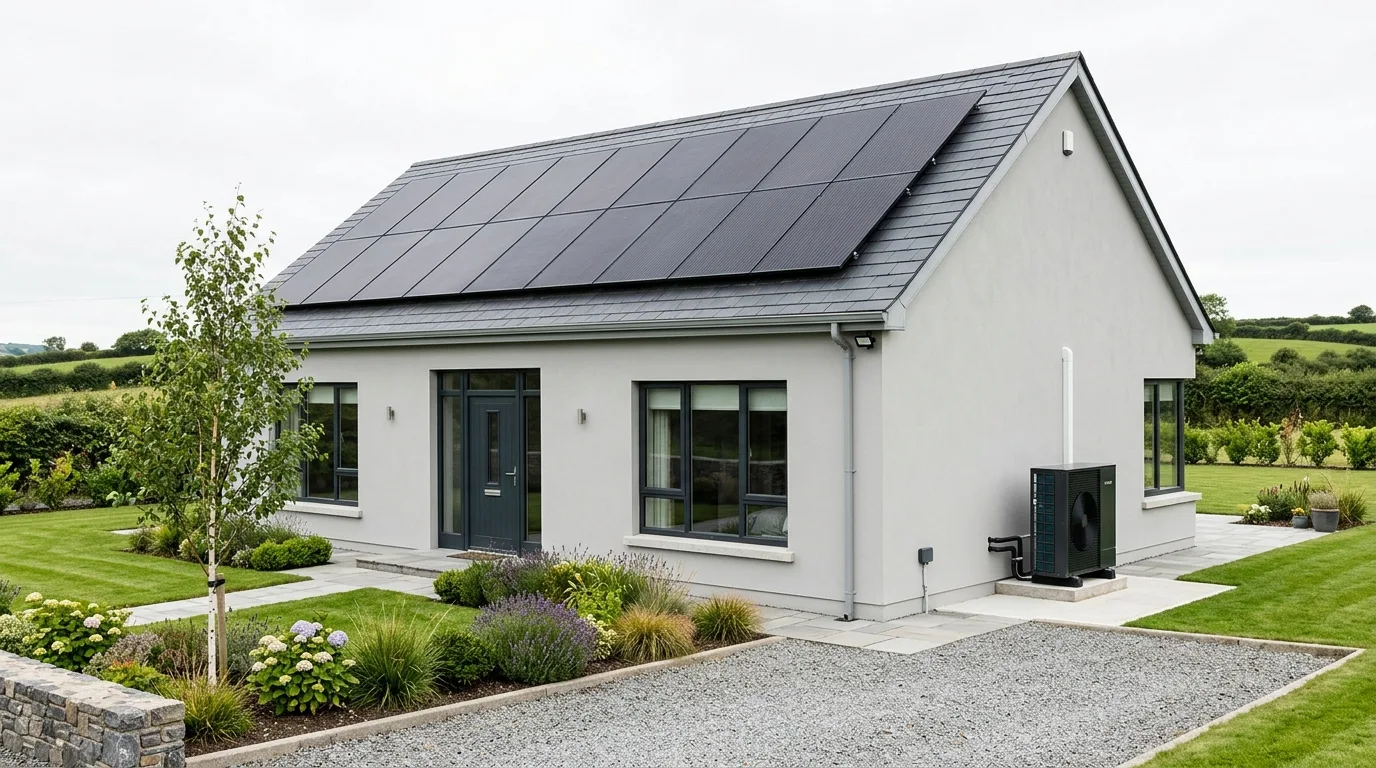
Since November 2021, all new residential buildings in Ireland must comply with Nearly Zero Energy Building (NZEB) standards, as required under the EU Energy Performance of Buildings Directive. In practical terms, this means every new Irish home must achieve a minimum BER A2 rating and primary energy demand below 50 kWh/m²/year. Achieving this standard without a heat pump is virtually impossible — which is why heat pumps have become the default heating choice for every new home built in Ireland.
Why New Builds and Heat Pumps Are the Perfect Match
New Irish homes are built to dramatically higher standards than the existing stock. Key features that make them ideal for heat pump heating:
High-performance insulation: NZEB-compliant homes have wall U-values of 0.18–0.15 W/m²K, roof U-values of 0.11–0.13 W/m²K, and floor U-values of 0.13–0.15 W/m²K. This insulation dramatically reduces heat demand compared to older homes.
Excellent airtightness: New builds must achieve air permeability of 3 m³/hr/m² or better (many achieve 1–2). Airtight construction means very little heat is wasted through infiltration. Combined with MVHR (mandatory for high-airtightness homes), indoor air quality is maintained without wasting heat.
Underfloor heating: The vast majority of new Irish homes include underfloor heating (UFH) on ground floor and often first floor too. UFH runs at 30–40°C flow temperature — the sweet spot for maximum heat pump efficiency (SCOP 4.0–4.8).
Correct electrical infrastructure: New builds include a consumer unit sized for heat pump operation, often with provisions for EV charging and solar PV, making future upgrades seamless.
What BER Rating Can a New Build Achieve?
With a modern heat pump and good construction quality:
| Construction Quality | Typical BER | Primary Energy |
|---|---|---|
| NZEB minimum (code) | A2 | ~45–49 kWh/m²/yr |
| Good practice (most developers) | A2 | ~35–45 kWh/m²/yr |
| Passive House standard | A1 | <15 kWh/m²/yr |
| A3 (older new builds, pre-2021) | A3 | ~50–75 kWh/m²/yr |
The BER has a direct impact on your heat pump's running efficiency and your energy bills. A better-insulated home has a lower heat demand, which means the heat pump runs fewer hours at higher efficiency.
Heat Pump Sizing for New Builds
New Irish homes are so well insulated that their heat demands are dramatically lower than retrofit projects:
| New Build Size | Typical Heat Demand (NZEB) | Recommended Heat Pump |
|---|---|---|
| 3-bed, 100 m² | 3,500–5,500 kWh/year | 4–6 kW |
| 4-bed, 130 m² | 5,000–8,000 kWh/year | 6–8 kW |
| 5-bed, 170 m² | 7,000–11,000 kWh/year | 8–10 kW |
Note that these heat demands are dramatically lower than equivalent-sized older homes. A 4-bed new build might need only 6,000 kWh/year compared to 15,000+ kWh for the same-sized 1980s house.
Oversizing risk in new builds: Because new builds have such low heat demands, installers must take care not to oversize the heat pump. An 8 kW heat pump in a 4-bed NZEB home will short-cycle constantly, reducing efficiency and increasing compressor wear. Modern inverter heat pumps modulate down to 30–40% of rated output, which helps, but a 4–6 kW unit is usually the correct choice for a typical new-build family home.
Popular Heat Pump Models for New Builds
Daikin Altherma 3 R (4–8 kW): The most commonly specified heat pump in Irish new builds. Excellent SCOP at W35 (4.5–5.1), quiet outdoor unit, comprehensive connectivity via the Onecta app. The 4-way valve option enables cooling in summer.
Mitsubishi Ecodan Ultraquiet (5–8.5 kW): As quietly as 45 dB(A) in standard mode, making it ideal for estates where neighbour proximity matters. MELCloud app enables full remote monitoring and scheduling.
Samsung EHS TDM Plus (4–12 kW): Multi-zone capability for homes with separate ground and first-floor zones. SmartThings integration for home automation enthusiasts.
Panasonic Aquarea J-series (5–9 kW): Excellent cold-climate performance, EU Ecodesign A+++ rated, competitive on installed cost.
Joule Cyclone Aire: Integrated unit with cylinder and heat distribution components in one indoor unit, popular in compact new builds where internal space is at a premium.
Underfloor Heating in a New Build: What to Expect
If your new build has underfloor heating (and most do, at least on the ground floor), here is what normal operation looks like:
Continuous low-temperature heating: UFH does not heat rooms quickly. It maintains a steady background temperature. The system should run at a low flow temperature (typically 30–38°C) for long hours — sometimes 8–14 hours per day — rather than blasting heat for 30-minute bursts like a boiler.
Response time: UFH in concrete screed takes 1–3 hours to respond to thermostat changes. It is best controlled with weather compensation (outdoor sensor adjusting flow temperature automatically) rather than room thermostats that turn on and off frequently.
First-floor heating: If your first floor has radiators rather than UFH, ensure these are correctly sized for heat pump low-temperature operation. Bedrooms with undersized radiators are a common complaint in new builds where the specification was not carefully managed.
Smart controls: Use the heat pump's smart scheduling to pre-heat during cheap night-rate electricity hours (11pm–8am) from Electric Ireland, Energia, SSE Airtricity, or Bord Gáis. The thermal mass of the floor screed holds heat for several hours, reducing the need for day-rate electricity.
Running Costs in a New Build: Real Expectations
For a 4-bed, 130 m² NZEB new build with heat pump and UFH:
- Annual heat demand (space + hot water): ~8,000 kWh
- Heat pump SCOP: 4.2 (underfloor heating, well-insulated)
- Annual electricity for heating: ~1,905 kWh
- Cost at 13 c/kWh (blended smart night rate): ~€248/year
Even at the standard day rate of 26–28 c/kWh: ~€495–€533/year.
This is significantly less than any gas or oil boiler could achieve for equivalent heating. A new-build family should expect to spend €250–€500/year on heat pump electricity for both space heating and hot water, depending on their tariff and usage patterns.
Solar PV + Heat Pump: The NZEB Dream Team
Many new Irish homes include both a heat pump and a solar PV system. Solar panels can generate 3,500–5,500 kWh/year for a typical 4 kWp system, which can supply a significant fraction of the heat pump's electricity demand during spring, summer, and autumn.
The combination of solar PV and a smart heat pump controller can shift the heat pump's peak operation to align with periods of solar generation — charging the floor thermal mass with free solar electricity and reducing grid electricity consumption.
A solar diverter (Eddi by MyEnergi or similar) can redirect surplus solar electricity to the hot water immersion, eliminating much of the heat pump's hot water electricity consumption from spring to autumn.
See our companion guide on solar and heat pump combination in Ireland for a full analysis.
Get 3 free heat pump quotes — free and no obligation.
Frequently asked questions
Are heat pumps mandatory in new Irish homes?
Not legally mandated by name, but the NZEB (Nearly Zero Energy Building) standard introduced in 2021 requires all new homes to achieve BER A2, which is effectively impossible without a heat pump. All new residential buildings in Ireland now include heat pumps as the primary heating system.
What SCOP can I expect from a heat pump in a new Irish build?
A new-build NZEB home with underfloor heating will typically see a real-world SPF (Seasonal Performance Factor) of 3.8–4.8. The well-insulated structure and low-temperature underfloor heating distribution are ideal for heat pump efficiency.
How much does it cost to run a heat pump in a new build in Ireland?
A 4-bed NZEB new build typically costs €250–€500/year to heat (space heating and hot water combined) on a smart night-rate electricity tariff. This is significantly less than any fossil fuel heating system.
Should I choose underfloor heating or radiators for my new build?
Underfloor heating is strongly preferred for maximum heat pump efficiency. UFH runs at 30–40°C flow temperature, giving SCOP of 4.0–5.0, compared to 2.8–3.5 for radiators at 45–55°C. If your new build has both (ground floor UFH, first floor radiators), ensure the upstairs radiators are sized for low-temperature operation.
Do new builds in Ireland qualify for the SEAI heat pump grant?
No. The SEAI €6,500 heat pump grant is for existing homes (retrofits). New builds must comply with NZEB standards regardless and do not qualify for retrofit grants. However, there may be developer incentives, lower running costs, and potential for solar PV grants if panels are added after initial construction.
Sources & further reading
- NZEB Requirements — SEAI — Sustainable Energy Authority of Ireland
- Building Regulations Part L — Technical Guidance Document — Department of Housing, Local Government and Heritage