Heat Pump for a Two-Storey House in Ireland: Sizing, Costs and Installation Guide
The two-storey semi-detached and detached house is the most common house type in Ireland's suburbs. Getting a heat pump right in these homes requires careful attention to upstairs radiator sizing, hot water cylinder placement, and zoning. This guide covers everything you need to know.
By Smart Solar Editorial · Updated 15 May 2026 · 8 min read
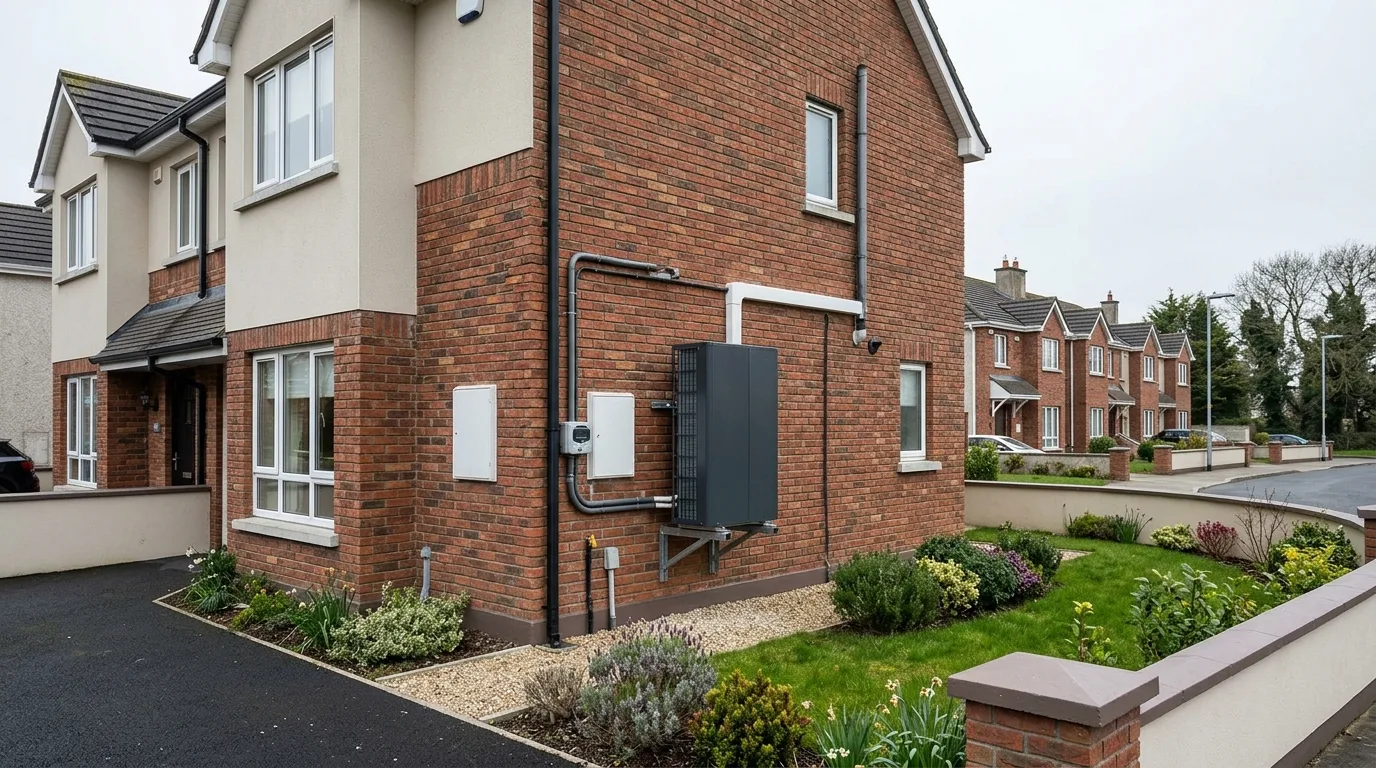
The two-storey Irish house — the classic semi-detached or terraced home found in estates across Dublin, Cork, Galway, Limerick, and every town in between — presents both the greatest opportunity and some of the most important technical challenges for heat pump installation. With over 400,000 such homes in Ireland and the SEAI heat pump grant at €6,500, this is the segment where the heat pump market is growing fastest in 2026.
The Two-Storey Challenge: Managing Heat Distribution Across Two Floors
The fundamental challenge in a two-storey house is ensuring adequate heat delivery to all zones — ground floor living areas, first-floor bedrooms, bathrooms, and landing — from a single heat pump system running at low flow temperatures.
In a traditional gas or oil boiler system, high flow temperatures (70–80°C) mean that even relatively small radiators can heat a room quickly. A heat pump running at 45–55°C requires radiators with a larger surface area to deliver the same heat output. In most two-storey Irish homes built since the 1990s, the upstairs radiators are the most likely constraint — bedroom radiators are often smaller than ideal and may need upgrading.
The solution is a proper room-by-room heat loss calculation. A competent installer will calculate the heat loss through walls, windows, ceiling, and floor for each room, then specify the required radiator output at the target flow temperature. Rooms with undersized radiators are identified and upgraded. In many cases, adding a panel radiator to the landing and upgrading 2–3 bedroom radiators is sufficient to allow the system to run efficiently at 50°C.
Typical Sizing for Irish Two-Storey Homes
Irish two-storey homes range from 90 m² (3-bed terraced) to 160 m² (4–5 bed detached). Post-retrofit BER B2 heat pump sizing guide:
| House Type | Floor Area | Post-Retrofit Heat Loss | Recommended Heat Pump |
|---|---|---|---|
| 3-bed terraced | 85–100 m² | 4.5–6.5 kW | 5–6 kW unit |
| 3-bed semi-detached | 95–115 m² | 5.5–8 kW | 6–8 kW unit |
| 4-bed semi-detached | 110–135 m² | 7–10 kW | 8–10 kW unit |
| 4-bed detached | 130–160 m² | 9–13 kW | 10–12 kW unit |
Modern inverter-driven heat pumps (Daikin Altherma 3, Mitsubishi Ecodan, Samsung EHS) modulate between approximately 30–100% of their rated output, so exact sizing is less critical than with on/off systems. However, a unit that is significantly oversized will short-cycle even with inverter technology, reducing efficiency and increasing wear.
Hot Water Cylinder Placement in Two-Storey Homes
An air-to-water heat pump requires a hot water cylinder — typically 200–300 litres for a 4-bedroom home. In a two-storey house, the cylinder is most commonly located:
- In the hot press (airing cupboard): Many Irish homes have a hot press on the landing or in a bedroom. A 200-litre slimline cylinder typically fits in a standard hot press space.
- In the utility room: Ground-floor utility rooms are an excellent location, minimising heat distribution pipework length.
- In the attic: Possible but not ideal — attics are cold and poorly insulated, increasing standing heat loss from the cylinder.
If your home does not have a hot press or utility room suitable for a 200-litre cylinder, you may need to reconfigure a ground-floor storage area. Discuss options with your installer before committing to a specific heat pump model, as some integrated units (Joule Cyclone Aire, Panasonic Aquarea tank units) combine the cylinder and heat distribution components in a single indoor unit.
Zoning: Ground Floor vs First Floor
Two-storey homes benefit significantly from two-zone heating control — ground floor living zone and upstairs bedroom zone. This allows:
- Ground floor to be heated in the morning and evening (active family time)
- Upstairs bedrooms to be heated to a lower setback temperature during the day
- Bedrooms to be pre-warmed in the evening before sleep
Modern heat pump controllers from Daikin, Mitsubishi, and Samsung all support two-zone control as standard. You will need separate thermostats (or smart TRVs) on each zone and zone valves in the heating circuit. The additional cost for two-zone control is typically €300–€600 on top of a single-zone installation.
Airtightness and Ventilation in Two-Storey Homes
One advantage of a two-storey house over a bungalow is that the upper floor ceiling acts as a natural barrier, reducing the chimney-effect air infiltration that can be significant in bungalows. However, if your two-storey home has been retrofitted with attic insulation and has draught-proofed windows, you should consider mechanical ventilation with heat recovery (MVHR) to maintain indoor air quality. MVHR units recover 85–90% of the heat from outgoing stale air and transfer it to fresh incoming air — both improving air quality and reducing heat demand.
The Most Common Two-Storey Heat Pump Projects in 2026
Scenario 1: 1990s semi-detached, BER C2, oil heat
- 120 m², standard radiators, hot press with existing 120-litre cylinder
- Works required: attic insulation top-up (€800), 3 upstairs radiator upgrades (€600), new 200-litre cylinder (€1,200)
- Heat pump (8 kW Mitsubishi Ecodan, installed): €16,000
- SEAI grant: €6,500; technical assessment: €200
- Net cost: ~€11,800; annual saving vs oil: ~€1,000; payback: ~12 years
Scenario 2: 2005 semi-detached, BER B3, gas heat
- 125 m², underfloor on ground floor, radiators upstairs, 150-litre cylinder
- Works required: upgrade 2 upstairs radiators (€400), replace cylinder with 210-litre HP cylinder (€1,400)
- Heat pump (8 kW Daikin Altherma 3, installed): €15,500
- SEAI grant: €6,500
- Net cost: ~€10,800; annual saving vs gas: ~€1,100; payback: ~10 years
Irish Planning Rules for Two-Storey Homes
Air source heat pump outdoor units are exempt from planning permission in most two-storey residential situations under Irish planning regulations, subject to:
- Unit does not protrude above the roofline
- Does not face a road
- Noise does not exceed 45 dB(A) at the nearest neighbour's window
- Setback distances from property boundaries are maintained
Terraced homes should plan carefully for the outdoor unit location — side or rear placement is almost always required where there is no front-of-house space.
Getting the Most from Your Two-Storey Heat Pump
Use weather compensation: All modern inverter heat pumps have a weather compensation function that automatically adjusts flow temperature based on outdoor temperature. This is the most important setting for efficiency — ensure your installer enables and correctly configures it.
Lower your thermostat: Running your home at 19–20°C rather than 22°C reduces heat loss by 15–20% and extends the heat pump's operating hours at higher efficiency points. Heat pump heating is gentler and more consistent than boiler heating — 19°C feels comfortable.
Schedule night-rate pre-heating: Use your heat pump's app (Daikin Onecta, Mitsubishi MELCloud, Samsung SmartThings) to pre-heat the home during cheap night-rate electricity hours (11pm–8am) from Electric Ireland, Energia, or SSE Airtricity, then let the home coast through the morning on stored thermal mass.
Get 3 free heat pump quotes — free and no obligation.
Frequently asked questions
What size heat pump does a 4-bed two-storey house need in Ireland?
A 4-bed semi-detached of around 120–135 m² with BER B2 rating typically needs an 8–10 kW heat pump. The exact size requires a heat loss calculation (EN 12831). Daikin Altherma 3, Mitsubishi Ecodan, and Samsung EHS all offer 8 and 10 kW units popular in this application.
Do I need to upgrade my radiators for a heat pump in a two-storey house?
Often, some radiator upgrades are needed — particularly upstairs bedroom radiators that tend to be undersized. A room-by-room heat loss calculation will identify which radiators need to be replaced or supplemented. This is a standard part of any professional heat pump installation proposal.
Can I keep my hot press cylinder when installing a heat pump?
If your existing cylinder is 200+ litres, well-insulated, and has a heat pump coil (twin coil), it may be reusable. Most installers replace older cylinders with a new 200–250 litre heat pump cylinder as part of the installation, ensuring optimal compatibility and efficiency.
Can a heat pump heat a two-storey house on very cold Irish winter nights?
Yes. Modern heat pumps operate efficiently down to −15°C outdoor temperature. Ireland rarely falls below −5°C even in the coldest weeks. On the coldest nights, the heat pump may run at a slightly lower SCOP, but output remains sufficient to maintain comfortable indoor temperatures in a well-insulated home.
How noisy is a heat pump outdoor unit for neighbours in a semi-detached house?
Modern heat pumps like the Mitsubishi Ecodan Ultra Quiet and Daikin Altherma 3 are designed to operate at 45–55 dB(A) at 1 m distance in normal operating mode. At the neighbour's window (typically 4–8 m away), levels are well below the 45 dB(A) planning threshold. Installation on the rear of the house further reduces any neighbour impact.
Sources & further reading
- SEAI Heat Pump Grant — Sustainable Energy Authority of Ireland
- SEAI Technical Assessment for Heat Pumps — Sustainable Energy Authority of Ireland