Planning Permission for Commercial Battery Storage in Ireland
Most outdoor commercial battery storage in Ireland needs planning approval - either a Section 5 declaration or full planning permission. Here is what triggers each and how to manage the process.
By Smart Solar Editorial · Updated 15 May 2026 · 8 min read
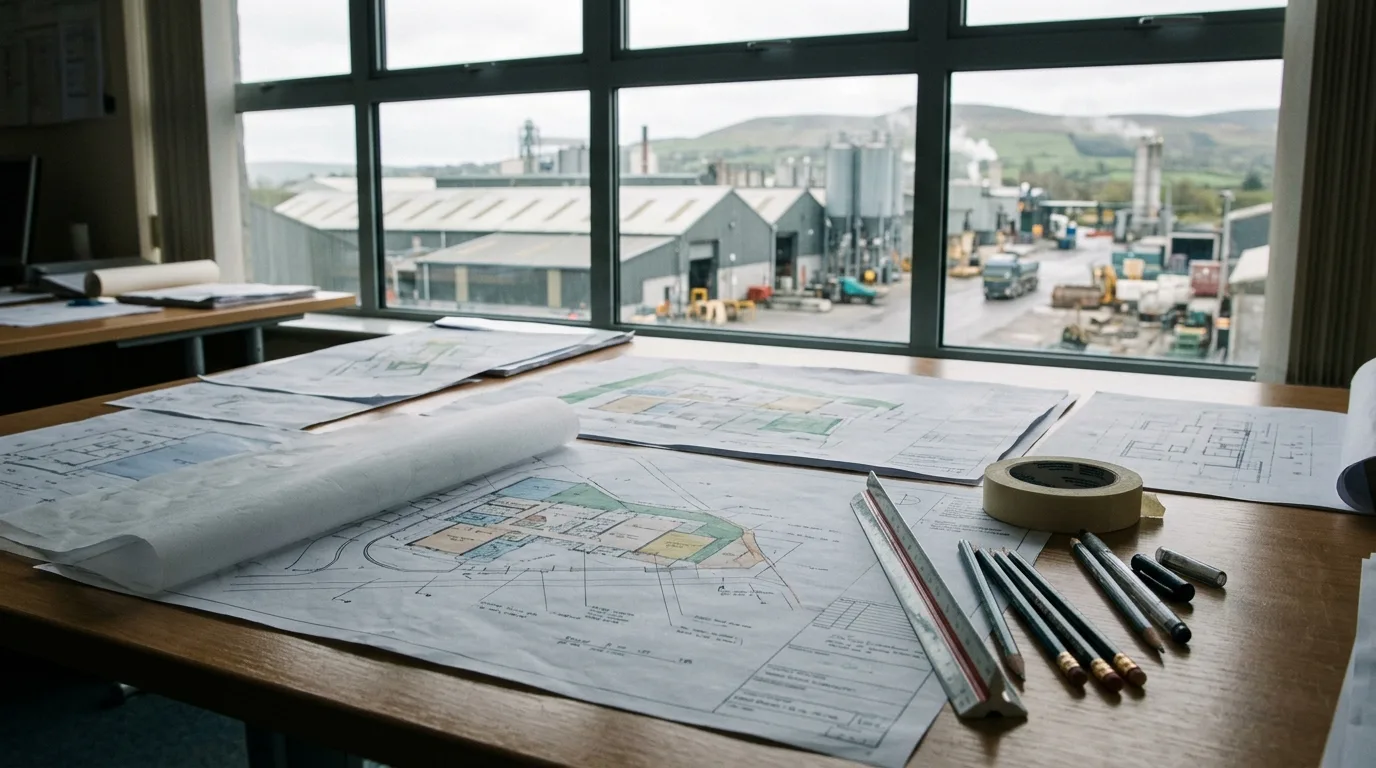
Planning permission is one of the most variable elements of a commercial BESS project in Ireland. A 50 kWh cabinet inside an existing electrical room may need no planning at all. A 4 MWh container compound on a greenfield site may need full planning permission and an environmental screening, adding 6-12 months to the timeline. This article walks through the framework for Irish commercial BESS planning in 2026.
The three planning categories
A commercial BESS in Ireland generally falls into one of three planning categories:
1. Exempted development. No planning permission required - some indoor installations qualify, particularly where the BESS is internal to an existing electrical room with no external impact.
2. Section 5 declaration. A formal local authority determination that the proposed development is exempted, or alternatively that planning is required. Useful when the situation is unclear or you want certainty. Typically resolved in 4-8 weeks.
3. Full planning permission. Required when the BESS constitutes development that is not exempted. The standard local authority planning process applies - typically 8-16 weeks to decision, with possible appeals to An Bord Pleanala adding 6-12 months.
What triggers full planning
Indicative triggers for full planning permission for a commercial BESS in Ireland:
- New outdoor container or large cabinet on a new concrete pad
- Height exceeding 2.5 m (or limits in local Development Plan)
- Proximity to neighbouring residential or sensitive land uses
- Installation within or adjacent to protected structures or curtilage
- Sites in or near Natura 2000 sites, SACs, SPAs (environmental sensitivity)
- Large-scale installations (typically >5 MW or >2,000 m² site area)
- Sites where the existing planning use does not contemplate energy infrastructure
What typically qualifies as exempted
Indicative situations where exempted development applies:
- Small indoor cabinet within existing electrical room (no external change)
- Wall-mounted unit within existing structure
- Minor outdoor cabinet on existing concrete area within an industrial estate (subject to local interpretation)
- Replacement of existing energy infrastructure with equivalent BESS
Even where exempted development appears to apply, a Section 5 declaration provides certainty and avoids enforcement risk.
The Section 5 declaration process
Section 5 of the Planning and Development Act 2000 allows any person to request a declaration from the local authority on whether specific works are exempted from planning permission.
Typical Section 5 process:
- Pre-application engagement with the Planning Department (often free, recommended)
- Application submission with site location map, drawings of the proposed BESS, technical description, and reasoning for exemption
- Application fee - typically €80 for individuals, €300+ for company applications
- Public consultation - 5-week period for observations
- Determination - planning officer issues a declaration confirming whether the development is exempted
Timeline: typically 4-8 weeks from submission to determination. Cost: €1,000-€5,000 including consultant fees.
Outcomes:
- Exempted: Proceed without further planning approval
- Not exempted: Apply for full planning permission
Full planning permission process for BESS
If full planning is needed:
- Pre-application meeting with Planning Department (recommended)
- Environmental screening if site is near sensitive habitats
- Application preparation - drawings, site plans, planning report, environmental considerations, design statement
- Application submission with statutory fees
- Public notice and consultation - newspaper notice, site notice, 5-week observation window
- Planning officer assessment including site visit
- Decision - typically within 8 weeks for standard applications, 16 weeks for complex projects
- Appeal window - 4 weeks from decision for any party to appeal to An Bord Pleanala
- Implementation - 5-year permission validity typical
Total typical timeline: 12-26 weeks for unappealed decisions. Add 6-12 months if appeals occur.
Documentation required for full planning
A typical commercial BESS planning application includes:
- 1:2500 location map
- 1:500 site layout plan showing existing and proposed
- Elevation drawings of the BESS
- Cross-sections through site
- Photo montage showing visual impact
- Planning statement / report
- Design statement
- Noise assessment (BESS HVAC and PCS noise)
- Visual impact assessment (for prominent sites)
- Ecological screening
- Traffic and access assessment
- Construction management plan
- Fire safety summary
- IS EN 62619 compliance summary
The Planning Department publishes a checklist for renewable energy / storage applications.
Local Development Plan considerations
Each Irish local authority maintains a Development Plan setting out land-use policies. Most current Development Plans (2022-2028 cycle) include explicit policies on renewable energy and storage, generally supportive but with location-specific constraints. Check:
- Zoning of your site (industrial, commercial, mixed-use, agricultural)
- Specific policies on energy infrastructure
- Constraints in protected zones (heritage, scenic, ecological)
- Noise and visual amenity standards
Most Irish local authorities are now familiar with BESS applications. Engagement at pre-application stage usually identifies any showstoppers early.
Environmental considerations
For sites near sensitive environmental designations, additional assessment may be needed:
- EIA screening under the Planning and Development Regulations
- Appropriate Assessment if near Natura 2000 sites
- Flood Risk Assessment if in flood-prone areas
- Noise impact study for residential proximity
- Bird and bat survey for greenfield rural sites
Most urban or established industrial sites avoid these requirements; rural and edge-of-development sites may trigger one or more.
Combining planning with ESB Networks NC7
For large commercial BESS requiring both planning permission and NC7 connection, the two processes run in parallel but interact:
- ESB Networks may require evidence of planning before issuing the Connection Offer
- Planning decision may depend on grid connection feasibility
- Some local authorities require ESB Networks confirmation as part of the application
Coordinate timelines and share documentation between the planning consultant and EPC team.
Section 254 licences
For BESS installations on or near public roads (charging hubs, public-facing infrastructure), Section 254 of the Planning Act requires a separate licence from the local authority. Less common for behind-the-meter commercial BESS but worth noting for EV charging hubs.
Recent trends and best practice
Irish 2024-2026 BESS planning experience shows:
- Local authorities are increasingly familiar with BESS applications
- Pre-application engagement substantially reduces unexpected requirements
- LFP chemistry simplifies fire safety case for planning
- Noise assessments are the most common technical hurdle for sites near residential
- Visual impact in scenic or amenity areas can require careful screening and landscaping
- Section 5 declarations have become more common as the standard exempted-development route
Use experienced planning consultants familiar with BESS - the typical fee of €5k-€20k pays for itself in faster, more successful applications.
When to start planning
Planning should start at the same time as ESB Networks NC6/NC7 application and EXEED grant application. For projects on a 12-24 month timeline, planning is rarely the critical path - but it can be if started late.
Common project timeline for a 1 MWh containerised BESS at an Irish industrial site:
- Month 0: Engage planning consultant, ESB Networks pre-application
- Month 1: Submit NC7 and Section 5 (if applicable)
- Month 2-3: Submit full planning (if needed)
- Month 4-5: Receive Section 5 / planning decisions
- Month 6-8: Implementation and EPC tender
- Month 12-18: Construction and commissioning
Bottom line
Planning for commercial BESS in Ireland varies from no permission required (small indoor) to 6+ month full planning + appeals (greenfield large). Engage early with the Planning Department, use a Section 5 declaration where the case is ambiguous, and budget €1k-€20k for planning consultancy depending on project complexity. Run planning in parallel with ESB Networks and grant applications to avoid critical-path delays.
Get 3 free commercial battery quotes — free and no obligation.
Frequently asked questions
Do I need planning permission for a commercial battery in Ireland?
Often yes for outdoor installations - either a Section 5 declaration confirming exempted status or full planning permission. Indoor cabinets within existing electrical rooms are often exempt. Engage the local Planning Department early to confirm.
What is a Section 5 declaration?
A formal local authority determination that proposed works are exempted from planning permission. Useful when the status is unclear. Typical timeline: 4-8 weeks. Cost: €1,000-€5,000 including consultant fees. Provides certainty before installation begins.
How long does planning permission take for a commercial BESS?
Standard applications: 8-16 weeks to decision. Section 5 declarations: 4-8 weeks. If appeals to An Bord Pleanala occur, add 6-12 months. Most BESS planning is straightforward at industrial sites but can be more involved at sensitive locations.
What planning documents do I need for a BESS application?
Typical package includes location map, site plan, elevations, cross-sections, photo montage, planning statement, noise assessment, visual impact assessment, ecological screening, fire safety summary, and IS EN 62619 compliance evidence.
Can I install a BESS in an existing electrical room without planning?
Often yes - indoor installations with no external change are usually exempted development. However, get a Section 5 declaration if there is any uncertainty (additional ventilation, external HVAC plant, fire room upgrades may trigger planning).
Sources & further reading
- Planning and Development Act 2000 — Irish Statute Book
- Department of Housing Planning Information — Government of Ireland