IS EN 62619 and BESS Fire Safety in Ireland: What Buyers Need to Know
Irish fire officers, insurers and Building Control increasingly require IS EN 62619 compliance for commercial battery storage. Here is what the standard covers and how to verify it.
By Smart Solar Editorial · Updated 15 May 2026 · 8 min read
As commercial battery storage has scaled in Ireland through 2024-2026, fire safety has become one of the most consequential regulatory and insurance considerations. The relevant European standard - IS EN 62619 - sets out the safety requirements for secondary lithium batteries used in industrial applications. Irish Building Control, Fire Officers and commercial insurers increasingly require evidence of compliance before approving a BESS installation. This article explains what IS EN 62619 covers and how to demonstrate compliance.
What IS EN 62619 is
IS EN 62619 is the Irish national adoption (via NSAI) of European standard EN 62619, "Secondary cells and batteries containing alkaline or other non-acid electrolytes - Safety requirements for secondary lithium cells and batteries, for use in industrial applications". It applies to:
- Battery packs and modules used in stationary industrial applications
- Both LFP (lithium iron phosphate) and NMC (nickel manganese cobalt) chemistries
- Capacity ranges from small commercial through utility-scale
It does not apply to mobile applications (covered by automotive and aerospace standards) or to small consumer products.
What the standard tests
IS EN 62619 specifies a series of safety tests, including:
1. Electrical tests
- Overcharge protection
- Over-discharge protection
- External short circuit
- Forced internal short circuit (cells)
- Charging at extreme temperatures
2. Mechanical tests
- Vibration
- Mechanical shock
- Drop tests (cells and packs)
- Crush tests
3. Environmental tests
- Temperature cycling
- Thermal abuse / oven test
- Humidity exposure
4. Propagation tests
- Single-cell thermal runaway initiation
- Adjacent cell propagation analysis
- Pack-level fire and smoke behaviour
The propagation tests are particularly important - they determine whether a single cell failure cascades into a full pack fire, which is the worst-case scenario for any lithium battery system.
Why LFP performs better than NMC under 62619
LFP cells (BYD Blade, CATL EnerC+, EVE Energy LF280K) generally pass IS EN 62619 propagation tests more easily than NMC cells. Key reasons:
- LFP thermal runaway onset is ~270°C vs ~150-200°C for NMC
- LFP releases far less oxygen during runaway
- LFP exotherm is lower energy
- LFP rarely produces self-sustaining fires
- LFP smoke and gas emissions are less toxic
Practical implication: LFP systems achieve IS EN 62619 compliance with simpler fire engineering, smaller separation distances, and lower insurance premiums than equivalent NMC systems. This is one of several reasons LFP dominates 2026 Irish commercial BESS deployments.
How compliance is demonstrated
Compliance with IS EN 62619 is typically shown via:
- Manufacturer test reports from accredited third-party labs (TÜV Rheinland, DEKRA, Intertek, UL Solutions, BV)
- Certificate of compliance issued by the test lab
- System-level fire engineering report prepared by a chartered fire engineer
- Risk assessment linking the standard to site-specific fire safety arrangements
Reputable commercial BESS vendors (Tesla, Sungrow, BYD, GE Vernova, Wartsila, Fluence, Sonnen Multi) provide IS EN 62619 documentation as standard with system delivery.
Beyond IS EN 62619: the wider Irish fire compliance picture
IS EN 62619 covers the battery itself. A complete Irish commercial BESS installation must also address:
1. NFPA 855 (international reference standard). Used by Building Control and Fire Officers for separation distances, ventilation, suppression and access. Often referenced even where not formally adopted.
2. UL 9540A (large-scale fire propagation test). Increasingly demanded for utility-scale BESS, with full-pack burn tests in accredited labs. Most major vendors have UL 9540A test reports for their flagship products.
3. Building Control Regulations Technical Guidance Document Part B (Fire). Sets out general fire safety provisions for Irish buildings, including separation distances and fire-resistant construction.
4. Fire Services Act 1981 (as amended). Empowers Fire Officers to require fire safety measures, including for BESS installations.
5. Section 18 / Fire Safety Certificate. Required for installations within or near buildings classified as relevant under Building Control. The Fire Safety Certificate process verifies design and installation against fire safety standards.
6. Insurance requirements. Aviva, Allianz, AXA, FBD, RSA Ireland, Zurich and Munich Re all have specific BESS underwriting criteria. Most require IS EN 62619, NFPA 855 alignment, and a chartered fire engineer report.
Typical fire engineering measures for Irish commercial BESS
A complete fire engineering package for a 1 MWh commercial BESS in Ireland typically includes:
- Separation distance: 5-10 m from buildings, 3 m from boundaries (LFP systems can sometimes go closer with engineered fire walls)
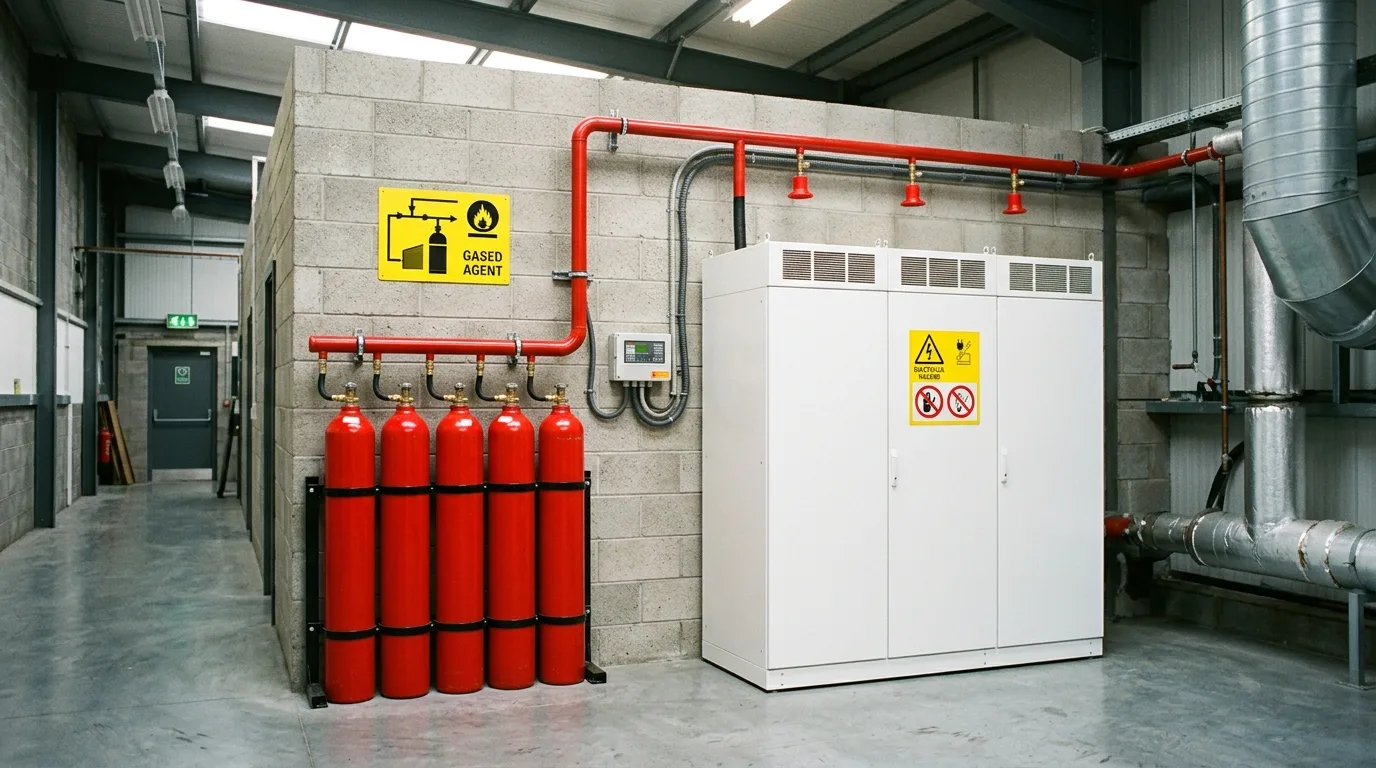
- Fire suppression: integrated gaseous (typically Novec 1230, FM-200, or aerosol) within the BESS enclosure
- Smoke and gas detection: lithium-specific detectors (Li-ion battery sensors)
- Thermal monitoring: continuous cell-level temperature with EMS alarms
- Fire-rated walls or barriers: 60-120 minute fire resistance where separation is reduced
- Bunding and drainage: to contain water from firefighting
- Emergency disconnect: clearly labelled, accessible by Fire Service
- Site signage: lithium battery hazard signs, contact info, emergency procedures
- Fire Service Plan: site-specific procedures shared with local Fire Brigade
Working with Fire Officers in Ireland
The local Fire Officer (typically based at the relevant Local Authority Fire Service) reviews BESS installations under the Fire Services Act. Best practice:
- Engage early - pre-design discussion with Fire Officer
- Share the project intent, vendor selection and IS EN 62619 documentation
- Conduct a site visit jointly with the Fire Officer
- Discuss separation distances and reasonable accommodations
- Provide draft Fire Safety Plan for review
- Incorporate Fire Officer feedback before final design
- Submit the Fire Safety Certificate application with complete documentation
- Invite Fire Officer to commissioning and final walk-through
Most Irish Fire Officers are now familiar with LFP BESS and have established preferences for system layouts, signage and suppression. Building this relationship is one of the highest-leverage activities in a commercial BESS project.
Recent fire incidents and lessons learned
There have been no major LFP commercial BESS fires in Ireland through 2024-2026. International incidents have largely been NMC-based or older battery chemistries. Lessons applied in Irish practice:
- Open-air outdoor container installations with adequate separation outperform enclosed indoor installations on fire safety
- Liquid-cooled systems with active thermal management have stronger fire records than passive-cooled systems
- Cell-to-pack designs (BYD Blade) show fewer cascade failures than module designs
- Continuous EMS monitoring with proactive alarming catches issues before failure
Cost of fire engineering compliance
A typical Irish 1 MWh commercial BESS fire engineering package costs:
- Fire engineering report: €3,000-€8,000
- Fire suppression system (if not integrated): €15,000-€40,000
- Fire-rated walls / separation works: €10,000-€40,000
- Detection and alarm integration: €5,000-€15,000
- Fire Safety Certificate fees and consultancy: €5,000-€12,000
Total: €38,000-€115,000 - typically 5-10% of BESS capex. Skipping this scope to save money is false economy - insurance refusal, Fire Officer enforcement notices, and reputational risk all far exceed the cost.
Bottom line
IS EN 62619 is the foundational European safety standard for industrial lithium battery systems, adopted in Ireland and demanded by Fire Officers, Building Control and insurers. LFP chemistry makes compliance significantly easier than NMC. Complete compliance requires not just the cell standard but also fire engineering, suppression, detection, separation and ongoing operational procedures. Budget 5-10% of BESS capex for the full fire engineering package and engage your local Fire Officer early - both pay back many times over in project certainty and insurance terms.
Get 3 free commercial battery quotes — free and no obligation.
Frequently asked questions
What is IS EN 62619?
IS EN 62619 is the Irish-adopted European safety standard for secondary lithium batteries used in industrial applications. It specifies electrical, mechanical, environmental and propagation tests that cell and pack manufacturers must pass to demonstrate safe operation.
Do I need IS EN 62619 compliance for my commercial battery in Ireland?
Yes - Irish Building Control, Fire Officers and commercial insurers increasingly require IS EN 62619 evidence before approving installations. Reputable commercial BESS vendors (Tesla, Sungrow, BYD, etc.) provide compliance documentation as standard.
Why is LFP safer than NMC under IS EN 62619?
LFP cells have higher thermal runaway onset temperature (~270°C vs ~150-200°C), release less oxygen during failure, produce lower-intensity fires, and rarely propagate cell-to-cell. This typically results in easier IS EN 62619 compliance, smaller fire separation distances, and lower insurance premiums.
How much does fire engineering cost for an Irish commercial BESS?
A complete fire engineering package for a 1 MWh BESS typically costs €38k-€115k including fire engineering report, suppression system, fire-rated separation, detection and alarms, and Fire Safety Certificate consultancy. Roughly 5-10% of overall BESS capex.
Do I need a Fire Safety Certificate for my BESS in Ireland?
Often yes - particularly for BESS installations within or near buildings classified as relevant under Building Control Regulations. Engage your local Fire Officer early to understand whether a Fire Safety Certificate is required for your specific project.
Sources & further reading
- NSAI Standards Catalogue — National Standards Authority of Ireland
- Building Control Technical Guidance Document B Fire Safety — Government of Ireland
- National Directorate for Fire and Emergency Management — Government of Ireland