LFP vs NMC for Commercial Battery Storage in Ireland: Why LFP Won the Stationary Market
By 2026 almost every new commercial BESS in Ireland uses LFP cells. Here is why LFP displaced NMC for stationary storage - and the rare cases where NMC still makes sense.
By Smart Solar Editorial · Updated 15 May 2026 · 8 min read
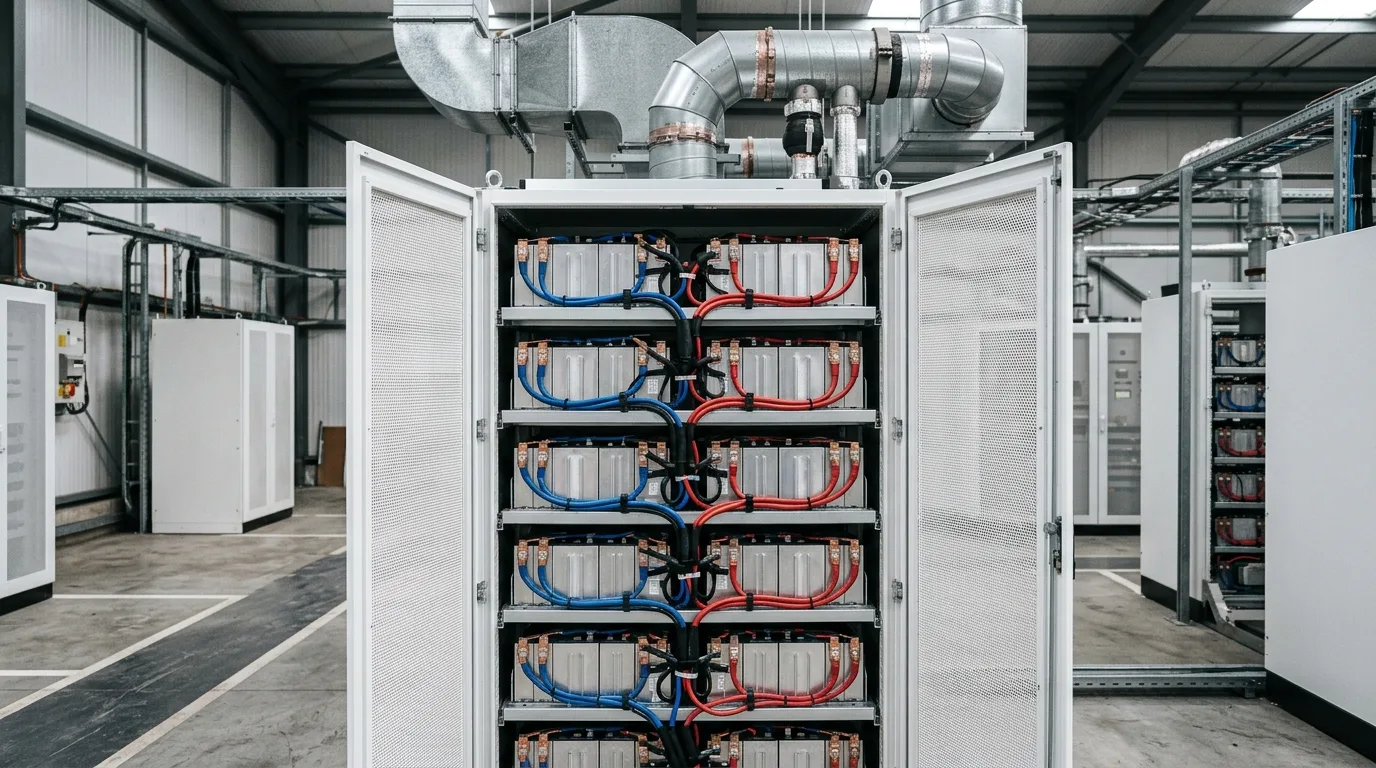
Five years ago, the battery chemistry debate was genuinely contested. By 2026, it is essentially settled for commercial stationary storage in Ireland: lithium iron phosphate (LFP) has won, and almost every BESS installed at an Irish factory, warehouse, retail park or data centre uses LFP cells. Understanding why - and the narrow cases where NMC still appears - helps you read commercial battery quotes with clear eyes.
The two chemistries in one paragraph
LFP (LiFePO4) uses iron and phosphate at the cathode. It is thermally stable, cobalt-free, lower energy density, longer cycle life, cheaper per kWh in 2026, and harder to push into thermal runaway.
NMC (Lithium Nickel Manganese Cobalt Oxide) uses nickel, manganese and cobalt at the cathode. Higher energy density, higher peak power, shorter cycle life, more thermally sensitive, more expensive in 2026, and uses cobalt with associated supply chain and ESG concerns.
For mobile applications where weight and volume matter (EVs, drones, aerospace), NMC and high-nickel variants still dominate. For stationary commercial storage, where every kWh sits in a cabinet on a concrete pad and cycles for 15 years, LFP wins on every dimension that matters.
Why LFP took over commercial BESS
1. Cycle life. Modern LFP cells are warranted for 6,000-10,000 cycles to 70-80% capacity. NMC commercial cells typically warranty 3,500-5,000 cycles. For an Irish BESS cycling once per day, that is 16-27 years of LFP life vs 10-14 years of NMC. The difference is decisive for grid-connected ROI models.
2. Thermal safety. LFP has a thermal runaway onset around 270°C, vs 150-200°C for NMC. LFP also releases far less oxygen during runaway, reducing fire intensity. This matters under IS EN 62619, the standard Irish insurers and fire authorities increasingly reference for commercial BESS installations. LFP makes the fire engineering and insurance conversation dramatically easier.
3. Cobalt-free supply chain. Major Irish corporates (Diageo, Glanbia, multinationals) now scope-3 audit their suppliers. LFP avoids cobalt sourcing risk entirely, simplifying ESG reporting.
4. Price. In 2022, NMC was cheaper per kWh than LFP. By 2026, LFP cell prices fell to under $60/kWh while NMC stayed around $90-110/kWh due to nickel and cobalt pricing pressure. LFP system-level pricing in Ireland sits at €600-€900 per kWh installed in 2026, vs €750-€1,100 per kWh for equivalent NMC.
5. Calendar life. LFP holds capacity better when sitting at high or low SOC. A commercial BESS in Ireland spends large chunks of weekends at low cycling - LFP shrugs this off while NMC degrades faster under the same conditions.
Where NMC still has a role
NMC has not entirely disappeared. You will still see it in:
1. Backup-power-first applications. Where a 30-minute backup duration is the dominant requirement and footprint matters (data centre rooms, retrofitting old UPS rooms), NMC's higher energy density saves floorspace. Vendors like Vertiv and Schneider Galaxy still offer NMC modules for these slots.
2. Hybrid PV inverters under 30 kW. Some residential and very small commercial systems still ship with NMC because of inverter compatibility - though this is rapidly migrating to LFP (Sonnen Multi, BYD Battery-Box Premium, GoodWe Lynx).
3. High-power short-duration DS3 niche. Rare cases where the FFR contract structure rewards extreme power density and 30-minute durations may marginally favour NMC, but most aggregators in Ireland (Statkraft, Veri, Power Capital, GridBeyond) now specify LFP for new contracts due to insurance and safety stance.
Vendor reality check in Ireland 2026
Every major commercial BESS available in Ireland in 2026 uses LFP for the cell stack:
- Tesla Megapack 2 / 2XL - LFP since 2022
- BYD MV / MV+ - LFP (BYD invented automotive-grade LFP)
- Sungrow PowerStack 200CS / 250CS - LFP (CATL EnerC+ or EVE Energy)
- GE Vernova Reservoir - LFP
- Wartsila GridSolv Quantum - LFP
- Fluence Gridstack - LFP
- Sonnen Multi (small commercial) - LFP
- Nidec / EnSync - LFP
If a 2026 commercial BESS quote in Ireland specifies NMC, ask the EPC explicitly why. The answer should be a specific application-driven justification, not a hangover from older product lines.
The IS EN 62619 angle
IS EN 62619 is the Irish-adopted European safety standard for secondary lithium batteries in industrial applications. Compliance is increasingly demanded by:
- Building Control Authorities for new installations
- Insurers (Aviva, Allianz, AXA, FBD, RSA Ireland)
- Fire officers under Section 18 of the Fire Services Act
- ESB Networks for connection approval at MV
LFP cells generally pass IS EN 62619 propagation tests more easily than NMC because the thermal runaway of one cell is less likely to propagate to neighbouring cells. This translates directly into lower insurance premiums and faster Fire Safety Certificate approval for Irish commercial BESS projects.
Energy density - and why it does not matter much in stationary
NMC packs about 220-280 Wh/kg at cell level. LFP packs 150-180 Wh/kg. NMC is 30-50% lighter and smaller for the same kWh.
For an EV, that matters. For a 500 kWh battery cabinet sitting on a concrete pad behind an Irish warehouse, an extra 30-40% volume means a slightly bigger cabinet on the same plot. The trade is trivial against safety, cycle life and price.
When to push back on an LFP-vs-NMC conversation
If a salesperson tells you NMC "gives you more power per square metre" - true but irrelevant for stationary. If they say NMC "lasts longer" - false. If they say NMC is "cheaper" - false in 2026. If they say NMC is "safer" - definitively false.
The only honest pro-NMC argument in 2026 is "we have legacy stock to clear." That is a procurement conversation, not a technical one.
Bottom line
LFP is the default for Irish commercial BESS in 2026, and the technical, economic, safety and ESG arguments all reinforce that. When you receive your shortlist of quotes, every one should specify LFP cells with named cell vendor (BYD, CATL, EVE), nameplate capacity, end-of-warranty usable capacity, and IS EN 62619 compliance evidence. Anything that deviates needs a written explanation before signing.
Get 3 free commercial battery quotes — free and no obligation.
Frequently asked questions
Why is LFP preferred over NMC for commercial battery storage?
LFP offers longer cycle life (6,000-10,000 cycles vs 3,500-5,000), better thermal safety, no cobalt supply chain risk, lower 2026 price per kWh, and easier IS EN 62619 fire compliance. For stationary commercial BESS in Ireland, LFP wins on every relevant dimension.
Is NMC ever a better choice for commercial BESS?
Rarely in 2026. NMC's higher energy density can save floorspace in retrofit data centre UPS replacements where every square metre is valuable. Outside that niche, LFP is the default.
How does LFP affect insurance for Irish commercial BESS?
LFP makes insurance and fire engineering significantly easier in Ireland. Lower thermal runaway risk, IS EN 62619 compliance, and reduced fire intensity translate into smaller fire separation distances, lower insurance premiums, and faster Building Control approval.
Do Tesla Megapack and Sungrow BESS use LFP or NMC?
Both Tesla Megapack (since 2022) and Sungrow PowerStack use LFP cells. So do BYD MV/MV+, GE Vernova Reservoir, Wartsila GridSolv Quantum, Fluence Gridstack, and Sonnen Multi - essentially every major commercial BESS sold in Ireland in 2026.
Does LFP work in cold Irish climates?
Yes. LFP performs well across the typical Irish temperature range (-5°C to 25°C). Heated cabinets or container HVAC are standard to maintain cells in the 15-25°C optimum range, with minor auxiliary load impact (1-3% of throughput).
Sources & further reading
- IS EN 62619 Secondary Lithium Batteries for Industrial Applications — National Standards Authority of Ireland
- SEAI Energy in Industry Reports — SEAI