C-Rate in Commercial BESS Explained: Why It Matters for Irish Business Projects
C-rate is the ratio of a battery's power to its capacity. It silently controls warranty length, throughput, and whether your BESS can chase DS3 frequency response or only do gentle solar smoothing.
By Smart Solar Editorial · Updated 15 May 2026 · 8 min read
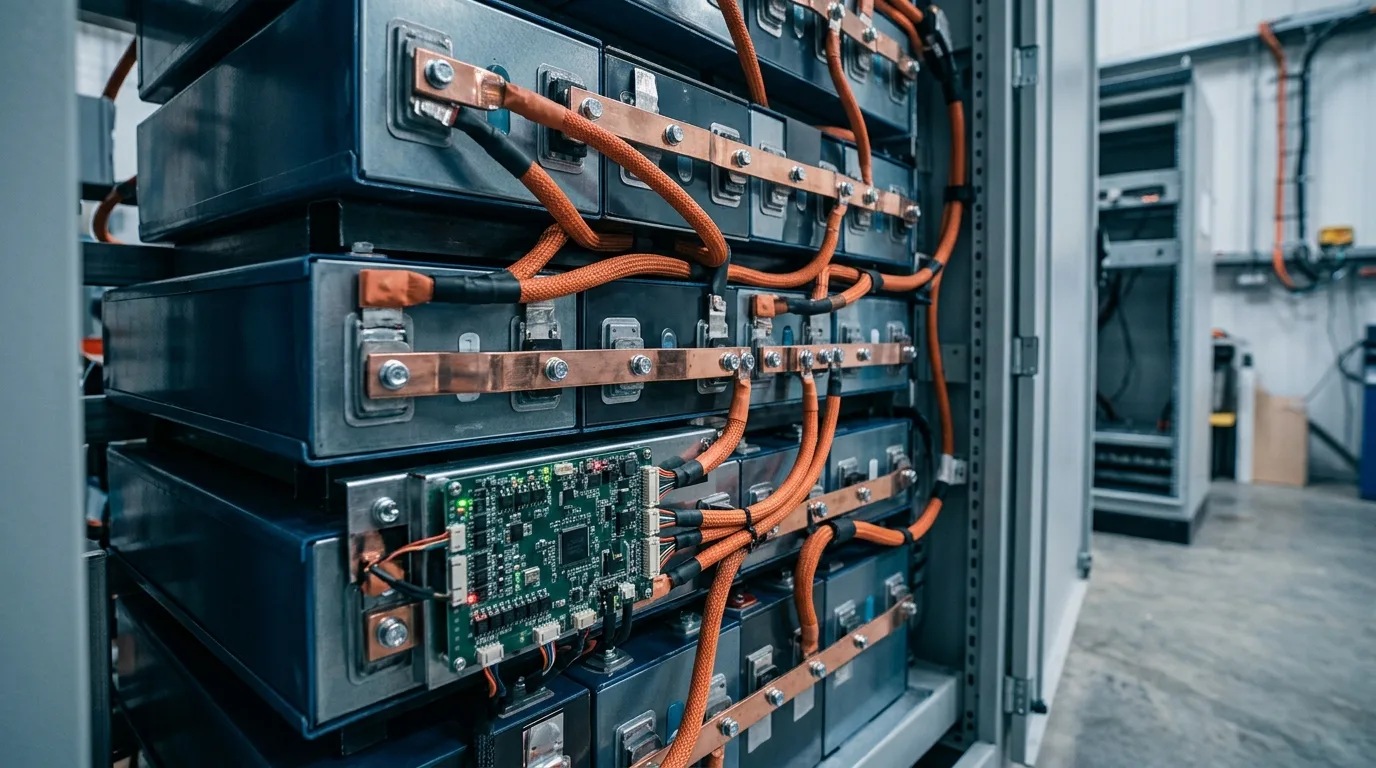
C-rate is one of those battery specifications that looks like jargon until the warranty arrives. Once you understand it, you can read any commercial BESS quote in Ireland and know within 30 seconds whether the system is sized for peak shaving, DS3 grid services, or solar smoothing.
What C-rate actually means
C-rate is the ratio between a battery's continuous power rating and its energy capacity, expressed as a multiple of its 1-hour rate.
- 1C = the battery fully discharges in 1 hour. A 100 kWh battery delivering 100 kW continuously is operating at 1C.
- 0.5C = 2-hour discharge. A 100 kWh battery delivering 50 kW continuously.
- 2C = 30-minute discharge. A 100 kWh battery delivering 200 kW continuously.
- 0.25C = 4-hour discharge. A 100 kWh battery delivering 25 kW continuously.
In a commercial BESS, the inverter (PCS) sets the achievable C-rate. The cells set the rated C-rate they can tolerate without accelerated degradation. A good system matches both: a 0.5C cell stack paired with a 0.5C PCS gets the cleanest warranty terms.
Why Irish commercial projects mostly land at 0.25C-1C
The commercial business case in Ireland is dominated by four use cases, and each implies a C-rate band:
1. Peak shaving / MIC reduction. Irish evening peaks last 1-3 hours. A 0.33C-0.5C battery (2-3 hour duration) covers them comfortably. Going above 1C wastes inverter capex.
2. Solar self-consumption. PV midday surplus needs to be soaked up over 4-6 hours and discharged across the evening. 0.2C-0.33C is ideal - long, slow, gentle on cells.
3. DS3 frequency response (FFR, POR, SOR). Fast frequency response events last 8-90 seconds, but the contracted availability window is longer. Aggregators typically specify 1C cells with a PCS sized at 1C-2C peak so the battery can respond hard then quickly recover. This is where you see Tesla Megapack and Sungrow PowerStack PCS pushed harder.
4. Backup / UPS replacement. Critical-load backup for 8-30 minutes is a 1C-4C burst, but only for the islanding window. The cell stack is usually sized for the longer peak-shaving job.
How C-rate affects warranty in Ireland
Every reputable LFP cell vendor - BYD, CATL, EVE, Sungrow, Tesla - publishes a warranty matrix. The throughput guaranteed at 0.5C is usually much higher than at 1C, and dramatically higher than at 2C.
Typical 2026 LFP commercial warranty bands:
| C-rate (continuous) | Guaranteed cycles to 70% | End-of-warranty period |
|---|---|---|
| 0.25C | 10,000 cycles | 12-15 years |
| 0.5C | 8,000 cycles | 10-12 years |
| 1C | 6,000 cycles | 8-10 years |
| 2C peak only | 4,000 equivalent cycles | 7-8 years |
Translated into Irish operational life on a once-per-day cycle: a 0.5C battery comfortably reaches 10 years to 80% capacity, while a 2C battery aggressively cycled for DS3 may need a mid-life cell refresh at year 7.
The hidden lever: usable depth-of-discharge
LFP commercial batteries usually quote 90-95% usable DoD. The nameplate kWh is not the same as usable kWh. A 1,000 kWh nameplate / 950 kWh usable battery operating at 0.5C delivers 475 kW continuously - not 500 kW. Always read the usable kWh at end of warranty figure when calculating C-rate.
For example, Sungrow PowerStack 250CS specs at 250 kWh nameplate / 232 kWh usable beginning-of-life / 197 kWh usable end-of-warranty. A 100 kW PCS on this stack is 0.4C nameplate but 0.5C end-of-life - and that is the number that matters for sizing your peak shave in year 9.
Worked example: dairy plant in Limerick
A medium-sized Irish dairy with 1.2 MVA MIC has two distinct load events:
- Evening factory shutdown: 800 kW peak for 45 minutes
- Morning chiller startup: 1.1 MW peak for 12 minutes
A naive approach would size to the larger peak: 1.1 MW PCS. But the morning event is only 12 minutes - it needs roughly 220 kWh. A smarter design specifies:
- PCS: 1.1 MW
- Usable kWh: 800 kWh (covers the longer evening peak with margin)
- Continuous C-rate: 1.375C peak, 1C continuous
The cell stack must be rated for 1C continuous - which means selecting commercial cells like BYD MV+ 314 Ah or CATL EnerC+ rather than budget 280 Ah stacks. The premium is roughly 8-12% on cell cost but avoids a warranty downgrade.
C-rate vs round-trip efficiency
Higher C-rate also reduces round-trip efficiency. A 0.25C cycle on a top-tier LFP system achieves 92-94% RTE (AC-AC at the meter). The same system at 1C drops to 86-88%. At 2C, you are looking at 82-84%. Across a 10-year operational life, every 2 percentage points of RTE loss can equate to €15k-€40k of lost arbitrage value on a 1 MWh system - so high C-rate operation is not free even before warranty considerations.
How to read a quote properly
When an Irish EPC quotes you a BESS, the C-rate often hides in the inverter spec sheet. Check:
- Nameplate C-rate: PCS kW ÷ nameplate kWh
- End-of-warranty C-rate: PCS kW ÷ end-of-warranty usable kWh
- Cell-level continuous C-rate: From the cell datasheet (BYD, CATL etc)
- Cell-level peak C-rate for 15 minutes: Especially relevant for DS3 use
If the end-of-warranty C-rate exceeds the cell-level continuous C-rate, you have a system that will spend its later life either derating output or accelerating degradation. Both reduce your business case.
Bottom line
For most Irish commercial BESS projects in 2026 - peak shaving, self-consumption, and modest DS3 stacking - 0.33C to 0.5C nameplate is the sweet spot. It hits a 2-3 hour duration that matches Irish demand peaks, keeps cell warranties intact, and leaves headroom for end-of-life capacity loss without losing the original business case.
Get 3 free commercial battery quotes — free and no obligation.
Frequently asked questions
What is C-rate in a battery?
C-rate is the ratio of the battery's continuous power to its energy capacity. A 1C battery discharges in 1 hour, 0.5C in 2 hours, 2C in 30 minutes. It is set by both the inverter rating and the cell chemistry.
What C-rate is best for Irish commercial peak shaving?
0.33C-0.5C is ideal for Irish evening peak shaving (1-3 hour events). It balances power, duration, and warranty life. Higher C-rates only make sense for DS3 grid services or fast UPS backup.
Does higher C-rate damage the battery?
Higher continuous C-rates accelerate calendar and cycle degradation through increased heat and electrochemical stress. Most LFP cell warranties cut guaranteed cycles by 25-40% when moving from 0.5C to 1C continuous operation.
What C-rate do I need for DS3 frequency response?
DS3 FFR typically needs 1C continuous capability with 1.5-2C burst for short events. Aggregators like Statkraft and Veri usually specify the C-rate in the contract, and EPCs size the PCS accordingly.
How does C-rate affect round-trip efficiency?
Each step up in C-rate reduces round-trip efficiency by 2-4 percentage points. A 0.25C LFP system reaches 92-94% RTE while a 2C system drops to 82-84%. Plan arbitrage revenue with the actual operational C-rate, not the headline efficiency.
Sources & further reading
- EirGrid DS3 System Services Performance Standards — EirGrid
- CRU Connection Policy for Storage — Commission for Regulation of Utilities