BMS and EMS Explained for Commercial BESS in Ireland
BMS protects the cells, EMS optimises the value. Both are essential and often confused. Here is what each does, how they interact, and what to look for in a commercial BESS quote.
By Smart Solar Editorial · Updated 15 May 2026 · 8 min read
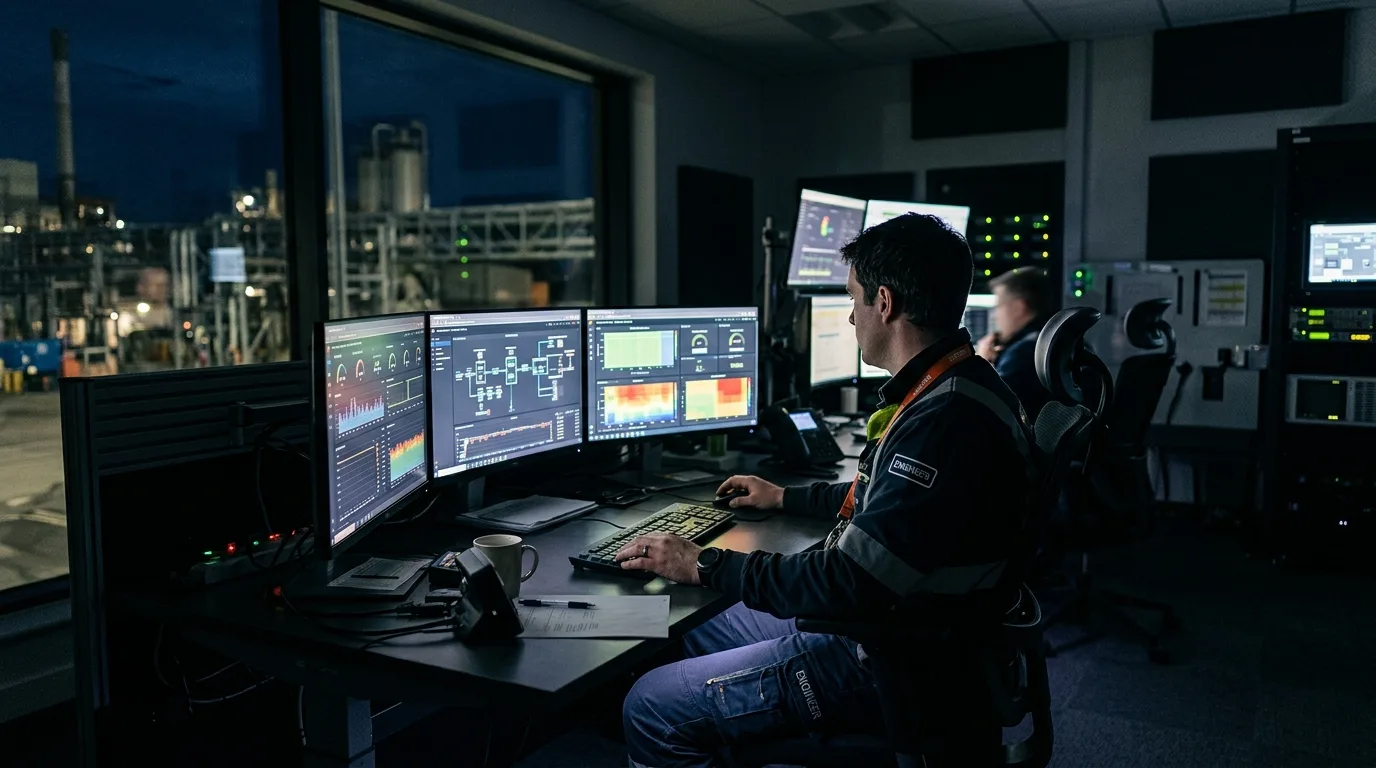
Every commercial battery system has two essential software layers: a Battery Management System (BMS) that protects the cells, and an Energy Management System (EMS) that optimises commercial value. They are different things, do different jobs, and often confuse buyers. This article explains both for Irish commercial BESS in 2026.
Battery Management System (BMS)
The BMS lives inside the battery. Its job is to keep the cells safe and healthy. It does not care about your electricity bill, your DS3 contract, or your solar production - those are upstream concerns.
What the BMS actually does:
1. Cell-level monitoring. Continuously measures voltage, temperature and current of every individual cell or cell group (typically 50-100+ measurement points per MWh).
2. Balancing. Equalises the state of charge across cells. Without balancing, weaker cells drift and reduce usable capacity. Two methods exist:
- Passive balancing: burns off excess charge from high cells through bleed resistors
- Active balancing: redistributes charge between cells
Most 2026 commercial LFP systems use a combination, with active balancing increasingly standard at higher tier products.
3. Safety protection. Trips the system off-line if any cell exceeds safe limits for voltage, temperature, current or impedance. Required for IS EN 62619 compliance.
4. State-of-charge estimation. Calculates SOC and state-of-health (SOH) for use by upstream systems.
5. Thermal management commands. Drives the HVAC system (liquid cooling pumps, container HVAC) to maintain optimal cell temperature (15-25°C typical).
6. Communication. Reports cell-level data to the PCS, EMS and SCADA via CAN bus or Modbus protocols.
The BMS is usually provided by the cell vendor (BYD, CATL, EVE) or integrated by the system vendor (Tesla, Sungrow). You do not typically choose a separate BMS - it comes with the cell stack.
Energy Management System (EMS)
The EMS lives at the system level, often on a small industrial computer or as a cloud service. Its job is to decide what the battery should do at any given moment to maximise commercial value within the safety constraints set by the BMS.
What the EMS does:
1. Multi-objective optimisation. Decides in real time whether to charge, discharge, idle, provide DS3 services, or reserve capacity for backup - based on:
- Current and forecast site load
- Tariff time-of-use schedule
- PV generation forecast
- DS3 contracted services and dispatch signals
- MIC limit and capacity charge structure
- Battery state-of-charge and degradation budget
2. Peak shaving. Continuously monitors site demand and discharges to keep import below the MIC ceiling.
3. Solar self-consumption optimisation. Captures PV surplus and discharges to displace high-tariff grid energy.
4. Tariff arbitrage. Charges during low-tariff windows (typically 02:00-06:00), discharges during peak (17:00-19:00).
5. DS3 dispatch. Responds to aggregator signals for frequency response and reserve services within milliseconds.
6. Reporting and analytics. Generates dashboards, alarms, and performance reports for facility managers and finance teams.
7. Integration. Interfaces with site SCADA, building management systems, PV inverters, smart meters, and aggregator platforms.
How BMS and EMS interact
The BMS sets the constraints; the EMS optimises within them.
A simplified example: it is 17:30, peak tariff hour, site demand is 850 kW, MIC limit is 900 kVA, battery SOC is 65%, cell temperature is 22°C.
- BMS: "All cells healthy. Permitted discharge rate: 500 kW continuous, 750 kW for 30 minutes."
- EMS: "Site demand 850 kW, peak tariff active. Discharge battery at 200 kW to offset peak-tariff import. Keep SOC above 25% to retain DS3 reserve."
- BMS: "Confirmed 200 kW discharge. Updating SOC every 5 seconds."
Both systems run continuously, with the BMS having final veto power over any unsafe command from the EMS.
EMS vendors and platforms in Ireland 2026
The EMS landscape is more diverse than the BMS landscape because EMS is not bundled with cells:
- Tesla Powerhub - integrated with Megapack, premium and polished
- Sungrow iEMS / iSolarCloud - integrated with PowerStack/PowerTitan
- BYD EMS - integrated with BYD MV/MV+
- GridBeyond Veritone - aggregator EMS with multi-vendor BESS support
- Statkraft GridScope - aggregator platform
- Veri (Veridian) EnergyHub - Irish aggregator EMS
- GE Predix - utility-scale EMS
- Open-source / custom (OpenADR, Tellus) - some industrial sites build their own
When an Irish commercial site uses a DS3 aggregator, the aggregator's EMS typically sits on top of (or alongside) the vendor's native EMS. Integration matters - mature EMS-aggregator pairings simplify dispatch and settlement.
What to look for in a BESS quote
Specifications to verify on BMS:
- Cell-level monitoring resolution (typically 1 measurement per cell or per 2-3 cells)
- Balancing method (passive vs active)
- IS EN 62619 compliance evidence
- BMS communication protocol (Modbus, CAN, Ethernet)
- Cyber security certifications (IEC 62443 family for industrial systems)
Specifications to verify on EMS:
- Multi-objective optimisation capability (peak shaving + arbitrage + DS3 simultaneously)
- DS3 aggregator integrations (named in the quote)
- SCADA integration protocols (DNP3, IEC 61850, Modbus TCP)
- Reporting dashboard quality (request a demo before signing)
- Cyber security certifications
- Cloud vs on-premise architecture
- API access for owner integration with own BMS/SCADA
Cyber security considerations
A commercial BESS is a network-connected industrial control system. Cyber security matters:
- BMS and EMS should support TLS-encrypted communications
- Remote access should require multi-factor authentication
- Software updates should be signed and verifiable
- IEC 62443 compliance is increasingly expected for utility-scale and large commercial
- Audit logging of all dispatch commands and configuration changes
Recent Irish CRU guidance on critical infrastructure cyber security applies to large BESS installations connected to the I-SEM system.
Common BMS/EMS issues to avoid
1. Proprietary lock-in. Some vendors require their EMS with their cells. Confirm whether third-party EMS integration is possible if you want flexibility.
2. Weak SCADA integration. EMS that cannot interface with your existing site SCADA forces parallel monitoring and adds operational overhead.
3. Poor DS3 aggregator coverage. If your preferred aggregator is not pre-integrated, integration cost can be €15k-€50k.
4. Inadequate reporting. "Black box" EMS that does not expose granular data makes performance verification difficult.
5. Single-objective optimisation. EMS that can only do one job at a time (peak shaving OR DS3) leaves stacked revenue on the table.
Bottom line
In a commercial BESS, the BMS is the safety system (provided by the cell vendor, non-negotiable for IS EN 62619 compliance), and the EMS is the value optimisation system (provided by the system vendor or a third-party aggregator). Both matter; both need attention during procurement. The BMS protects the asset; the EMS extracts the revenue. Together, they determine whether your 15-year BESS delivers its business case.
Get 3 free commercial battery quotes — free and no obligation.
Frequently asked questions
What is the difference between BMS and EMS?
BMS (Battery Management System) lives inside the battery, monitors and protects every cell, and ensures safe operation. EMS (Energy Management System) lives at the system level, optimises when and how the battery discharges to maximise commercial value within the BMS-set constraints.
Do I need a separate EMS or does it come with the battery?
Most commercial BESS vendors (Tesla, Sungrow, BYD) include a native EMS with the system. For DS3 participation, an aggregator EMS often sits on top. Pure-play standalone EMS providers (GridBeyond, Veri, Statkraft) integrate across multiple battery vendors.
What is cell balancing in a BMS?
Balancing equalises state of charge across all cells in the battery. Passive balancing burns off excess charge from over-charged cells; active balancing redistributes charge between cells. Without balancing, weaker cells degrade faster and usable capacity drops.
Can the EMS handle peak shaving and DS3 at the same time?
Modern multi-objective EMS platforms (Tesla Powerhub, Sungrow iEMS, GridBeyond Veritone, Veri EnergyHub) handle stacked use cases simultaneously - peak shaving + arbitrage + DS3 + solar self-consumption. Older single-objective EMS cannot, leaving revenue on the table.
Is BESS cyber security a real concern in Ireland?
Yes - commercial BESS are network-connected industrial control systems. CRU and EU NIS2 Directive guidance require encrypted communications, MFA, signed software updates and audit logging. Larger systems connected to I-SEM should comply with IEC 62443 series standards.