How Commercial Battery Storage (BESS) Works in Ireland: A Plant-Manager's Guide
Commercial battery storage is no longer a science project in Ireland. Here is how a Battery Energy Storage System actually works on an Irish factory, warehouse or data centre site - and where the value comes from.
By Smart Solar Editorial · Updated 15 May 2026 · 9 min read
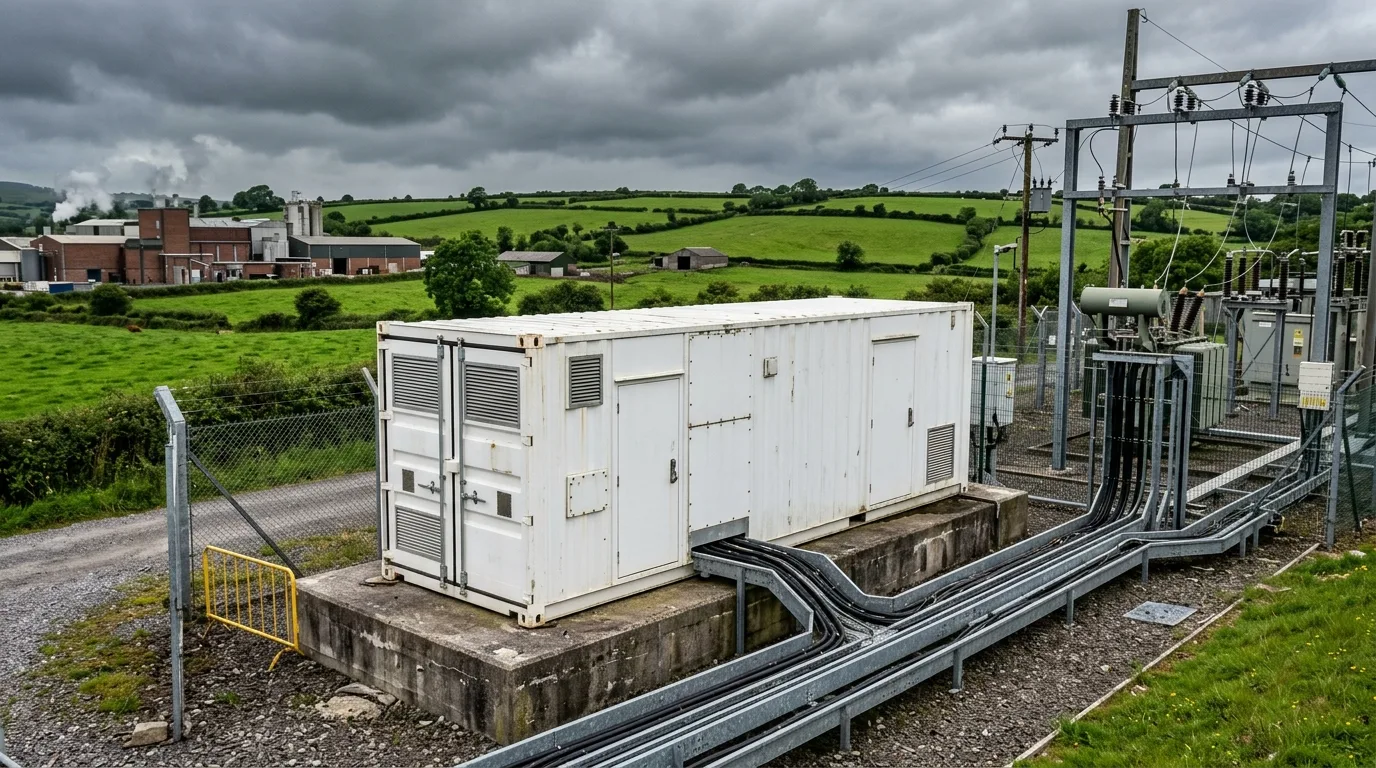
Commercial battery storage in Ireland has moved from pilot to mainstream. Between 2024 and 2026, ESB Networks connected hundreds of behind-the-meter systems at factories, data centres, dairy plants and logistics hubs - and a growing pipeline of standalone front-of-meter projects bidding into EirGrid's DS3 system services market. Yet for most facility managers, finance directors and operations teams, the question still comes up: how does a commercial BESS actually work, and where does the value come from?
This guide explains the moving parts of a commercial battery system - hardware, software, grid interface, and economics - in plain Irish business terms.
The four layers of a commercial BESS
Every commercial battery system, whether a 50 kWh wall cabinet at a SuperValu or a 4 MWh container at a Cork pharma plant, is built from four layers.
1. Cells. The chemistry doing the actual electrochemical work. In 2026, almost every new commercial BESS in Ireland uses lithium iron phosphate (LFP) prismatic cells, typically from BYD, CATL or EVE. LFP has replaced NMC for stationary storage because it is more thermally stable, lasts 6,000 to 10,000 cycles, and avoids cobalt supply-chain risk.
2. Modules and racks. Cells are grouped into modules (typically 5-10 kWh each), then stacked into racks (50-250 kWh). Each rack has its own battery management system (BMS) monitoring voltage, current and temperature at the cell level.
3. Power Conversion System (PCS). A bi-directional inverter that converts DC battery power to AC grid power, and back. Sizing is independent of capacity - a 500 kW / 1,000 kWh system has a 500 kW PCS and 1,000 kWh of cells, giving it a 2-hour duration. Vendors include Sungrow, Sungrow PowerStack, GE Vernova, Nidec and Fluence.
4. Energy Management System (EMS). The brain. The EMS decides when to charge, when to discharge, and which market signal to chase - peak shaving, solar self-consumption, DS3 frequency response, or grid arbitrage. The EMS connects to ESB Networks metering, your site SCADA, and any aggregator partner such as Statkraft, Veri or Power Capital.
What sits between the BESS and the grid
In Ireland, a commercial battery does not connect to the ESB Networks system on its own. It sits behind your existing site connection, governed by a Connection Agreement under the NC6 process (LV, up to ~200 kW) or NC7 process (MV, larger). Between the battery and the meter you will typically find:
- An isolation switch and AC distribution panel
- Protection relays (G99 compliant)
- A revenue-grade meter (often a second one for grid services settlement)
- A site EMS gateway communicating with the aggregator and with ESB Networks SCADA where required
For a 250 kWh / 100 kW system on a Mayo bakery, this hardware fits in a single 2.5 m cabinet next to the existing main board. For a 4 MWh / 2 MW system at a Dublin data centre, you are looking at a containerised solution on a concrete pad with its own LV switchroom.
Where the money actually comes from
A commercial BESS in Ireland in 2026 typically stacks two to five revenue streams:
1. Maximum Import Capacity (MIC) reduction. ESB Networks charges Irish business customers a capacity charge ranging from roughly €100 to €200 per kVA per year depending on tariff band. If your peak is 800 kVA but you only need that for 4 hours a day, a battery can shave the peak and let you reduce your contracted MIC - saving €40k-€120k per year on a typical mid-size site.
2. Time-of-use arbitrage. Day/night/peak/off-peak tariff spreads in Ireland regularly exceed 10-15 c/kWh between 02:00-06:00 and the 17:00-19:00 evening peak. Charging cheap, discharging at peak adds 5-10% on top of MIC savings.
3. Solar self-consumption uplift. If you have a 500 kWp rooftop PV array, midday generation often exceeds onsite load. A battery captures the surplus instead of exporting it at low CEG rates (typically 18-21 c/kWh in 2026), pushing self-consumption from 55% to 85-90%.
4. DS3 system services revenue. EirGrid pays for fast frequency response (FFR), primary, secondary and tertiary operating reserves. A 1 MW / 2 MWh BESS contracted via an aggregator like Statkraft or GridBeyond typically earns €30k-€60k per MW per year in 2026 after aggregator fees.
5. Demand Side Unit (DSU) participation. Larger sites can register as a DSU and earn capacity market payments through I-SEM for being available to reduce demand when called.
Why Irish businesses are adopting BESS now
Three things changed between 2023 and 2026 that made commercial BESS economic in Ireland:
- Cell prices fell. LFP cell prices dropped from over $150/kWh in 2022 to under $60/kWh in 2026, pulling installed system pricing for 250-1,000 kWh commercial systems into the €600-€900 per kWh range.
- SEAI EXEED grants scaled. The EXEED scheme now offers up to 30% capex support (capped at €3M per project) for energy efficiency investments including BESS where it forms part of an integrated energy plan.
- Accelerated Capital Allowance (ACA). Eligible battery storage equipment qualifies for 100% first-year tax write-off, meaning a profitable Irish company effectively saves another 12.5% via corporation tax relief in year one.
Typical commercial BESS sizing in Ireland
| Site type | Typical size | Indicative installed cost (2026) |
|---|---|---|
| Retail / SME (SuperValu, hotel) | 50-150 kWh | €40k-€120k |
| Mid-size factory or warehouse | 250-500 kWh | €150k-€350k |
| Large industrial / dairy / pharma | 1-4 MWh | €600k-€2.4M |
| Front-of-meter standalone | 5-50 MWh | €3M-€25M |
These are blended turnkey numbers - cells, PCS, EMS, ESB Networks connection works, civils, commissioning and 2-year warranty. EXEED grant and ACA tax relief can reduce net cost by 35-45% for an eligible project.
What to do next
If you are evaluating BESS for an Irish business site, start with a 12-month half-hourly load profile from ESB Networks (request via your supplier). Overlay it with your tariff structure and any PV generation profile. That single dataset tells an experienced energy advisor within 30 minutes whether peak shaving, arbitrage, self-consumption uplift or grid services will be the dominant revenue stream - and therefore what size and chemistry of BESS makes sense.
From there, the path is: feasibility study, ESB Networks NC6/NC7 application, EXEED grant application (if applicable), EPC tender, installation, commissioning and 25-year operational life. Most Irish commercial BESS projects deliver payback in 4-7 years and an internal rate of return of 15-25%.
Get 3 free commercial battery quotes — free and no obligation.
Frequently asked questions
How long does a commercial BESS last in Ireland?
Modern LFP commercial battery systems are warranted for 10 years and 6,000-10,000 cycles, with a useful life of 15-20 years. Most Irish commercial sites cycle once per day, so the cell stack typically reaches 70% of original capacity after 12-15 years and is then refreshed or replaced.
Do I need planning permission for a commercial BESS in Ireland?
Sub-50 kWh wall-mounted units typically do not require planning. Containerised systems above ~100 kWh on a new pad, or in sensitive locations, will usually need a planning application or at minimum a Section 5 declaration from the local authority. Front-of-meter systems above 5 MW often require full planning and an environmental screening.
Can a commercial BESS provide backup power during ESB Networks outages?
Yes, but only if it is specified with an islanding-capable inverter (often called grid-forming) and an automatic transfer switch. Most behind-the-meter BESS in Ireland are grid-following and will trip off in an outage for G99 safety compliance. Backup capability adds roughly 10-15% to system cost.
What revenue can I expect from DS3 services on an Irish BESS?
In 2026, a 1 MW / 2 MWh battery contracted through a DS3 aggregator typically earns €30k-€60k per MW per year for Fast Frequency Response, after aggregator fees of 15-25%. Stacking with MIC reduction and time-of-use arbitrage often takes total annual revenue per MW to €80k-€150k.
Is the EXEED grant available for battery storage?
Yes - SEAI's EXEED scheme (Excellence in Energy Efficient Design) supports BESS as part of an integrated energy efficiency project, with grants of up to 30% of eligible capex capped at €3M per project in 2026. The battery must be justified in the energy modelling and the project must have an accredited Energy Manager involved from the design phase.
Sources & further reading
- SEAI EXEED Grant Scheme — Sustainable Energy Authority of Ireland
- EirGrid DS3 System Services — EirGrid
- ESB Networks Connection Process — ESB Networks