Cost of Commercial Battery Storage in Ireland 2026: Real Installed Prices
Commercial BESS pricing in Ireland fell 35% between 2022 and 2026. Here are realistic installed costs by system size, what is included, and the hidden line items that catch out first-time buyers.
By Smart Solar Editorial · Updated 15 May 2026 · 9 min read
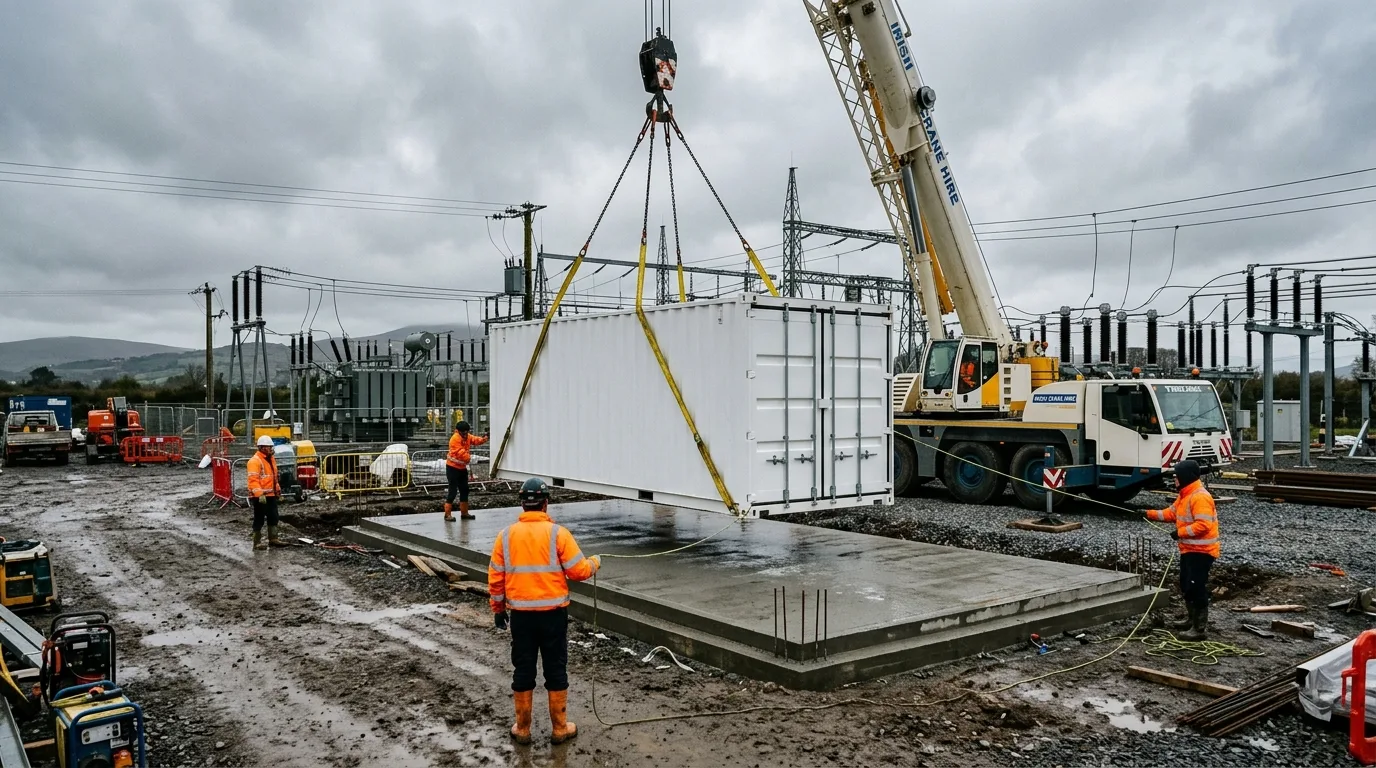
Commercial battery storage in Ireland has become dramatically cheaper since 2022. LFP cell prices dropped from over $150/kWh to under $60/kWh by 2026, pulling installed system pricing into the €600-€900 per kWh range for typical mid-size commercial projects. This article gives realistic 2026 Irish installed prices by system size, what is included in a turnkey quote, and the line items that often get missed.
Headline installed prices by size
These are blended turnkey prices for behind-the-meter commercial BESS in Ireland, 2026, including PCS, LFP cells, EMS, ESB Networks connection works, civils, commissioning and 2-year warranty:
| System size | Per-kWh installed | Total installed price |
|---|---|---|
| 50 kWh (LV retail, hotel) | €1,200-€1,500/kWh | €60k-€75k |
| 100 kWh (SME factory) | €950-€1,200/kWh | €95k-€120k |
| 250 kWh (medium factory) | €700-€900/kWh | €175k-€225k |
| 500 kWh (large warehouse) | €650-€800/kWh | €325k-€400k |
| 1,000 kWh (mid industrial) | €600-€750/kWh | €600k-€750k |
| 2,000 kWh (dairy, pharma) | €550-€700/kWh | €1.1M-€1.4M |
| 4,000 kWh (large industrial) | €500-€650/kWh | €2.0M-€2.6M |
| Standalone 10 MWh+ | €450-€600/kWh | €4.5M-€6M+ |
Larger systems benefit from economies of scale - PCS, EMS, civils and grid connection costs are largely fixed per project, so per-kWh price falls sharply above 1 MWh.
What is in a turnkey quote
A complete Irish commercial BESS turnkey quote should include:
Hardware:
- LFP battery cells (specify vendor: BYD, CATL, EVE, Tesla, etc.)
- Power Conversion System (Sungrow, Tesla, GE Vernova, Nidec, Fluence)
- Battery Management System (cell-level monitoring)
- Energy Management System (site-level control)
- Container or cabinet enclosure with HVAC
- Fire suppression system (typically aerosol or Novec)
- Auxiliary panel and isolation switches
Site works:
- Concrete pad foundation
- Bollards and fencing if outdoor
- AC cabling to main board
- Communications cabling to site SCADA
- Earthing and surge protection
Connection:
- ESB Networks NC6 or NC7 application fee
- Connection charges (deeply variable - €5k to €200k+ depending on reinforcement)
- G99 compliance documentation and inverter certification
- Protection relays (if required by ESB Networks)
- Second revenue-grade meter (if separate settlement needed)
Commissioning and handover:
- Pre-commissioning testing (BMS, PCS, EMS)
- EirGrid qualification trials (if DS3 participation)
- Witness commissioning by ESB Networks (MV)
- Operator training
- O&M manual and as-built drawings
Warranty and support:
- 2-year workmanship warranty
- 10-year LFP cell warranty (manufacturer)
- 10-year PCS warranty (manufacturer)
- First-year O&M (sometimes bundled, often separate)
What often gets missed in early-stage budgets
- ESB Networks deep reinforcement costs. A rural MV site requiring a substation transformer upgrade can add €50k-€300k. NC7 estimate quotes are non-binding until the formal connection offer.
- Planning permission. Containerised systems often need a Section 5 declaration or full planning - €5k-€25k including consultant fees.
- Fire engineering report. Required for insurance and Fire Officer approval - €3k-€15k.
- Insurance premium uplift. First-year commercial property insurance premium may rise €5k-€30k once a BESS is added until track record is established.
- DS3 aggregator setup fees. Telemetry installation, qualification trials, and onboarding: €10k-€40k one-off.
- Project management. Owner's engineer or external PM: 5-10% of project value.
- Spare parts package. Recommended 3-5% of capex held as critical spares.
Add 12-20% on top of the headline turnkey quote to budget the full installed cost including all the above.
After EXEED grant and ACA
SEAI's EXEED scheme can grant up to 30% of eligible capex, capped at €3M per project. Eligibility requires an integrated energy efficiency project with accredited Energy Manager involvement from design phase.
Accelerated Capital Allowance (ACA) provides 100% first-year tax write-off on eligible energy-efficient equipment, including most LFP BESS systems. For a profitable Irish company at the 12.5% corporation tax rate, this effectively reduces net cost by an additional 12.5% in year one.
Worked example: 1 MWh / 500 kW BESS for an Irish food manufacturer
- Gross installed cost: €650k
- EXEED grant 30%: -€195k
- Net cost after grant: €455k
- ACA tax shield in year 1: -€57k (12.5% of €455k)
- Effective net cost: €398k
That is roughly 39% off the headline turnkey price for an eligible project. Most Irish BESS projects in 2026 model both EXEED and ACA into the financial case.
Price trend: 2022 to 2026
| Year | Typical 500 kWh installed (Ireland) | Per kWh |
|---|---|---|
| 2022 | €625k | €1,250/kWh |
| 2023 | €510k | €1,020/kWh |
| 2024 | €420k | €840/kWh |
| 2025 | €375k | €750/kWh |
| 2026 | €350k | €700/kWh |
Most analysts expect prices to continue softening through 2027 (CATL and BYD expanding LFP capacity), but at a slower rate (3-7% per year vs 15-20% in 2022-2024).
How vendor choice affects price
Within the €600-€900/kWh band at 1 MWh scale, vendor choice typically swings price by €100-€200/kWh:
- Tesla Megapack 2: premium pricing (~€780-€900/kWh installed), strong reliability and bankability
- Sungrow PowerStack: mid-market (~€650-€800/kWh), good balance of cost and quality
- BYD MV / MV+: competitive (~€620-€750/kWh), large global install base
- GE Vernova Reservoir: premium (~€750-€850/kWh), strong utility/grid relationships
- Wartsila GridSolv Quantum: premium (~€750-€880/kWh), excellent fire engineering
- Fluence Gridstack: premium (~€770-€900/kWh), market leader in standalone
- Sonnen Multi: specialised commercial under 200 kW
- Nidec / EnSync: competitive mid-market
Lower-cost Tier 2 Chinese options (Hithium, REPT, Gotion) exist at €500-€600/kWh installed but with shorter Irish track records and weaker EU after-sales support.
How to verify quoted prices
If you receive an unusually low quote, check:
- Cell vendor and Tier 1 status (BloombergNEF / Wood Mackenzie tier list)
- End-of-warranty kWh figure (not just nameplate)
- AC round-trip efficiency at 0.5C (88-92% expected)
- Cycle warranty (6,000-10,000 cycles for LFP)
- Fire compliance evidence (IS EN 62619)
- Insurance and bonding (especially for sub-€700/kWh quotes on >500 kWh)
- Local Irish installation references
A price that is 25%+ below market should trigger detailed scrutiny, not a quick signature.
Bottom line
In 2026, expect to pay €600-€900/kWh installed for typical 250-1,000 kWh Irish commercial BESS projects, falling to €500-€650/kWh at 4 MWh scale and above. EXEED and ACA together can reduce net cost by 35-45%. Budget an additional 12-20% on top of headline turnkey for ESB Networks reinforcement, planning, fire engineering and project management overhead.
Get 3 free commercial battery quotes — free and no obligation.
Frequently asked questions
What does a 500 kWh commercial battery cost in Ireland?
Approximately €325k-€400k installed in 2026 for a turnkey LFP system including PCS, cells, EMS, civils, ESB Networks connection and commissioning. EXEED grant and ACA tax relief can reduce net cost by 35-45% for eligible projects.
What is the cheapest commercial battery option in Ireland?
Tier 2 LFP systems from Chinese vendors like Hithium and REPT can land at €500-€600/kWh installed for 1 MWh+ systems, but offer shorter Irish track records and weaker after-sales support. Tier 1 brands (Tesla, Sungrow, BYD, GE Vernova) sit at €600-€900/kWh for typical mid-size projects.
How much does ESB Networks connection cost for a BESS?
Highly variable. A 100 kW NC6 LV connection on an existing supply may cost €15k-€40k. An NC7 MV connection with deep reinforcement can cost €100k-€300k+ depending on substation distance and feeder capacity.
Does the EXEED grant cover battery storage?
Yes - SEAI's EXEED scheme funds BESS as part of an integrated energy efficiency project, with up to 30% of eligible capex granted, capped at €3M per project. Accredited Energy Manager involvement is required from design phase.
Has commercial battery cost fallen recently?
Yes - installed Irish commercial BESS prices fell roughly 35% between 2022 and 2026, driven by LFP cell price drops from $150/kWh to $60/kWh. Further softening of 3-7% per year is expected through 2027.
Sources & further reading
- SEAI EXEED Grant Scheme — SEAI
- Revenue Accelerated Capital Allowance — Revenue Commissioners
- BloombergNEF Battery Price Survey — BloombergNEF