Peak Shaving with BESS in Ireland: How to Cut Your MIC Capacity Charge
Capacity charges of €100-€200 per kVA per year add up fast on a 1 MVA Irish factory. Peak shaving with BESS is the single biggest near-term ROI driver for commercial battery storage in Ireland.
By Smart Solar Editorial · Updated 15 May 2026 · 9 min read
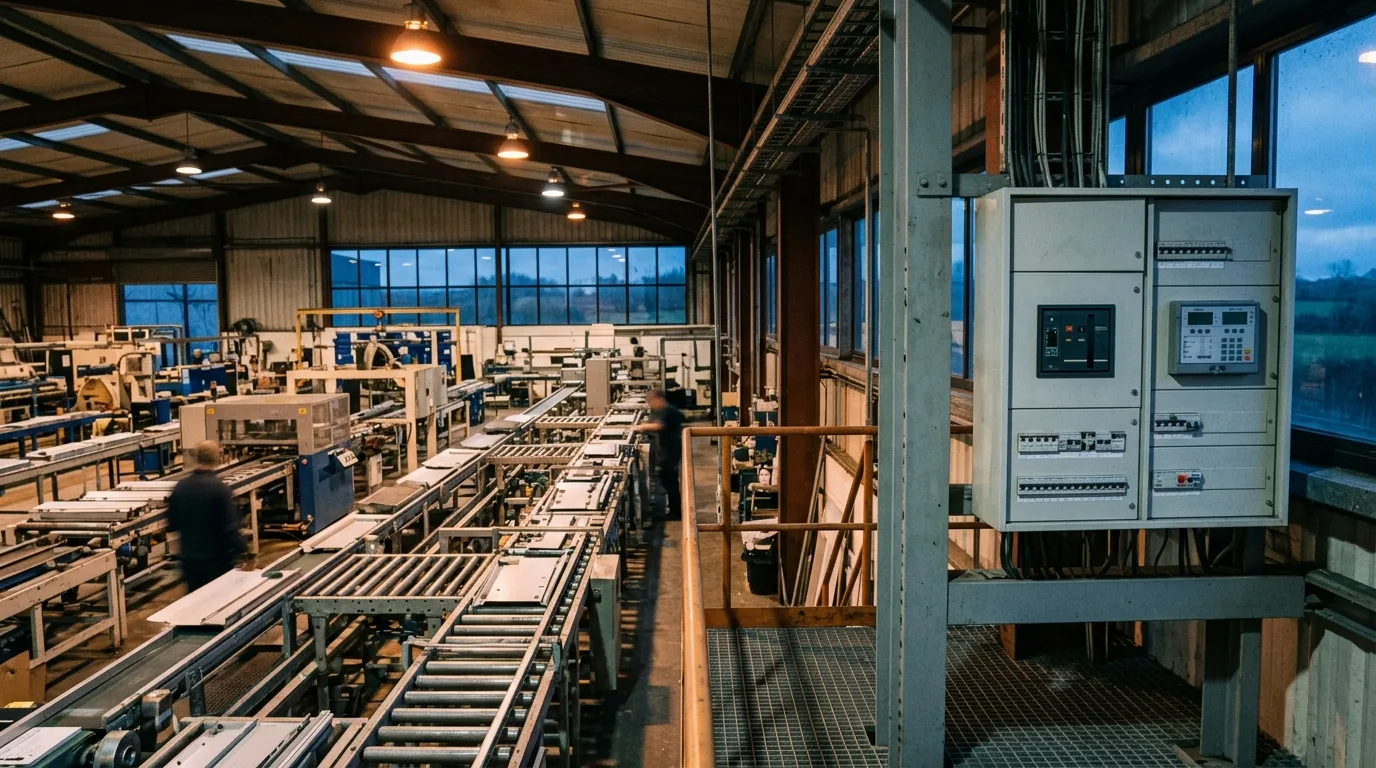
For most Irish commercial sites, the fastest payback line on a BESS business case is not solar self-consumption or DS3 grid services. It is reducing Maximum Import Capacity (MIC) - the contracted demand band that ESB Networks bills you for every month, whether or not you actually use it.
This article explains how MIC works, why peak shaving with a commercial battery is so effective, and what realistic savings look like on Irish sites in 2026.
What is MIC and how is it billed?
Every Irish business with a non-domestic ESB connection has a Maximum Import Capacity, measured in kVA, set in your Connection Agreement. ESB Networks charges your supplier a capacity charge for that MIC band - and your supplier passes it through on your bill as either a separate line item or rolled into the standing charge.
In 2026, capacity charges typically range from:
- €80-€110 per kVA per year on LV connections (under 200 kVA)
- €140-€175 per kVA per year on MV connections (200 kVA - 5 MVA)
- €175-€210 per kVA per year on large MV / dual MV connections (over 5 MVA)
A site with a 1,000 kVA MIC on a standard MV tariff is paying roughly €150,000 per year in capacity charges alone, before consuming a single kWh.
The 4 ways MIC actually gets billed in Ireland
It is worth understanding the nuance because peak shaving design depends on it:
- Standing capacity charge. Flat monthly fee based on contracted MIC band, regardless of usage.
- Excess capacity charge. If you exceed your MIC, ESB Networks bills the overshoot at penal rates (typically 3-5x the standard capacity rate) for that month.
- Power factor surcharge. If your power factor drops below 0.95 you pay extra; BESS with reactive power capability can help here.
- Time-of-use demand charges. Some 2026 tariffs include a separate demand charge billed on the highest 15-minute import during peak hours (typically 17:00-19:00).
Peak shaving with BESS targets categories 1, 2 and 4 directly, and can address 3 through PCS reactive power injection.
How peak shaving with BESS works
A commercial battery EMS monitors your half-hourly site load in real time. When demand approaches a configured threshold (e.g. 70% of MIC), the battery discharges to keep the site import below that ceiling. Outside peak windows, the battery recharges from grid (cheap night rate) or from on-site PV.
The result: your billable peak drops by the BESS power rating (kW), as long as the battery has enough energy (kWh) to cover the duration of the peak event.
After 12-18 months of operation, you submit a formal MIC reduction request to ESB Networks via your supplier. With consistent half-hourly data showing your new peak, ESB Networks updates your Connection Agreement to the lower MIC band - locking in the saving.
Real Irish examples (2026)
Example 1: Cork engineering plant, 800 kVA MIC
- Pre-BESS peak: 720 kW on winter evenings (17:30-18:30)
- BESS installed: 250 kW / 500 kWh Sungrow PowerStack
- Post-BESS peak: 480 kW
- MIC reduced from 800 kVA to 550 kVA
- Annual saving: 250 kVA × €155 = €38,750/yr in capacity charges
- Plus excess capacity penalty avoidance: ~€12,000/yr
- Total annual benefit: ~€50,750/yr from peak shaving alone
Example 2: Dublin cold storage facility, 1.4 MVA MIC
- Pre-BESS peak: 1,250 kW during chiller cycling
- BESS installed: 500 kW / 1,500 kWh Tesla Megapack
- Post-BESS peak: 800 kW
- MIC reduced from 1,400 kVA to 950 kVA
- Annual saving: 450 kVA × €165 = €74,250/yr
- Plus arbitrage uplift: ~€28,000/yr
- Plus DS3 stacking: ~€32,000/yr
- Total annual benefit: ~€134,250/yr
Example 3: Mid-size Galway dairy, 2.2 MVA MIC
- Pre-BESS peak: 2,050 kW on cleaning cycle days
- BESS installed: 1,000 kW / 2,500 kWh BYD MV+
- Post-BESS peak: 1,200 kW
- MIC reduced from 2,200 kVA to 1,400 kVA
- Annual saving: 800 kVA × €175 = €140,000/yr in capacity charges alone
Sizing a peak-shaving BESS properly
The single most important input is a 12-month half-hourly load profile from ESB Networks. With this data, you can:
- Plot the load duration curve to identify the top 100 highest demand intervals
- Group those intervals into peak events (typically lasting 30-120 minutes)
- Find the worst-case event - the longest event at the highest shave power
- Size the BESS kW for the shave power and kWh for the longest event with 15-20% degradation buffer
A common mistake is to size only for the mean of peak events rather than the worst case. If your BESS cannot cover one 90-minute event in February, you cannot lower your MIC - because ESB Networks bases the new MIC on the highest 15-minute interval across the full billing year.
What about combined heat & power and standby generators?
Many Irish industrial sites already have backup diesels (Cummins, Caterpillar, Atlas Copco). Could you peak shave with these instead of a BESS? Technically yes, but in 2026:
- Diesel running costs at peak fuel prices exceed grid peak tariff
- EPA emissions licensing for daily operation is restrictive
- Carbon tax (€90+ per tonne CO2 from 2026) makes diesel uneconomic
- Neighbour complaints about noise / NOx are real
BESS is silent, zero-emission, requires no fuel logistics, and qualifies for the ACA tax allowance. Diesel still has a role as deep backup but is no longer the right peak shaving tool.
How long does MIC reduction take?
The full process from BESS commissioning to a lower bill:
- Months 1-3: Commission BESS, configure EMS, baseline operation
- Months 3-12: Operate at reduced peak, accumulate half-hourly data
- Month 13: Submit MIC reduction request via supplier (ElectricIreland, Bord Gais Energy, Energia, SSE Airtricity, Pinergy, Flogas, Yuno)
- Months 13-15: ESB Networks review and confirm new MIC
- Month 15 onwards: Lower capacity charge appears on bill
Some suppliers will accept a 6-month dataset for the request if BESS operation is consistent. Plan a 12-15 month payback window for the MIC saving to fully crystallise.
The combination effect
Peak shaving is rarely the only revenue stream. Stacking it with arbitrage, solar self-consumption, and DS3 typically lifts annual returns by 50-100% over peak shaving alone. But peak shaving is usually the largest single contributor on Irish commercial sites in 2026, and it is the one that justifies the BESS capex on its own in most business cases.
Get 3 free commercial battery quotes — free and no obligation.
Frequently asked questions
How much can a BESS save on my ESB capacity charge?
Typical savings are €40k-€200k per year on Irish commercial sites depending on MIC size and peak shave depth. At 2026 rates of €150-€175 per kVA per year, every 100 kVA of MIC reduction saves €15k-€17.5k annually.
How long does it take to reduce MIC after installing a battery?
Plan for 12-15 months from BESS commissioning to a lower bill. ESB Networks requires consistent half-hourly data showing the lower peak before approving a new Connection Agreement, and the formal request goes through your supplier.
Can I reduce MIC without a battery?
Possible but limited. Load shifting through scheduling, voltage optimisation, power factor correction and HVAC controls can trim 5-15% of peak demand. A BESS is required to shave deeper peaks, especially short-duration events that drive your MIC.
What if I exceed my new lower MIC after the reduction?
ESB Networks bills excess capacity at penal rates (typically 3-5x standard) and may require you to return to the higher MIC band if exceedance is persistent. The BESS EMS must include hard peak limiting and an alarm tier to prevent this.
Do I need ESB Networks approval to install a peak shaving BESS?
Yes - all behind-the-meter battery systems above approximately 25 kVA need a Connection Agreement under the NC6 (LV) or NC7 (MV) process. Pure load-side BESS that never exports is simpler to approve than systems that bid into DS3 markets.
Sources & further reading
- ESB Networks Tariff Schedule — ESB Networks
- CRU Network Tariff Decisions — Commission for Regulation of Utilities