ESB Networks NC6 for Commercial Battery Storage: Step-by-Step in 2026
Every commercial BESS up to ~200 kVA in Ireland goes through ESB Networks NC6. Here is the process, what each form does, and how to keep your project on schedule.
By Smart Solar Editorial · Updated 15 May 2026 · 8 min read
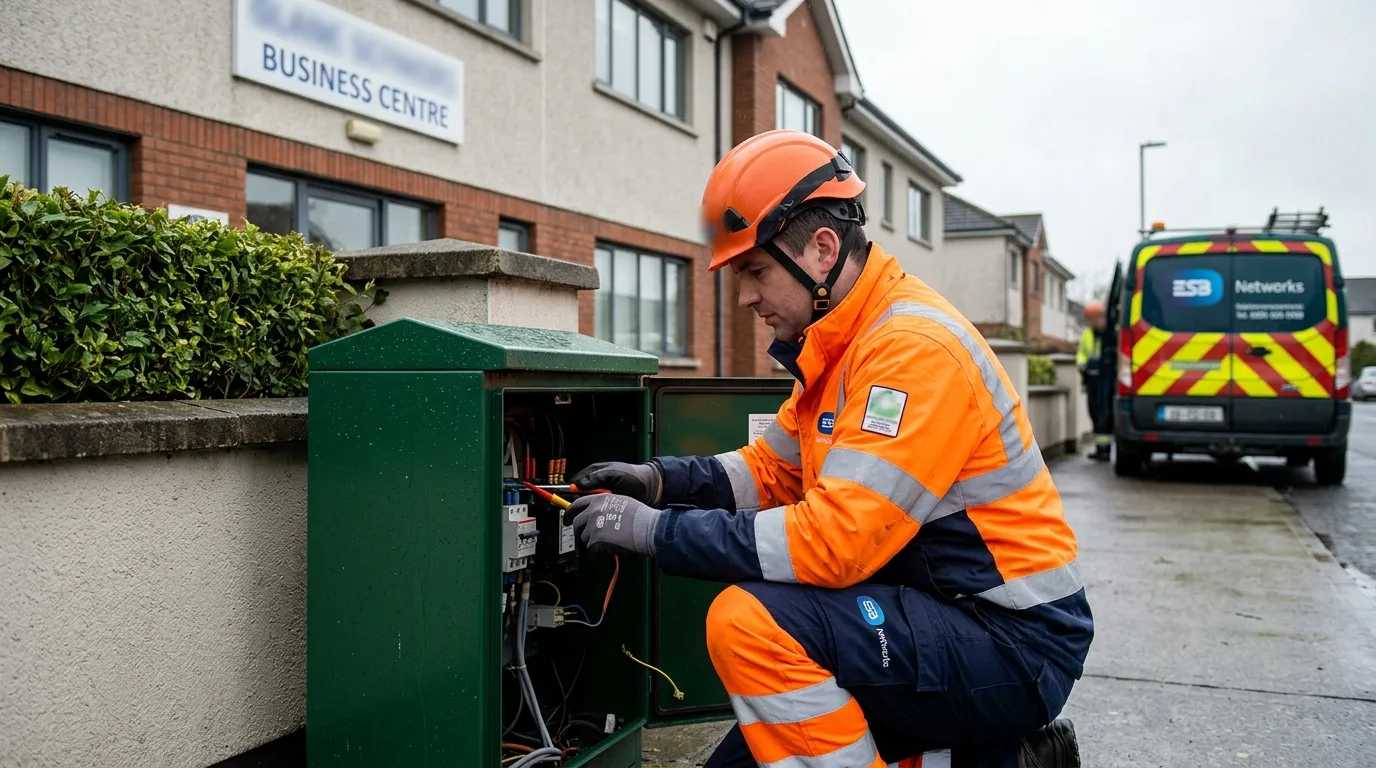
Every commercial battery storage system in Ireland needs an ESB Networks Connection Agreement. For systems up to approximately 200 kVA - the typical SME, retail and small commercial threshold - the relevant process is the NC6 application. This article walks through NC6 step by step, explains common delays, and shows how to keep your project on track in 2026.
What NC6 is
NC6 is the ESB Networks application form (Form NC6) and associated process for connecting non-domestic mini-generation and small-scale storage to the low-voltage (LV) network. Despite the name, it applies to:
- Solar PV from ~6 kW up to 200 kVA
- Battery storage (charge and discharge) up to 200 kVA
- Combined PV + storage hybrid systems
- Wind, hydro and CHP at small commercial scale
For larger systems above 200 kVA, the NC7 process for MV connections applies (separate article).
When NC6 applies to your BESS
NC6 applies if:
- Your battery PCS rated power is ≤200 kVA
- Your existing connection is LV (typically 400V 3-phase)
- Your installation is in Ireland (ESB Networks operates the LV distribution network)
If any of these is false, NC7 or other processes apply.
The NC6 process in 11 steps
1. Site assessment and design. Your installer designs the BESS system, confirms G99-compliant equipment selection (Tesla, Sungrow, BYD etc. are all pre-certified), and confirms the PCS rating.
2. NC6 application submission. Complete Form NC6 with site address, existing MIC/MEC, proposed inverter spec, single-line diagram, equipment specifications including G99 certificate, and applicant details. Submit via the ESB Networks online portal.
3. ESB Networks acknowledgement. Typically 5-10 working days.
4. Technical assessment. ESB Networks engineers review the application against local network capacity. For most LV connections this is a desk review; for constrained networks it may involve site survey.
5. Connection Offer. ESB Networks issues a Connection Offer letter confirming acceptance, any technical conditions, and connection fees if applicable. Typical timeline from application: 4-8 weeks.
6. Acceptance. You accept the Connection Offer in writing, pay any applicable fees, and confirm equipment specification.
7. Installation. Your installer completes the BESS installation. ESB Networks does not attend - installation is the installer's responsibility under ETCI / Safe Electric registration.
8. ETCI completion certificate. Your registered electrical contractor issues an ETCI (now Safe Electric) certificate confirming installation compliance.
9. Pre-commissioning testing. Installer tests the BESS, PCS, BMS, and ESB Networks meter interface to confirm operation and G99 compliance.
10. Commissioning notification. Submit completion documentation to ESB Networks including ETCI certificate, commissioning report, and G99 commissioning checklist.
11. ESB Networks acceptance. Typically 2-4 weeks. Once accepted, you can operate the BESS. Smart meter is updated to reflect any export capability.
Total typical NC6 timeline: 8-16 weeks from application submission to operational sign-off, depending on network constraints and installer responsiveness.
What G99 is
G99 is the engineering recommendation (under IEC 61727 internationally) governing how distributed generation and storage connects to a distribution network. In Ireland, G99 compliance is mandatory for:
- All grid-connected inverters above 0.8 kW
- All storage PCS above 0.8 kW
- Combined PV + storage systems
Key G99 requirements for commercial BESS:
- Anti-islanding protection (PCS disconnects within 5s of grid loss)
- Voltage and frequency operating limits
- Power quality (harmonics, flicker)
- Reactive power capability
- Communications interface where required by ESB Networks
Most modern commercial BESS hardware (Tesla, Sungrow, BYD, Sonnen Multi, BYD Battery-Box Premium HV) is pre-certified to G99 by the manufacturer. Your installer provides the certificate number on the NC6 form.
Fees and costs
Typical 2026 NC6 fees:
- NC6 application fee: Often nil or low (~€100) for storage <200 kVA
- Connection charges: Vary widely - €0 for net-zero impact, €500-€20,000 for systems requiring network reinforcement (transformer upgrade, etc.)
- MIC change fee: €0-€500 if MIC needs adjustment
- Smart meter installation: Usually included or nominal cost
For most LV commercial BESS in 2026, total ESB Networks NC6-related fees are €0-€5,000 unless deeper reinforcement is needed.
Common reasons for NC6 delays
1. Incomplete application. Missing G99 certificate, single-line diagram, equipment spec sheets are the most common reasons for rejection. Pre-flight your application package.
2. Network constraints. Some Irish LV feeders, especially rural and edge-of-network locations, have limited remaining capacity. NC6 application may be approved with reduced export capability or require reinforcement.
3. Existing MIC mismatch. If your existing MIC band cannot accommodate the BESS, a separate MIC review is needed in parallel.
4. Inverter spec changes during build. Switching inverters mid-project triggers re-submission. Lock equipment selection before NC6 submission.
5. Commissioning paperwork. Missing ETCI certificate or G99 commissioning checklist delays the final sign-off step.
How to keep NC6 on track
Pre-flight checklist before submission:
- Equipment confirmed (PCS, BMS, EMS spec frozen)
- G99 certificates collected for all inverters
- Single-line diagram complete and labelled
- Existing MIC verified against new total demand
- Site address matches existing ESB Networks records exactly
- Installer registered with Safe Electric
- Application package PDF compiled and named clearly
During the process:
- Acknowledge ESB Networks correspondence within 5 working days
- Pay any fees promptly
- Confirm any technical conditions immediately
- Submit commissioning paperwork the same week as commissioning
NC6 and DS3 participation
NC6 itself does not enable DS3 grid services participation - that requires separate registration with EirGrid via your aggregator. However, the NC6 Connection Offer must permit the export profile that DS3 participation requires. Tell your installer if DS3 is planned so the application reflects realistic dispatch behaviour.
For sites below 200 kVA, DS3 participation is unusual but possible via aggregator portfolio pooling - confirm with your aggregator before locking NC6 specs.
NC6 vs NC7 - when to switch process
If your project crosses the LV/MV boundary:
- PCS >200 kVA: NC7 mandatory
- Existing site already MV-connected: NC7 mandatory regardless of BESS size
- Total site demand exceeding LV transformer capacity: NC7 likely
Some projects start out targeting NC6 then discover they need NC7 due to total connection demand. Get this assessed at design stage to avoid restarting the process.
CRU oversight
The Commission for Regulation of Utilities (CRU) sets the policy framework that ESB Networks implements through NC6. CRU publications periodically update connection charge structures, fast-track provisions for renewables, and storage-specific provisions. The current direction of policy strongly favours storage deployment with simplified connection where network impact is neutral.
Bottom line
NC6 is a manageable 8-16 week process for commercial battery storage up to 200 kVA in Ireland. The single biggest determinant of timeline is the quality of your application package - complete, accurate, and well-documented submissions move fast; incomplete or ambiguous ones add weeks or months. Work with installers experienced in NC6 (Activ8, Enerpower, Powerlink, Smart Solar Ireland and others maintain dedicated NC6 teams) and you should land in the lower half of the timeline range.
Get 3 free commercial battery quotes — free and no obligation.
Frequently asked questions
What is the ESB Networks NC6 process?
NC6 is the ESB Networks application process for connecting LV (low-voltage) generation and storage up to approximately 200 kVA to the Irish distribution network. It covers solar PV, battery storage, wind and CHP at small commercial scale.
How long does NC6 take in Ireland?
Typically 8-16 weeks from application submission to commissioning sign-off. Connection Offer typically 4-8 weeks; installation, commissioning paperwork and ESB acceptance another 4-8 weeks. Delays usually stem from incomplete applications.
How much does ESB Networks NC6 cost for a commercial battery?
Application fees are typically nil or nominal (~€100). Connection charges range from €0 (net-neutral impact) to €20,000+ if network reinforcement is required. Most LV commercial BESS in 2026 have total ESB Networks fees of €0-€5,000.
Do I need G99 certification for my battery?
Yes - all grid-connected inverters and battery PCS above 0.8 kW in Ireland must comply with G99 engineering recommendations. Most modern commercial BESS hardware is pre-certified by the manufacturer; your installer provides the certificate number.
What is the difference between NC6 and NC7?
NC6 applies to LV connections up to ~200 kVA. NC7 applies to MV connections (200 kVA to 5 MVA). The NC7 process is longer (typically 12-24 months) and more involved, often requiring detailed substation engineering studies.
Sources & further reading
- ESB Networks New Connections — ESB Networks
- ESB Networks Mini-Generation Connection Information — ESB Networks
- CRU Distribution Connection Policy — Commission for Regulation of Utilities