Hybrid vs AC-Coupled Commercial BESS in Ireland: Which Architecture to Choose
DC-coupled hybrid systems beat AC-coupled on efficiency. AC-coupled systems beat hybrid on flexibility and retrofit. Here is how to choose for an Irish commercial PV + BESS.
By Smart Solar Editorial · Updated 15 May 2026 · 8 min read
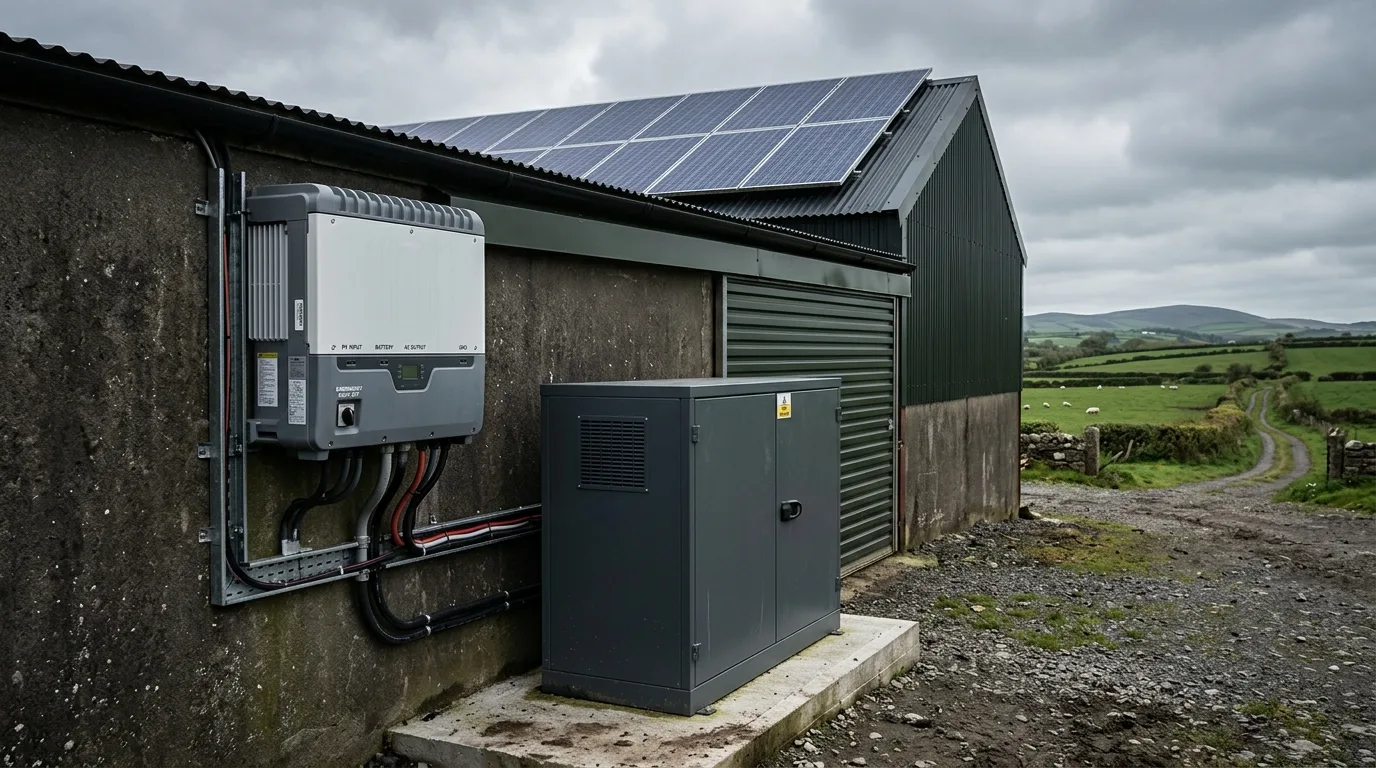
When pairing a commercial battery with rooftop or ground-mounted PV in Ireland, two architectural choices exist: DC-coupled (hybrid) systems where the PV and battery share a single DC bus, and AC-coupled systems where the PV inverter and battery PCS operate independently and meet on the AC side. Each suits different scenarios. This article explains the choice for Irish commercial projects.
DC-coupled (hybrid) - the basics
A hybrid system uses a hybrid inverter that internally manages both PV and battery flows. PV strings connect to the inverter DC side, the battery connects to the same DC side (or a shared DC bus via a charge controller), and the inverter outputs AC to the grid and onsite loads.
Diagrammatically:
PV strings (DC) -> Hybrid Inverter -> AC bus -> Grid + Loads ^ | Battery (DC)
Examples of commercial hybrid inverters: Sungrow SH-RT range (up to 50 kW), GoodWe BT-ESCO, BYD Battery-Box Premium HV with compatible hybrid inverter, SolarEdge Energy Hub. Below 50 kW these dominate; above 100 kW hybrid systems become rarer.
AC-coupled - the basics
An AC-coupled system has a separate PV inverter and battery PCS that both connect to the AC distribution panel:
PV strings (DC) -> PV Inverter (AC) -> AC bus -> Grid + Loads ^ | Battery (DC) -> Battery PCS (AC)
This is the dominant architecture above 100 kW, and the only realistic choice for retrofits to existing PV systems.
Round-trip efficiency comparison
The efficiency difference comes from how many conversion steps PV-to-battery energy takes:
DC-coupled (hybrid): PV DC -> Battery DC (via shared bus or DC-DC converter): ~96-97% efficient Battery DC -> AC grid (single inverter conversion): ~97% efficient Total PV-to-grid via battery: ~93-94%
AC-coupled: PV DC -> PV inverter -> AC: ~97% efficient AC -> Battery PCS -> Battery DC: ~96% efficient Battery DC -> Battery PCS -> AC: ~96% efficient Total PV-to-grid via battery: ~89-90%
The efficiency gap is roughly 4 percentage points for PV-routed energy. For grid-charged energy, both architectures are similar (battery PCS conversion both directions).
Sizing flexibility
Hybrid: PV array and battery capacity are constrained by the hybrid inverter's design. Most hybrid inverters allow 1.2-1.5x DC oversizing (PV) relative to inverter AC rating, and a battery capacity limit of 1-2x AC rating. This works fine for residential and small commercial (under 50 kW) but becomes restrictive at larger scale.
AC-coupled: PV and battery sizes are completely independent. You can pair a 500 kWp PV system with a 50 kWh battery, or with a 5 MWh battery - both work. This flexibility is critical for projects where peak shaving or DS3 sizing diverges from PV self-consumption sizing.
Retrofit vs new build
Retrofit: AC-coupled is the only practical choice. The existing PV inverter stays in place; a separate battery PCS is installed on the AC side. No PV array modifications.
New build: Either architecture is possible. Below 50 kW, hybrid is often simpler and more cost-effective. Above 100 kW, AC-coupled is standard practice.
For Irish commercial sites with existing PV (and there are many - thousands of pre-2023 commercial PV installations across Ireland), AC-coupled retrofit is the dominant 2026 model for adding storage.
Cost comparison
Below 50 kW:
- Hybrid: typically 5-15% cheaper than separate PV inverter + battery PCS at equivalent capacity, plus simpler installation
- AC-coupled: more components, slightly higher cost, but more flexible
Above 100 kW:
- Hybrid: limited product availability, cost premium for higher-power hybrid inverters
- AC-coupled: standard architecture, competitive pricing across all major commercial PCS brands
Grid services and DS3
For DS3 participation, the battery must respond independently of PV output (DS3 events can happen at any time, including night). Both architectures can deliver this, but AC-coupled is often preferred because:
- Battery PCS dispatch is independent of PV inverter scheduling
- Aggregator EMS integration is simpler (single PCS interface)
- Hybrid inverters with DS3 capability are rarer above 50 kW
- AC-coupling allows separate metering for DS3 settlement
For commercial DS3-capable BESS above 100 kW, AC-coupled is the dominant choice.
Backup capability
Both architectures can support grid-forming backup, but configurations differ:
Hybrid: Most modern hybrid inverters offer backup output (essential or critical loads circuit). Limited to inverter AC rating during backup.
AC-coupled: Backup requires a grid-forming battery PCS plus automatic transfer switch (ATS). PV inverter typically resynchronises to the islanded battery PCS after a short delay.
Hybrid backup is simpler in small commercial; AC-coupled backup scales better in large commercial.
ESB Networks compliance
Both architectures require G99 compliance for grid-connected operation. AC-coupled installations need G99 certification for both the PV inverter and battery PCS (often pre-certified). Hybrid installations need G99 for the single integrated unit.
The ESB Networks NC6/NC7 application process is broadly similar; AC-coupled may add minor complexity due to two inverters needing documentation.
When to choose DC-coupled (hybrid)
Hybrid suits when:
- System is under 50 kW (most hybrid products fit here)
- New build with PV and battery designed together
- Solar self-consumption is the dominant use case
- Footprint and component count matter
- Budget pressure favours simpler architecture
- Backup is needed and a simple solution suffices
Common Irish hybrid systems for SMEs, agricultural buildings, hospitality and small retail.
When to choose AC-coupled
AC-coupled suits when:
- System is above 100 kW
- Retrofitting to existing PV
- Battery sizing diverges from PV sizing (peak shaving, DS3 priority)
- DS3 / DSU participation is targeted
- Future PV expansion or battery expansion is planned
- Multi-objective EMS optimisation matters
Dominant architecture for Irish industrial, large commercial, and any DS3-participating system.
Hybrid commercial product landscape (2026)
For Irish commercial hybrid installations (under 100 kW typically):
- Sungrow SH-RT series (5-50 kW): mature, well-supported
- GoodWe BT-ESCO (up to 30 kW): commercial-grade hybrid
- SolarEdge Energy Hub (up to 100 kW): inverter + battery integration
- Sonnen Multi (up to 32 kW per module, expandable): German engineering, premium pricing
- Fronius Symo Hybrid (up to 20 kW): residential to small commercial
- BYD Battery-Box Premium HV with compatible hybrid inverter
AC-coupled commercial product landscape (2026)
For Irish AC-coupled commercial above 100 kW:
- Sungrow PowerStack 100/200/250CS with integrated PCS
- Tesla Megapack (integrated PCS, AC interface)
- BYD MV / MV+ with integrated or external PCS
- GE Vernova Reservoir containerised systems
- Wartsila GridSolv Quantum
- Fluence Gridstack
- Nidec / EnSync integrated systems
Bottom line
For Irish commercial PV + BESS projects in 2026, the architectural choice usually falls naturally from system size and existing infrastructure: hybrid for sub-50 kW new builds, AC-coupled for retrofits and anything above 100 kW. The 3-4 percentage point efficiency advantage of DC-coupled hybrid systems is meaningful for solar-routed energy but rarely decisive against the flexibility, scalability and DS3 readiness of AC-coupled commercial systems.
Get 3 free commercial battery quotes — free and no obligation.
Frequently asked questions
What is the difference between hybrid and AC-coupled battery systems?
Hybrid (DC-coupled) systems share a single inverter and DC bus between PV and battery. AC-coupled systems have separate PV inverter and battery PCS that meet on the AC distribution side. Hybrid is more efficient for PV-to-battery flow; AC-coupled is more flexible and scalable.
Can I add a battery to my existing commercial solar system?
Yes - AC-coupled retrofit is the standard approach. The existing PV inverter stays in place, and a separate battery PCS is installed on the AC side. No modifications to the PV array. Most retrofits in Irish commercial in 2026 use this approach.
Which is better for DS3 grid services - hybrid or AC-coupled?
AC-coupled is the dominant choice for DS3-capable commercial BESS above 100 kW. Battery PCS dispatch is independent of PV output, aggregator integration is simpler, and most DS3-capable PCS products are AC-coupled designs.
How much more efficient is a hybrid system than AC-coupled?
Approximately 4 percentage points higher round-trip efficiency for PV-routed energy (93-94% vs 89-90%). The difference matters more for systems where PV is the dominant battery charging source; for grid-charged batteries, both architectures are similar.
What size is hybrid suitable for in commercial?
Hybrid inverters are mostly available up to 50 kW, with a few products extending to 100 kW. Above 50-100 kW, AC-coupled becomes the dominant and more cost-effective architecture for Irish commercial deployments.
Sources & further reading
- ESB Networks Microgeneration Connection — ESB Networks
- SEAI Solar PV Information — SEAI