Commercial Solar Self-Consumption with BESS in Ireland: From 55% to 90%
Most Irish commercial PV systems only self-consume about 55% of generation. A correctly-sized battery lifts that to 85-90% - and changes the entire ROI conversation.
By Smart Solar Editorial · Updated 15 May 2026 · 9 min read
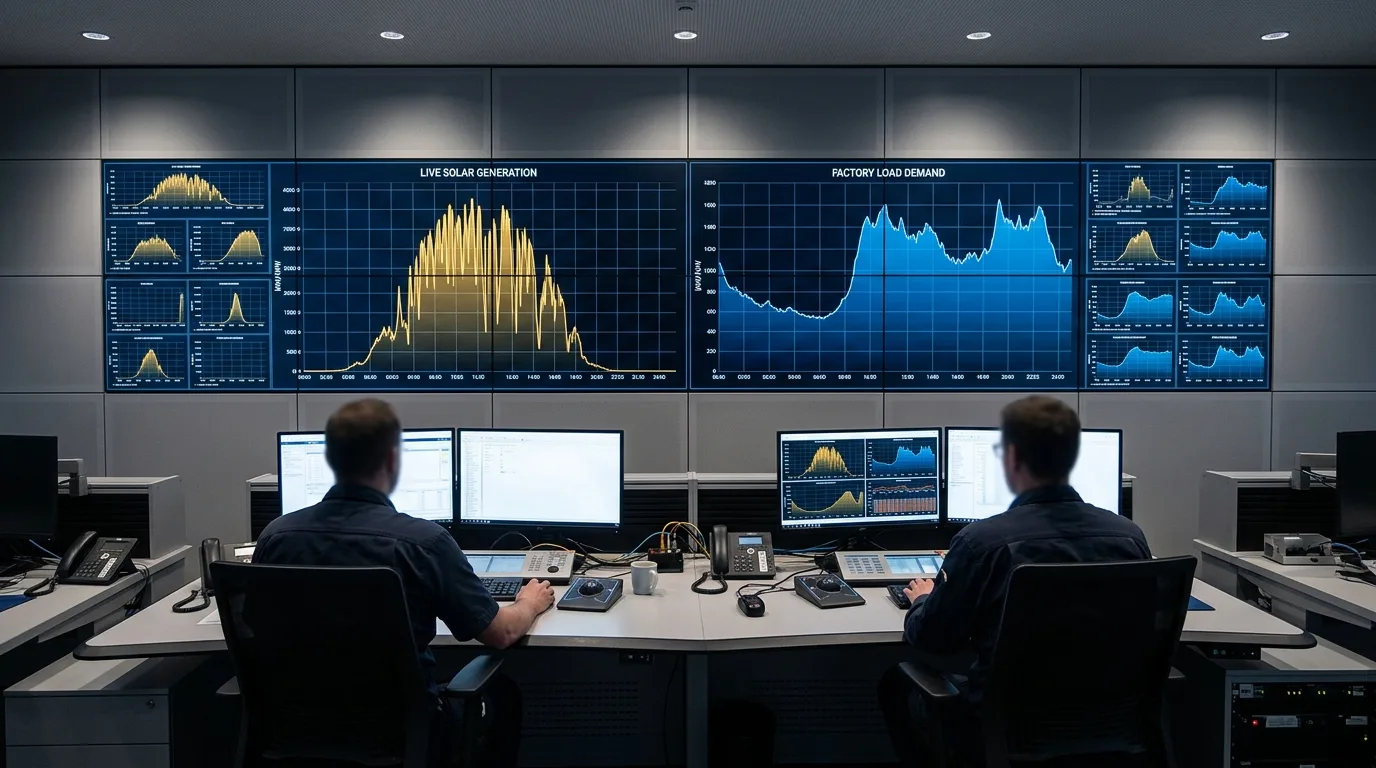
An Irish commercial PV system without a battery typically self-consumes 45-60% of its generation. The remaining 40-55% gets exported under the Clean Export Guarantee (CEG) at tariffs between 18-21 c/kWh in 2026 - well below the daytime import rate of 26-32 c/kWh. Pairing PV with a correctly-sized battery closes that gap by pushing self-consumption to 85-90%, and turns the marginal hour of PV output from low-margin export into high-margin self-use.
Why commercial PV self-consumption stalls at ~55%
Three structural mismatches limit standalone PV self-consumption in Ireland:
1. Weekend generation. Most Irish commercial sites operate Mon-Fri, but PV generates all 7 days. Saturday and Sunday produce roughly 28% of annual generation with very low onsite load - 80%+ of weekend generation gets exported.
2. Midday surplus. A 500 kWp array peaks around 350 kW at midday. Many commercial loads sit between 100-200 kW during business hours. Even mid-week, 30-40% of midday PV exceeds onsite load and exports.
3. Evening demand. Irish commercial demand peaks at 17:00-19:00, exactly when PV is fading. The evening peak is grid-supplied at the most expensive tariff window of the day.
These three patterns combine to cap standalone self-consumption at 50-60% for typical Irish commercial sites.
How BESS unlocks higher self-consumption
A BESS sized for solar shifting captures weekend and midday surplus PV, then discharges across the evening peak and overnight if needed. The result:
- Weekend PV that would export at 18-21 c/kWh now offsets Monday morning import at 26-32 c/kWh
- Midday surplus offsets evening peak at 30-35 c/kWh (often higher with demand charges)
- Net self-consumption rises from 55% to 85-90%
The economic uplift depends on the spread between import rate and CEG export rate. In 2026:
- Day import: 26-32 c/kWh
- Peak import: 30-38 c/kWh
- CEG export: 18-21 c/kWh
- Self-consumption uplift per kWh: 8-17 c/kWh
On a 500 kWp array generating 450,000 kWh per year, shifting 100,000 kWh from export to self-consumption uplifts revenue by €8k-€17k per year on top of the underlying PV income.
Sizing the battery for solar shifting
The right battery size depends on the PV peak surplus and how long it needs to be stored.
A useful rule of thumb: target 2-3 hours of midday peak surplus as battery energy capacity.
Example: 500 kWp commercial PV in Ireland
- Peak generation: ~350 kW at solar noon
- Typical business-hour load: 180 kW
- Peak surplus: 170 kW for ~3 midday hours
- Storage target: ~500 kWh (3 hours × 170 kW)
- Battery sizing: 200 kW / 500 kWh (0.4C)
This battery captures most of the midday surplus, then discharges across the 17:00-19:00 evening peak at 250 kW for 2 hours.
Worked Irish example: 1 MWp PV at a Westmeath food processor
A medium-sized Irish food processor has:
- 1 MWp rooftop PV (annual generation: 900,000 kWh)
- Pre-BESS self-consumption: 58% (522,000 kWh self-used)
- Export: 378,000 kWh at 19 c/kWh CEG = €71,820 export revenue
- Day import offset value at 28 c/kWh: 522,000 × €0.28 = €146,160
BESS installed: 400 kW / 1,000 kWh Tesla Megapack at €750/kWh = €750k
Post-BESS performance:
- New self-consumption: 88% (792,000 kWh self-used)
- Export reduced to: 108,000 kWh at 19 c/kWh = €20,520
- Day import offset value: 792,000 × €0.28 = €221,760
- Plus evening peak offset uplift (vs day import): ~€12,000/yr
- Plus weekend shift value: ~€8,000/yr
Annual uplift over standalone PV: €90k-€100k
Add MIC reduction (typical €40k-€60k) and DS3 (€15k-€25k for this size). Total annual BESS benefit: €145k-€185k. Payback: 4-5 years.
What if your PV is already exporting under FIT/REFIT?
Older Irish commercial PV systems (pre-2021) on legacy REFIT or PSO export tariffs may have economics that favour continued export rather than self-consumption shifting. Check your tariff schedule before assuming BESS makes sense - if export pays more than import, the battery business case shifts entirely toward MIC reduction and DS3.
For most 2024+ Irish commercial PV installations on CEG (which replaced REFIT for new installs), self-consumption shifting is highly economic.
How DC-coupled vs AC-coupled affects design
Two architectures exist for pairing BESS with commercial PV:
1. DC-coupled (hybrid inverter). PV strings connect to a shared DC bus with the battery, then a single hybrid inverter feeds AC to the grid. Common for systems under 200 kW. Higher round-trip efficiency for PV-to-battery flow (~95%) because it skips one DC-AC conversion.
2. AC-coupled. Existing PV inverter stays in place. A separate battery PCS sits in parallel on the AC side. Required for retrofits to existing PV arrays. Slightly lower PV-to-battery efficiency (~88%) due to the extra conversion step.
For new builds under 200 kW, DC coupling is usually preferred. For retrofits or systems above 200 kW, AC coupling is standard and easier to scale.
Combining solar shifting with peak shaving
The same battery can do solar shifting and peak shaving simultaneously if the EMS is configured for multi-objective optimisation. Modern EMS platforms from Sungrow, Tesla, GridBeyond and Veri handle this routinely:
- Morning: charge from cheap night rate or early PV
- Midday: store PV surplus
- Evening: discharge to shave peak and offset peak import
- Night: idle or absorb wind-heavy grid energy at low cost
This dual-purpose operation is what gives Irish commercial BESS its strong 2026 economics - the same hardware capex delivers multiple revenue streams.
Practical considerations
- PV inverter G99 compliance is mandatory for any AC-coupled BESS
- ESB Networks export limit may cap PV+BESS export to your existing MIC value
- Tariff structure of your supplier changes the optimisation logic - Electric Ireland, Bord Gais, Energia, SSE Airtricity, Pinergy and Flogas all have different commercial tariffs
- CEG enrolment is automatic for new installations but worth confirming - export revenue is part of the business case
Bottom line
A correctly-sized BESS paired with Irish commercial PV lifts self-consumption from ~55% to 85-90%, adding €15k-€100k+ per year of value depending on system size. When combined with MIC reduction and DS3, it underpins payback periods of 4-6 years for the entire integrated PV+BESS system in 2026 Irish conditions.
Get 3 free commercial battery quotes — free and no obligation.
Frequently asked questions
How much does a battery improve commercial solar self-consumption?
A correctly-sized BESS typically lifts commercial PV self-consumption from 55-60% to 85-90% in Ireland. The exact uplift depends on the load profile, PV peak surplus, and battery capacity relative to weekend generation.
How big should a battery be for a 500 kWp commercial PV system in Ireland?
A practical rule of thumb is 1 kWh of battery per 1 kWp of PV for self-consumption shifting alone. So 500 kWp pairs with roughly 500 kWh of battery, with 200 kW of PCS. Increase capacity if MIC reduction or DS3 is also targeted.
Is the Clean Export Guarantee (CEG) worth more than self-consumption?
Almost never in 2026. CEG rates range 18-21 c/kWh while import rates are 26-32 c/kWh during business hours and 30-38 c/kWh at peak. Self-consumption typically uplifts each shifted kWh by 8-17 cents over export.
Can I retrofit a battery to an existing commercial PV system?
Yes - AC-coupled BESS installs alongside the existing PV inverter without modifying the original PV system. Most Irish commercial PV retrofits in 2026 use AC coupling. DC coupling requires replacing the PV inverter with a hybrid model.
Does adding a battery affect my G99 inverter certification?
Yes - the combined PV+BESS system needs an updated G99 application with ESB Networks. Most BESS PCS are pre-certified to G99 and the application is straightforward, but it must be submitted before commissioning.
Sources & further reading
- SEAI Clean Export Guarantee Information — SEAI
- CRU Microgeneration and Small-Scale Generation — Commission for Regulation of Utilities