ESB Networks NC7 MV Connection for Commercial BESS: 2026 Guide
NC7 is the MV connection process for any commercial BESS above 200 kVA in Ireland. Plan 12-24 months, expect €100k+ in connection costs, and engage early.
By Smart Solar Editorial · Updated 15 May 2026 · 9 min read
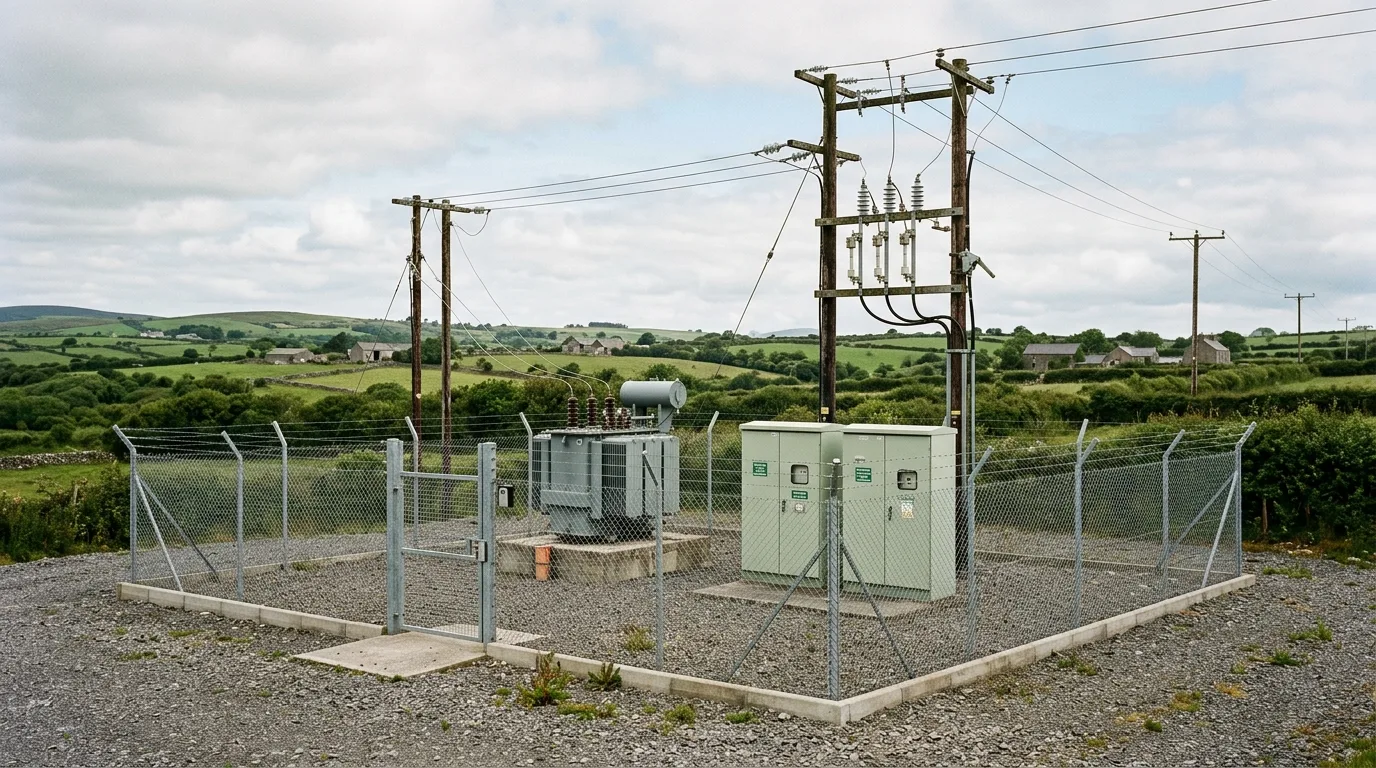
For any commercial BESS larger than approximately 200 kVA - which covers most industrial sites, larger commercial properties, data centres, dairy plants and standalone storage projects - the relevant ESB Networks process is NC7, the Medium Voltage (MV) connection process. NC7 is significantly more involved than NC6: longer timelines (12-24 months typical), higher costs (€100k-€2M+ in connection fees alone), and more demanding technical requirements. This article explains the NC7 process for Irish commercial BESS in 2026.
When NC7 applies
NC7 applies when one or more of the following is true:
- BESS PCS rating exceeds 200 kVA
- Total site demand exceeds LV transformer capacity
- Existing site is already MV-connected (10/20/38 kV)
- Site is a new development with anticipated MV-scale load
- BESS is standalone front-of-meter (no site host load)
For a typical 500 kW / 1 MWh commercial BESS at an Irish factory, NC7 is mandatory.
NC7 vs NC6 - the key differences
| Dimension | NC6 (LV) | NC7 (MV) |
|---|---|---|
| Capacity range | Up to ~200 kVA | 200 kVA to 5 MVA (and above) |
| Voltage | 400V 3-phase | 10/20/38 kV |
| Typical timeline | 8-16 weeks | 12-24 months |
| Application fee | €100 (nominal) | €5,000-€15,000+ |
| Connection charges | €0-€20k typical | €100k-€2M+ |
| Technical depth | Desk review | Detailed network impact study |
| Equipment | Standard LV switchgear | MV transformer + switchgear + protection |
| Commissioning | ETCI + installer sign-off | ESB Networks witness commissioning |
| Compliance | G99 | G99 + EirGrid grid code for larger systems |
The NC7 process in 14 steps
1. Pre-application engagement. Optional but highly recommended. Discuss the project with ESB Networks Regional Customer Service team to understand local network constraints and indicative costs.
2. NC7 application. Submit Form NC7 with site plans, single-line diagrams, equipment specifications, load and generation profiles, and applicant details.
3. Application acknowledgement and fees. ESB Networks confirms receipt and issues invoice for the application fee.
4. Technical Assessment. ESB Networks engineers undertake a detailed network impact study including:
- Voltage rise / fall analysis
- Thermal capacity of feeders and transformers
- Fault level studies
- Protection coordination studies
- Reactive power compensation requirements
- Substation capacity assessment
This typically takes 12-20 weeks.
5. Connection Offer. ESB Networks issues a formal Connection Offer specifying:
- Connection point and voltage level
- Connection charges (often called a "deep" charge for any required network reinforcement plus a "shallow" charge for direct connection works)
- Technical conditions of connection
- Equipment requirements (transformer rating, switchgear spec, protection settings)
- Validity period (typically 90 days to accept)
6. Acceptance and payment. You accept the Connection Offer in writing and pay the agreed fees. Connection works are often staged, with initial payments unlocking design and procurement.
7. ESB Networks design. For deep reinforcement (new substation, transformer upgrade, cable replacement), ESB Networks completes detailed engineering design - typically 12-24 weeks.
8. ESB Networks procurement. Major equipment (transformers, switchgear) often has 12-30 week lead times. ESB Networks places orders and tracks delivery.
9. Site preparation and customer works. In parallel, you complete:
- Civil works for BESS pad
- Customer-side substation room (if applicable)
- LV/MV interconnect cabling
- Protection relay panel
- Communications and SCADA infrastructure
10. ESB Networks construction. ESB Networks completes any required network reinforcement on the public side of the connection.
11. Connection works completion. ESB Networks completes the new connection point.
12. BESS installation. Your installer/EPC installs the BESS, PCS, EMS and protection at the customer side.
13. Witness commissioning. ESB Networks attends site to witness commissioning testing including:
- Functional testing of protection
- G99 anti-islanding tests
- Reactive power capability tests
- Communications tests
- Operational ramp tests
14. Energisation and acceptance. ESB Networks formally energises the connection. The BESS can begin operation.
Typical NC7 cost structure for a 1 MW BESS
For a 1 MW / 2 MWh standalone BESS at a typical Irish industrial site (existing 20 kV connection):
| Item | Indicative cost (2026) |
|---|---|
| NC7 application fee | €8,000 |
| Connection charges (shallow + deep) | €120,000-€350,000 |
| Customer-side substation works | €60,000-€180,000 |
| MV switchgear and protection | €80,000-€150,000 |
| LV/MV interconnect cabling | €30,000-€80,000 |
| Witness commissioning fees | €5,000-€12,000 |
| Project management and engineering | €30,000-€80,000 |
| Total connection-related cost | €333,000-€860,000 |
For projects requiring deep reinforcement (new substation transformer, feeder upgrade, multi-km cable replacement), connection charges alone can exceed €1M-€2M.
Common reasons for NC7 delays
1. Network constraints. Some Irish MV feeders are at or near capacity. ESB Networks may require deep reinforcement that adds 6-12 months to the timeline.
2. Substation transformer lead times. Major equipment lead times stretched to 30+ weeks in 2024-2026 due to global supply chain pressures.
3. Planning permission interactions. If the connection requires new substation buildings or overhead line works, separate planning approvals can add 12-24 months.
4. Customer-side delays. Late finalisation of equipment specs, civils delays, or BESS vendor lead times can push back commissioning.
5. Witness commissioning slot availability. ESB Networks witness engineers are in demand; commissioning slot booking often requires 4-8 weeks notice.
How to keep NC7 on track
Best practice for NC7 commercial BESS projects:
- Engage ESB Networks pre-application to understand constraints early
- Lock equipment specs at design stage - changing PCS mid-project triggers re-assessment
- Track milestones weekly with ESB Networks Project Manager
- Procure long-lead items early in parallel with ESB Networks design
- Plan civils to align with ESB Networks construction - avoid wait states
- Book witness commissioning slots well in advance
- Maintain owner's engineer involvement throughout for technical decisions
NC7 and DS3 / capacity market participation
NC7 enables DS3 grid services participation and capacity market entry (subject to separate EirGrid registration). Key NC7-related considerations for DS3 participants:
- Export capability must be in the Connection Offer (be explicit about expected dispatch)
- Telemetry interface (typically DNP3 or IEC 61850) needs ESB Networks acceptance
- Protection settings must accommodate frequent dispatch
- Reactive power capability matters for DRR (Dynamic Reactive Response) services
For standalone front-of-meter BESS targeting full DS3 and capacity market participation, NC7 design must reflect aggressive dispatch from day one.
CRU policy direction
CRU has signalled support for storage deployment and has issued multiple decisions adjusting NC7 charges and processes to remove barriers. Recent themes include:
- Reduced charges for storage that supports grid stability
- Faster-track provisions for storage on capacity-constrained feeders
- Clarification of who pays for deep reinforcement
- Encouragement of co-located renewable + storage projects
Monitor CRU publications during your project - policy changes can occasionally reduce costs or accelerate timelines.
Bottom line
NC7 is a substantial project in its own right - typically 12-24 months from application to operation, with €100k-€2M+ in direct connection costs. For Irish commercial BESS above 200 kVA, the NC7 timeline is usually the critical path. Plan for it from project inception, engage ESB Networks early, and align all other project workstreams (planning, EPC tendering, financing, EXEED grant) to the NC7 milestones rather than the other way around.
Get 3 free commercial battery quotes — free and no obligation.
Frequently asked questions
When does ESB Networks NC7 apply to a commercial battery?
NC7 applies when the BESS PCS rating exceeds 200 kVA, the site is already MV-connected, or total site demand exceeds LV transformer capacity. For most industrial commercial BESS projects above 200 kW PCS, NC7 is mandatory.
How long does NC7 take in Ireland?
Typically 12-24 months from application to commissioning, depending on network constraints and equipment lead times. Connection Offer typically 12-20 weeks; design, procurement, construction and commissioning another 9-18 months.
How much does NC7 cost for a 1 MW commercial BESS?
Typical 2026 total NC7-related cost for a 1 MW BESS is €333k-€860k including application fees, connection charges, customer-side substation works, MV switchgear, and project engineering. Deep reinforcement can push this to €1M+.
What is witness commissioning?
ESB Networks attends site at MV connection commissioning to witness G99 protection tests, anti-islanding response, reactive power capability, and other compliance items. Slot booking requires 4-8 weeks notice and adds €5k-€12k to project costs.
Can I do DS3 grid services with an NC7 connection?
Yes - NC7 connections support DS3 participation via aggregator. The Connection Offer must specifically include the export capability and dispatch profile DS3 requires. Tell ESB Networks at application stage if DS3 is planned.
Sources & further reading
- ESB Networks Generator Connection Information — ESB Networks
- CRU Connection Policy Decisions — Commission for Regulation of Utilities
- EirGrid Grid Code — EirGrid