Demand Response and DSU Participation in Ireland: How BESS Helps You Get Paid
Irish businesses with 4+ MW of flexible load can register as a Demand Side Unit (DSU) and earn capacity market plus DS3 revenue. A BESS makes participation seamless and protects production.
By Smart Solar Editorial · Updated 15 May 2026 · 9 min read
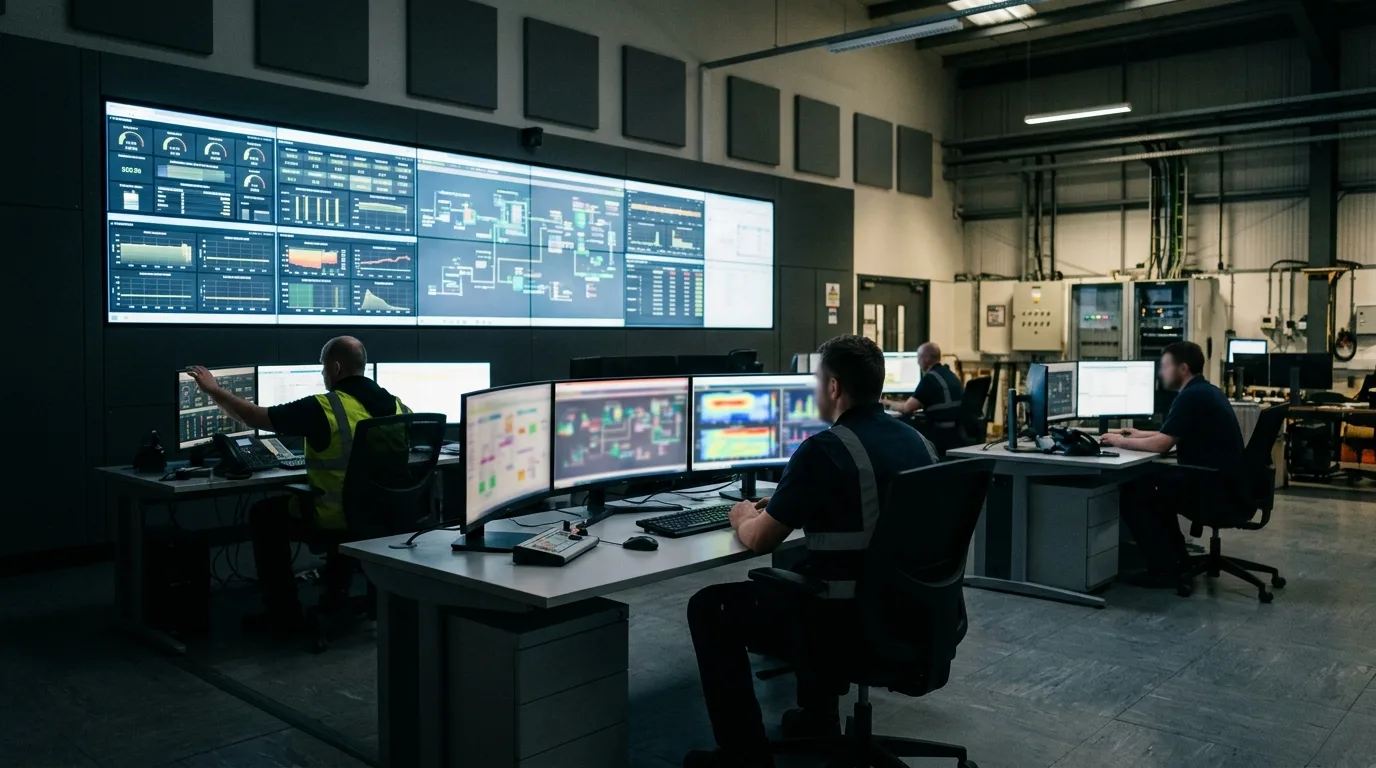
Demand Response is the oldest grid services market in Ireland. For nearly two decades, EirGrid has paid large industrial sites to reduce demand on call, helping maintain system frequency and avoid blackouts during tight supply windows. By 2026 the market is well-developed, with multiple aggregators competing for portfolio share - and BESS is fundamentally changing how Irish businesses participate.
What is a Demand Side Unit (DSU)?
A Demand Side Unit is a registered participant in the I-SEM (Integrated Single Electricity Market) that can reduce demand on instruction from EirGrid. DSUs are paid for both:
- Capacity availability (being available to reduce demand when called)
- Energy dispatched (actually reducing demand during called events)
Most DSUs are not individual sites - they are aggregated portfolios of 5-50 sites pooled by a registered aggregator. The aggregator handles registration, telemetry, dispatch, settlement and compliance with EirGrid.
How DSU registration works
To register as part of a DSU portfolio, a site typically needs:
- Minimum reducible load: 0.1-0.5 MW per site (aggregator dependent)
- Aggregated portfolio: 4 MW minimum at registration
- Response time capability: typically able to reduce within 2-15 minutes of instruction
- Reduction duration capability: sustain reduction for up to 4 hours per event
- Telemetry: real-time data feed to aggregator and EirGrid (typically 5-second granularity)
- Smart meter or interval meter: for settlement
- Connection Agreement compatibility: ESB Networks must accept DSU participation on the connection
Aggregators active in Ireland include Statkraft, GridBeyond, Veri, Power Capital, Mercury / Energia, EnerNOC (Enel X), Activate.
DSU revenue streams in 2026
Three revenue streams stack within DSU participation:
1. Capacity Market (Reliability Options). Annual capacity auction administered by SEMO. DSUs win capacity contracts and are paid for being available to reduce demand. 2026 clearing prices typically €40k-€55k per MW per year.
2. DS3 System Services. Same set of frequency and reserve products used by BESS owners. DSUs can provide TOR1, TOR2, RRD products. Adds €15k-€35k per MW per year.
3. Energy Market participation. Imbalance-period buy/sell. Smaller and more volatile but adds €5k-€15k per MW per year.
Total typical 2026 DSU revenue: €60k-€105k per MW of reducible load per year, less aggregator fees of 15-25%.
Why BESS changes the DSU economics
Traditionally, Irish DSU participants reduced demand through real process curtailment - stopping production lines, switching off chillers, derating air compressors. This had three problems:
- Production impact. Even short curtailment events disrupted batch processes, customer commitments, throughput KPIs.
- Operator overhead. Manual response or complex automation required.
- Comfort and quality risk. Building HVAC and lighting reductions affected staff and product.
A BESS solves all three. When EirGrid calls for demand reduction, the BESS simply discharges to offset onsite consumption. The factory sees no change - the grid sees an equivalent reduction in import. Production is unaffected, operators do not need to act, and quality is not at risk.
This is why almost every new Irish DSU registration in 2024-2026 includes a BESS as the primary reduction asset, with real load curtailment as backup only.
Worked example: pharma plant in Dublin
A Dublin-based pharmaceutical manufacturing facility with:
- 3.5 MW continuous load (24/7)
- 2 MW reducible (HVAC, non-critical chillers, charging stations)
- Quality concerns about repeated process curtailment
Option A: Traditional DSU - register 2 MW reducible load
- Risk of curtailing production during called events
- Capacity market revenue: 2 MW × €48k = €96k/yr
- DS3 revenue: 2 MW × €25k = €50k/yr
- Total: €146k/yr (gross), ~€110k net after aggregator fee
- BUT: Production risk valued at €40k+/yr in unplanned curtailment cost
- Net effective: ~€70k/yr
Option B: 2 MW / 4 MWh BESS + DSU registration
- BESS handles all DSU events with zero production impact
- DSU revenue: €146k/yr gross, ~€110k net
- BESS also earns peak shaving (-€60k MIC charge), DS3 standalone if not stacked with DSU, arbitrage (€15k), solar self-consumption (€20k)
- Total BESS + DSU revenue: ~€225k/yr
- BESS capex: €1.4M
- Payback: 6 years standalone, 4-5 years with EXEED grant
The BESS unlocks DSU participation that the site would otherwise reject as too operationally risky.
DSU dispatch frequency in Ireland
EirGrid typically dispatches DSUs:
- 10-20 times per year for energy events
- Capacity stress events: 1-5 times per year
- Test events: 2-4 per year (mandatory for capacity contract)
Typical event duration: 1-3 hours. Annual reduced energy: 30-80 MWh per MW of registered DSU capacity. Easily within typical BESS cycling envelopes.
DSU vs DS3 - can a BESS do both?
Yes, with some constraints. Most aggregators structure contracts so a BESS can:
- Be primary DSU for capacity market participation
- Provide DS3 system services (typically TOR1, TOR2) when not in DSU dispatch
- Continue MIC reduction and arbitrage outside both
Some product overlaps exist (TOR2 and DSU response windows are similar), so the aggregator manages the portfolio to avoid double-counting. The owner sees consolidated monthly settlement.
Compliance and performance requirements
DSU registration has stricter compliance than DS3 alone:
- Availability: Must be available 95%+ of contracted hours
- Response accuracy: Within ±5% of contracted MW
- Telemetry uptime: 99%+ data delivery to aggregator
- Annual testing: Mandatory dispatch tests under EirGrid observation
- Penalties: Failure to deliver during capacity stress events can trigger Reliability Option penalties (significant - often €20k-€50k per missed event)
A BESS-based DSU response is far more reliable than process curtailment, which is why insurance and contract terms with aggregators are tightening to favour BESS-supported portfolios.
The political and regulatory tailwind
Ireland's data centre electricity demand has grown to over 20% of national consumption, and EirGrid forecasts ongoing tightness in supply-demand balance through the late 2020s. CRU policy explicitly encourages demand response participation, and the capacity market design (with multi-year forward contracts) provides revenue certainty.
For Irish businesses with 1+ MW of flexible load, DSU participation is one of the more underused revenue opportunities - and BESS makes it operationally trivial.
Bottom line
For mid-size and large Irish industrial sites, DSU registration via an aggregator can add €60k-€105k per MW per year of net revenue. A BESS makes participation operationally seamless by absorbing the demand reduction without affecting production - and the BESS also delivers MIC reduction, DS3 and arbitrage on top. For sites above 1 MW reducible load, the combined economics typically deliver 4-6 year payback.
Get 3 free commercial battery quotes — free and no obligation.
Frequently asked questions
What is a Demand Side Unit (DSU) in Ireland?
A DSU is a registered participant in the I-SEM electricity market that can reduce demand on instruction from EirGrid. DSUs are paid for capacity availability and dispatched energy. Most participate through aggregator portfolios rather than directly.
How much can a 1 MW DSU earn in Ireland?
In 2026, a 1 MW DSU typically earns €60k-€105k gross per year combining capacity market (€40-55k/MW), DS3 (€15-35k/MW) and energy market participation, less 15-25% aggregator fees. Net revenue typically €50k-€80k per MW.
Can a battery replace process curtailment for DSU events?
Yes - a BESS sized for the registered reduction capacity can absorb all DSU events without affecting onsite operations. The grid sees the reduced demand; the facility sees no production impact. This is now the standard 2026 model for Irish DSU participants.
What are the minimum site size requirements for DSU?
Most aggregators accept individual sites with 100-500 kW reducible load. Aggregated portfolio minimum is typically 4 MW. Smaller sites can still participate by joining established portfolios at aggregators like Statkraft, GridBeyond, Veri or EnerNOC.
Are there penalties for failing to respond to a DSU event?
Yes - capacity market Reliability Option penalties can be €20k-€50k per missed event under tight supply conditions. This is why BESS-supported portfolios have largely displaced pure process curtailment - much higher response reliability.
Sources & further reading
- EirGrid Demand Side Unit Information — EirGrid
- SEM Capacity Market Auction Results — SEM Committee