Container vs Cabinet BESS: Form Factor Choices for Irish Commercial Sites
Containerised BESS scales fast but needs concrete pads and planning. Cabinet BESS slots into existing switchrooms. Here is how to choose the right form factor for an Irish commercial site.
By Smart Solar Editorial · Updated 15 May 2026 · 8 min read
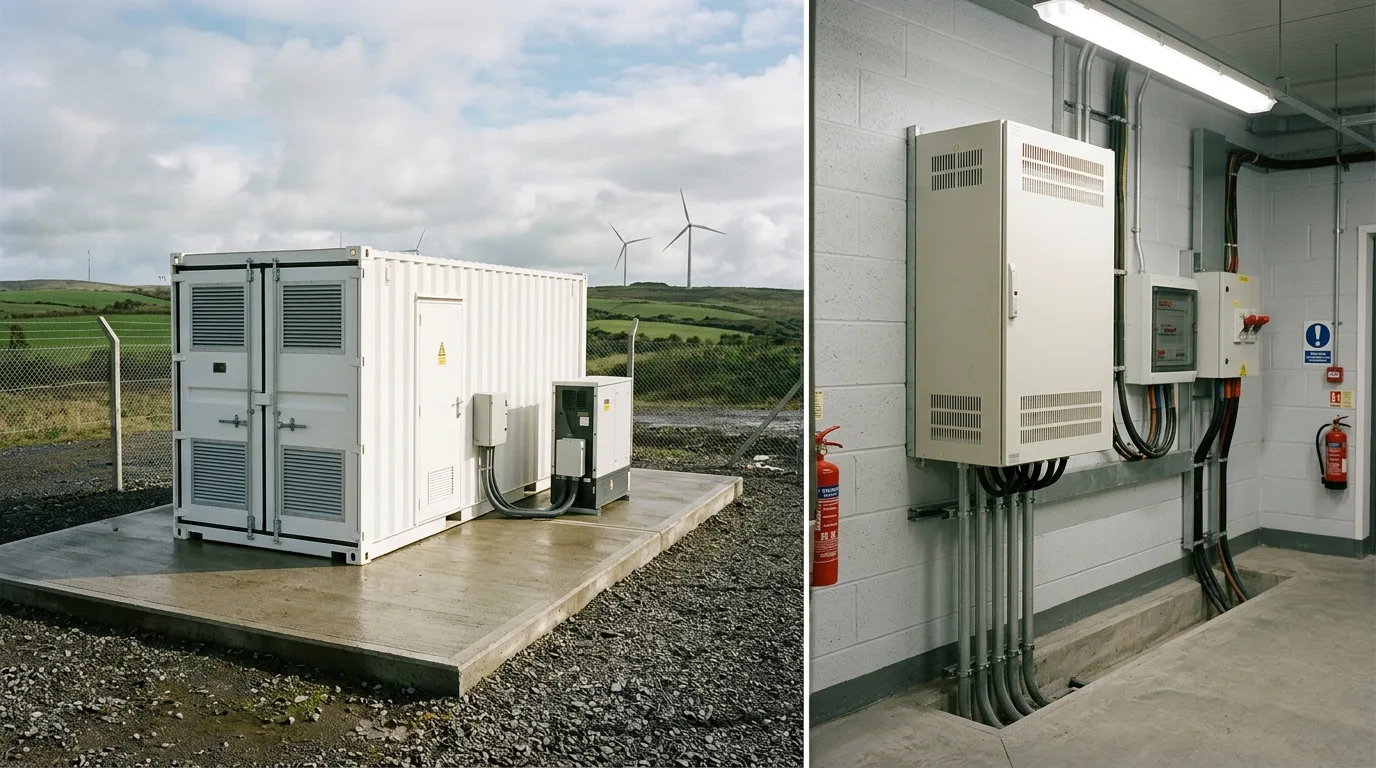
Commercial battery storage in Ireland comes in two main physical formats: containers (outdoor ISO-container-sized units mounted on concrete pads) and cabinets (smaller indoor or outdoor floor-standing or wall-mounted units). The choice between them affects footprint, planning, fire separation, scalability, cost and operational flexibility. This article walks through the considerations for Irish commercial deployments.
What "container" means in BESS
A containerised BESS is typically:
- 6 m (20-foot) or 12 m (40-foot) ISO-container form factor
- Self-contained: cells, BMS, PCS, EMS, HVAC, fire suppression all inside
- Designed for outdoor installation on a concrete pad
- Single transport unit (forklift or crane installable)
- 1 MWh to 5 MWh per container typical
- 20 to 25 tonnes weight
Examples: Tesla Megapack 2 / 2 XL, Sungrow PowerTitan, BYD MV+, GE Vernova Reservoir, Wartsila GridSolv Quantum, Fluence Gridstack.
What "cabinet" means in BESS
A cabinet BESS is typically:
- 1 m to 2.5 m wide x 0.7-1.5 m deep x 2 m high
- Modular - one to ten cabinets clustered for larger projects
- 10 kWh to 250 kWh per cabinet
- Indoor or outdoor IP54/IP55 rated versions
- Floor-standing (mostly) or wall-mounted (smaller versions)
- 200 kg to 2,500 kg per cabinet
Examples: Sungrow PowerStack 100CS / 250CS, BYD Battery-Box Premium HV, BYD MV cabinet, Sonnen Multi, GoodWe BT-ESCO with battery cabinets, Nidec ASI commercial cabinet range.
Footprint comparison
For 1 MWh of usable battery capacity in Ireland 2026:
| Form factor | Footprint | Approximate area |
|---|---|---|
| Tesla Megapack 2 (single unit) | 7.3m x 1.7m | ~12 m² |
| BYD MV+ container | 6.0m x 2.4m | ~14 m² |
| Sungrow PowerTitan container | 6.0m x 2.4m | ~14 m² |
| 4x Sungrow PowerStack 250CS | 4 x (1.6m x 1.2m) | ~8 m² (clustered) |
| 10x BYD Battery-Box (100 kWh each) | 10 x (1.5m x 0.7m) | ~10 m² (wall-mounted possible) |
Cabinets are generally more space-efficient per kWh in indoor switchroom retrofits, while containers are more space-efficient at multi-MWh scale on greenfield sites.
Planning permission
Irish planning permission considerations:
Containers (outdoor):
- Section 5 declaration typically required for new pad installation
- Full planning often required if >2.5 m height or proximity to neighbours
- Most Irish local authorities now have BESS-specific guidance
- Typical Section 5 timeline: 4-8 weeks
- Typical full planning timeline: 8-16 weeks
Cabinets (indoor):
- No planning typically required if internal to existing electrical room
- Minor change of use may apply in some properties
- Building Control notification typically sufficient
- Quick approval - often days rather than weeks
Cabinets (outdoor):
- Often qualify as ancillary to existing site
- Section 5 declaration usually sufficient
- Faster than container planning in most cases
For Irish commercial sites where planning timeline matters, cabinet form factor often wins.
Fire separation and IS EN 62619
Both form factors must comply with IS EN 62619 and current Irish fire safety guidance. Key separation distances (2026 best practice, varies by local Fire Officer):
Containers:
- Minimum 5-10 m from any building
- Minimum 3 m from site boundary
- Minimum 3 m between adjacent containers
- 60-minute fire-rated wall if smaller separation needed
Cabinets (indoor):
- 2-hour fire rated room with appropriate ventilation
- Fire suppression in room
- Smoke detection
- No occupied space directly above
Cabinets (outdoor):
- 2-5 m from buildings depending on cabinet size
- Bollards for vehicle impact protection
These standards continue to evolve - check current Fire Officer guidance for the specific site.
Scalability
Containers: Excellent above 2 MWh. Add another container, add another concrete pad, expand the LV/MV interconnection. Each container is a discrete operational unit.
Cabinets: Excellent up to 1-2 MWh. Modular cabinets cluster neatly. Above 2 MWh, the cable management, footprint and switchgear complexity grows quickly relative to a single container.
The break-even is typically around 1.5-2 MWh - below that, cabinets win on flexibility; above that, containers win on simplicity.
Cost comparison
For 1 MWh installed in Ireland 2026:
| Form factor | Typical installed cost |
|---|---|
| Container (single unit) | €600-€800/kWh |
| Cabinet cluster (4-5 units) | €700-€900/kWh |
Containers achieve lower per-kWh cost above 1 MWh due to single-unit logistics, integrated PCS, and shared HVAC. Below 1 MWh, cabinet pricing is more competitive.
Operational and maintenance differences
Containers:
- Single-point access for service crews
- Integrated HVAC simplifies climate control
- Bigger units to move if relocation needed
- Self-contained fire suppression
- Often have remote diagnostics built-in
Cabinets:
- Easier to access individual units
- Lower component-level disruption when servicing
- Easier to replace single failed cabinets
- May need shared room HVAC
- Often easier to integrate with existing site infrastructure
Climate considerations
Ireland's climate (typical 5-15°C) suits both form factors. Container HVAC and cabinet HVAC are sized for the worst-case envelope. A notable consideration: containers are exposed to coastal salt air on western and southern sites - look for marine-grade enclosures (IP55+, stainless steel, anti-corrosion coating) for sites within 1 km of the Atlantic or Irish Sea.
When to choose container
Container BESS suits:
- Greenfield sites with space for pad
- Projects above 1.5 MWh
- Standalone front-of-meter projects
- Sites where planning is feasible
- Future expansion likely
- DS3 / utility-scale projects
When to choose cabinet
Cabinet BESS suits:
- Existing switchrooms or electrical rooms
- Projects under 1.5 MWh
- Constrained outdoor space
- Quick deployment timelines (avoiding planning)
- Retrofits to existing buildings
- Multi-site rollouts with standardised cabinet specification
Hybrid approach
Some Irish projects mix both. A large multi-site retailer might use:
- Indoor cabinets at each store location (50-100 kWh per store, fast deployment)
- Outdoor containers at distribution centres (1-2 MWh per centre)
This gives standardisation at scale while matching form factor to local site constraints.
Bottom line
For Irish commercial BESS in 2026, the form factor decision is driven by site constraints more than vendor preference. Cabinets suit projects under 1.5 MWh, retrofits and indoor deployments. Containers suit projects above 1.5 MWh, greenfield sites and standalone front-of-meter applications. Both architectures can meet IS EN 62619, deliver good economics and integrate with DS3 aggregators - the right choice for your project depends on space, planning timeline and scale.
Get 3 free commercial battery quotes — free and no obligation.
Frequently asked questions
What is the difference between container and cabinet BESS?
Container BESS is a self-contained ISO-container-sized unit (6-12 m long) installed outdoors on a concrete pad, typically 1-5 MWh per unit. Cabinet BESS is smaller (1-2.5 m wide) and can be indoor or outdoor, typically 10-250 kWh per cabinet with modular clustering.
Which is cheaper - container or cabinet BESS?
Container BESS is cheaper per kWh above 1.5 MWh due to integrated PCS, shared HVAC and single-unit logistics. Cabinet BESS is more cost-effective below 1 MWh, especially for indoor deployments or retrofits.
Does a BESS container need planning permission in Ireland?
Usually yes - either a Section 5 declaration or full planning permission depending on size, height, and proximity to neighbours. Indoor cabinets typically only need Building Control notification. Plan 4-16 weeks for planning approval on containerised systems.
What is the minimum fire separation distance for a BESS container in Ireland?
Typically 5-10 m from buildings and 3 m from site boundaries for IS EN 62619-compliant LFP containers, with 60-minute fire-rated walls if closer. Exact requirements vary by local Fire Officer and current Building Control guidance.
Can I install a BESS cabinet in my existing electrical room?
Often yes - provided the room has adequate ventilation, fire rating, and structural capacity for the cabinet weight. Smaller cabinets (under 250 kg) can be wall-mounted; larger cabinets need floor mounting. Building Control notification typically required.
Sources & further reading
- Department of Housing Planning Information — Government of Ireland
- NSAI Standards for Electrical Safety — NSAI